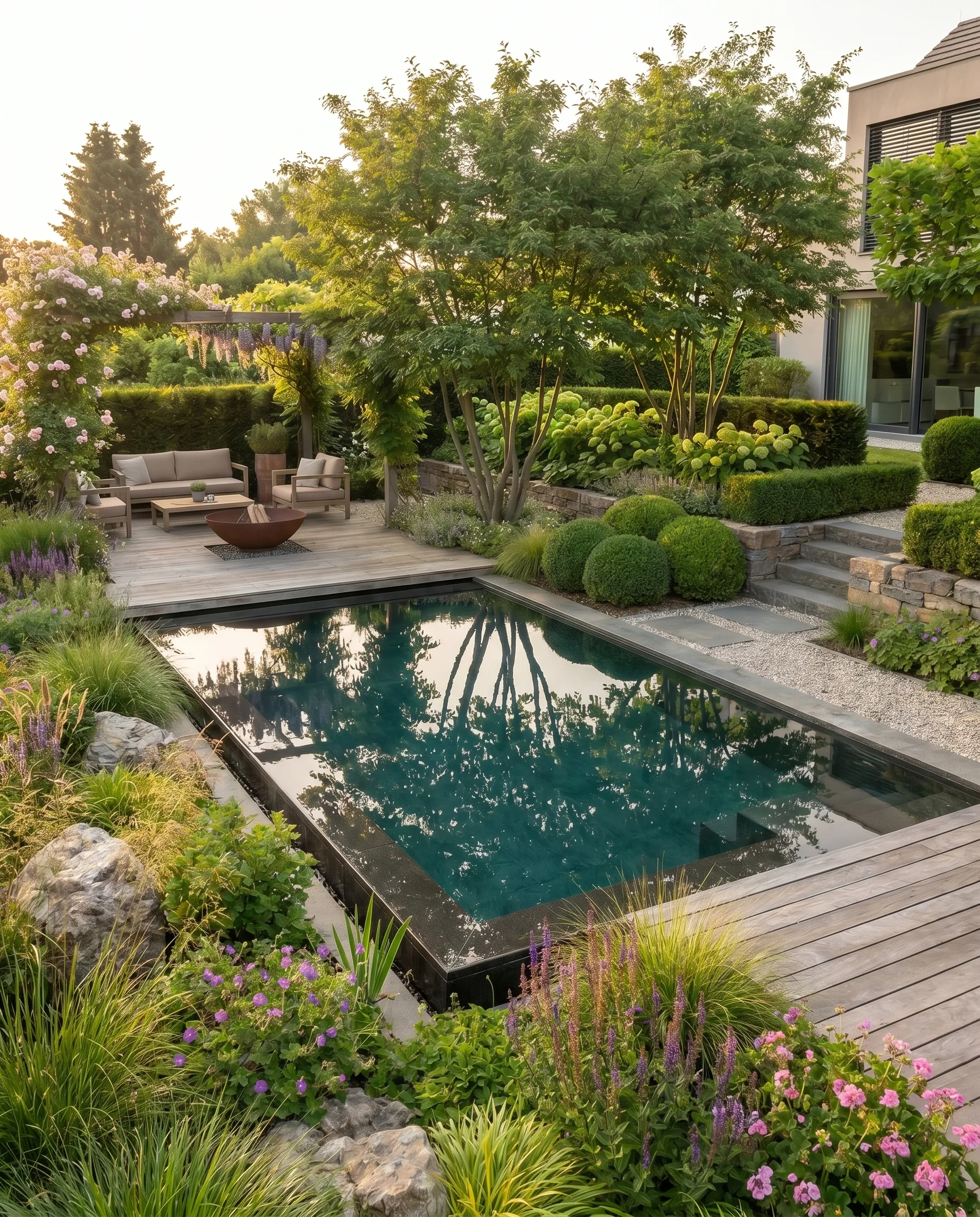
A pool is one of the biggest decisions you can make in a garden. It needs a lot of space, an excavation, equipment and upkeep, and for decades afterwards it shapes how the rest of the garden works. This article goes through the questions in the order you should settle them: which type of pool suits you, where the pool should go, what to clarify legally beforehand, how to protect children and how pool and garden come together. Two explained examples at the end show how differently the same task can be solved.
At a glance
- First decide what the water is for. For swimming you need a pool or a swimming pond. If you are after calm and reflections, a water basin is often enough.
- The location follows sun, wind and view, not the empty corner. Deciduous trees above the pool mean work every autumn.
- Permit-free does not mean rule-free. In Germany, whether you need a permit depends on your federal state's building code. A development plan or a roof can change everything.
- Children need a fence, not just a cover. Plan it from the start and it is easy to work into the design.
- Equipment and electricity belong in the plan, not at the end: pump, filter and pipes need a place, and electrical work at the pool belongs in the hands of a qualified electrician.
1. Pool, natural pool or swimming pond?
Before shape and location comes the question of how the water stays clean. Space, appearance and upkeep all depend on it.
| How the water stays clear | Effect in the garden | |
|---|---|---|
| Pool | filter, pump and disinfection | compact, crisp edge |
| Natural pool | pump and biological filter, no chlorine | like a pool, often with a planted zone |
| Swimming pond | planted regeneration zone, little or no equipment | like a pond, needs more space |
The boundaries are fluid. In its recommendations for private swimming and bathing ponds, the German landscaping research society FLL distinguishes five types: from a pond with no equipment at all, where plants and tiny organisms clean the water, to a natural pool where pump and filter do the work. The less equipment, the larger the planted area has to be. A swimming pond therefore needs considerably more space than a pool with a swimming area of the same size.
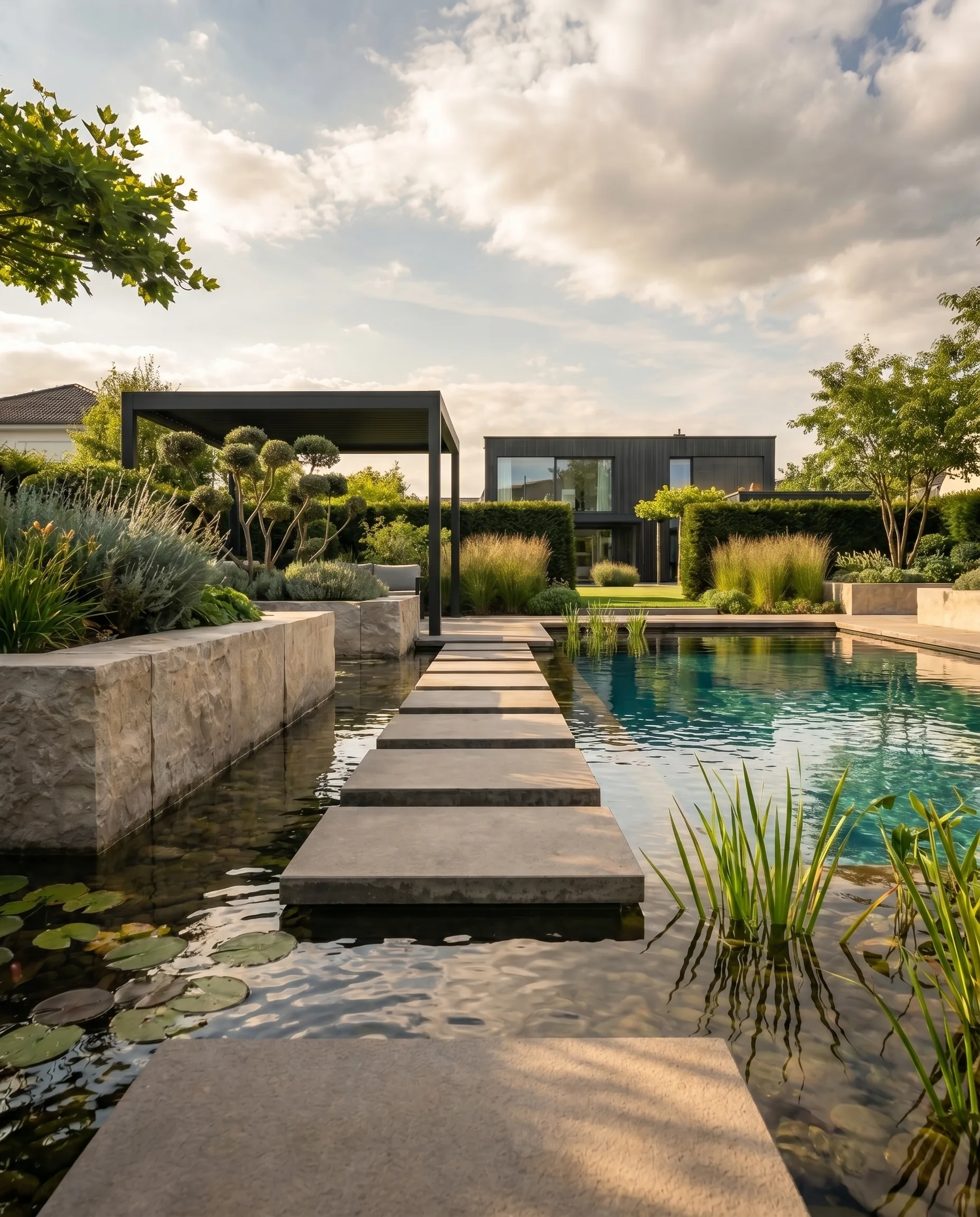
And if you don't want to swim at all? Many pictures of "modern gardens with a pool" show dark, calm water surfaces whose main job is to reflect. For that, a water basin is often enough: shallower, smaller and with less equipment. Shapes, materials and limits are covered in the article on water basins in the garden. If you want to design around a natural pond or bank, see Designing a garden by the water.
2. Where the pool should go
The location of a pool is hard to correct. Check these points on site, ideally on a sunny day at the times you would swim.
- Sun: A pool in the sun warms up, one in the shade stays cool. Watch when the house, neighbouring buildings and trees cast shade on the area.
- Wind: A sheltered spot is more pleasant for lying out. Wind cools the water surface and blows leaves and dust into the pool.
- Trees: Leaves, flowers and seeds end up in the water, and an excavation can damage roots. Before you fell a large tree for the pool, ask your local authority. In Germany, many towns protect trees on private land with a tree protection bylaw; Cologne, for example, protects deciduous trees from a trunk circumference of 80 cm.
- View: From the house or terrace you can see what is happening at the pool. That does not replace a fence, but it helps with supervision.
- Distance from the house: Close to the house, the paths are short and the pool feels like an extension of the terrace. Further away it becomes a garden room of its own, but the way to the kitchen and bathroom gets longer. The examples below show both options.
- Neighbours: Pump, filter and a heat pump make noise. Don't place the equipment right at the boundary below the neighbours' windows.
- Construction: An excavator has to get into the garden for the pit, and the spoil has to be taken away. Check whether there is access.
3. Permits: what to clarify beforehand
In Germany, whether a pool needs a building permit is governed by the building code of your federal state. The rules differ; two examples:
- North Rhine-Westphalia: Swimming pools with a volume of up to 100 m³ are permit-free (§ 62 (1) no. 10 a BauO NRW). Restrictions apply in undeveloped outlying areas.
- Bavaria: Swimming pools in gardens are permit-free, except in undeveloped outlying areas (Art. 57 (1) no. 10 a BayBO).
Permit-free does not mean that no rules apply. You are then personally responsible for complying with all regulations. Typical points:
- Development plan: It can specify where on the plot ancillary structures such as a pool are allowed.
- Roof: If a fixed roof turns the pool into a building, in North Rhine-Westphalia it needs a permit and at least 3 m distance from the neighbouring boundary (information sheet of the town of Porta Westfalica).
- Listed buildings: On listed properties and in conservation areas, separate permission is required.
- Water: Some German municipalities ask you to register filling in advance. In dry summers, municipalities have also temporarily banned filling pools. In many municipalities, old pool water counts as waste water and must go into the sewer, not into the garden.
If in doubt, ask your local building authority before you sign a quote.
4. Safety: children and electricity
Children
Toddlers drown silently. If they fall into the water, they cannot lift their head and cannot call for help. The German lifesaving association DLRG warns that a few seconds of inattention are enough. This also applies if no children live in your household: visiting children or children from the neighbourhood don't know the pool.
What the DLRG recommends for private pools:
- A fence all around the pool, at least one metre high and built so that children cannot climb over it.
- A self-closing gate that children cannot open on their own.
- No furniture outside the fence that could serve as a climbing aid, and no toys inside the fenced area to tempt children.
- Covers alone are not enough. Roller covers mainly serve to keep the heat in the water. Children can get underneath a cover.
- Pool alarms only as an addition, never as the only safeguard.
- Secure the pool outside the season too, especially if water stays in it over winter.
- Supervision without gaps whenever children are in or near the water.
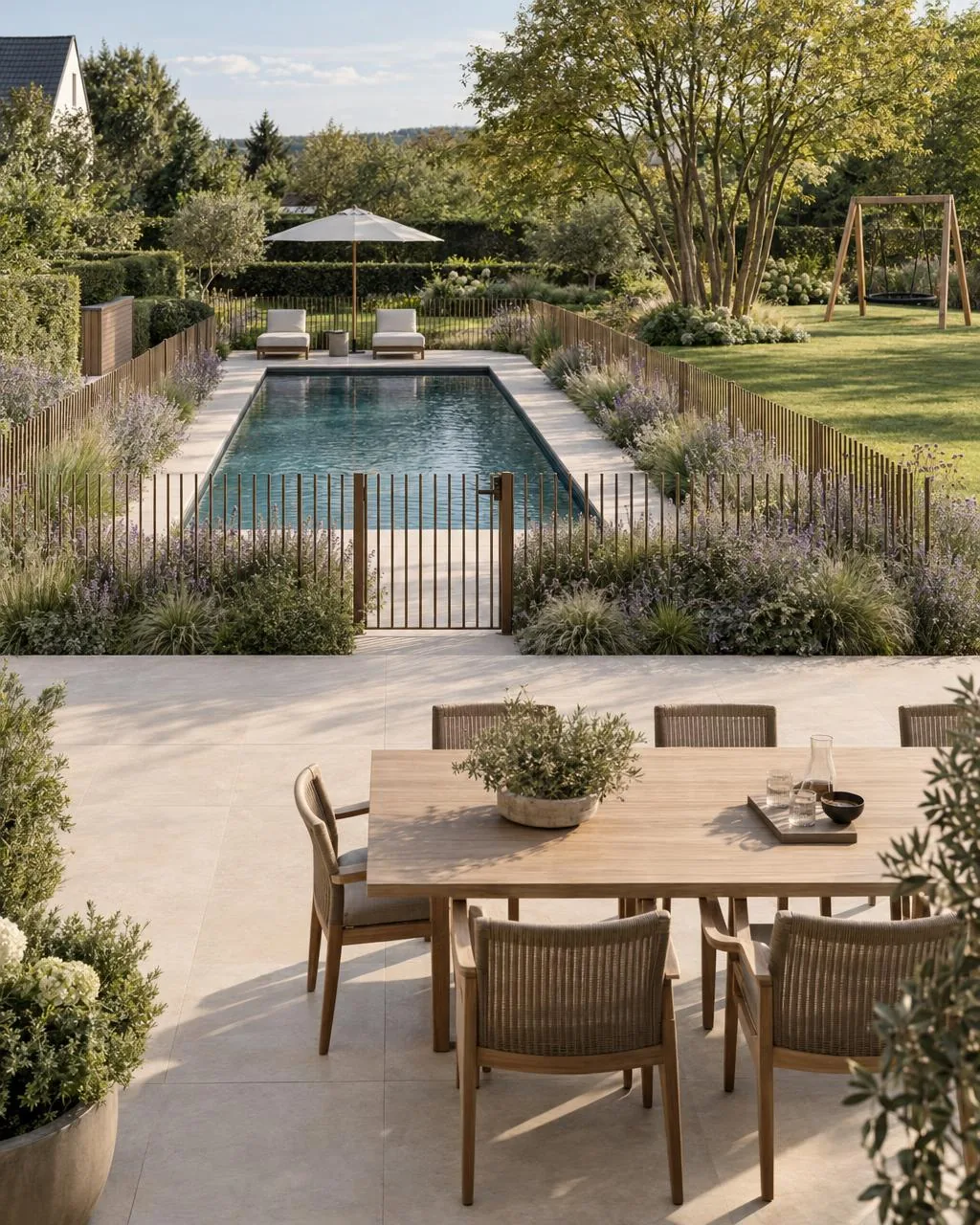
For the design, this means: plan the fence from the start. A fence set within a hedge or planting is barely noticeable. A fence added later straight across the terrace gets in the way every day.
Electricity
Electrical installations in and around swimming pools are covered by their own standard in Germany (DIN VDE 0100-702). In the pool and in a zone around its edge, only certain voltages and protective measures are allowed. Underwater lights, the pump, sockets and garden lights at the pool therefore belong in the hands of a qualified electrician.
5. Connecting pool and garden
A pool feels like part of the garden when it doesn't sit alone on the lawn. What matters is the area around the pool, the plants, privacy screening and a place for the equipment.
The area around the pool
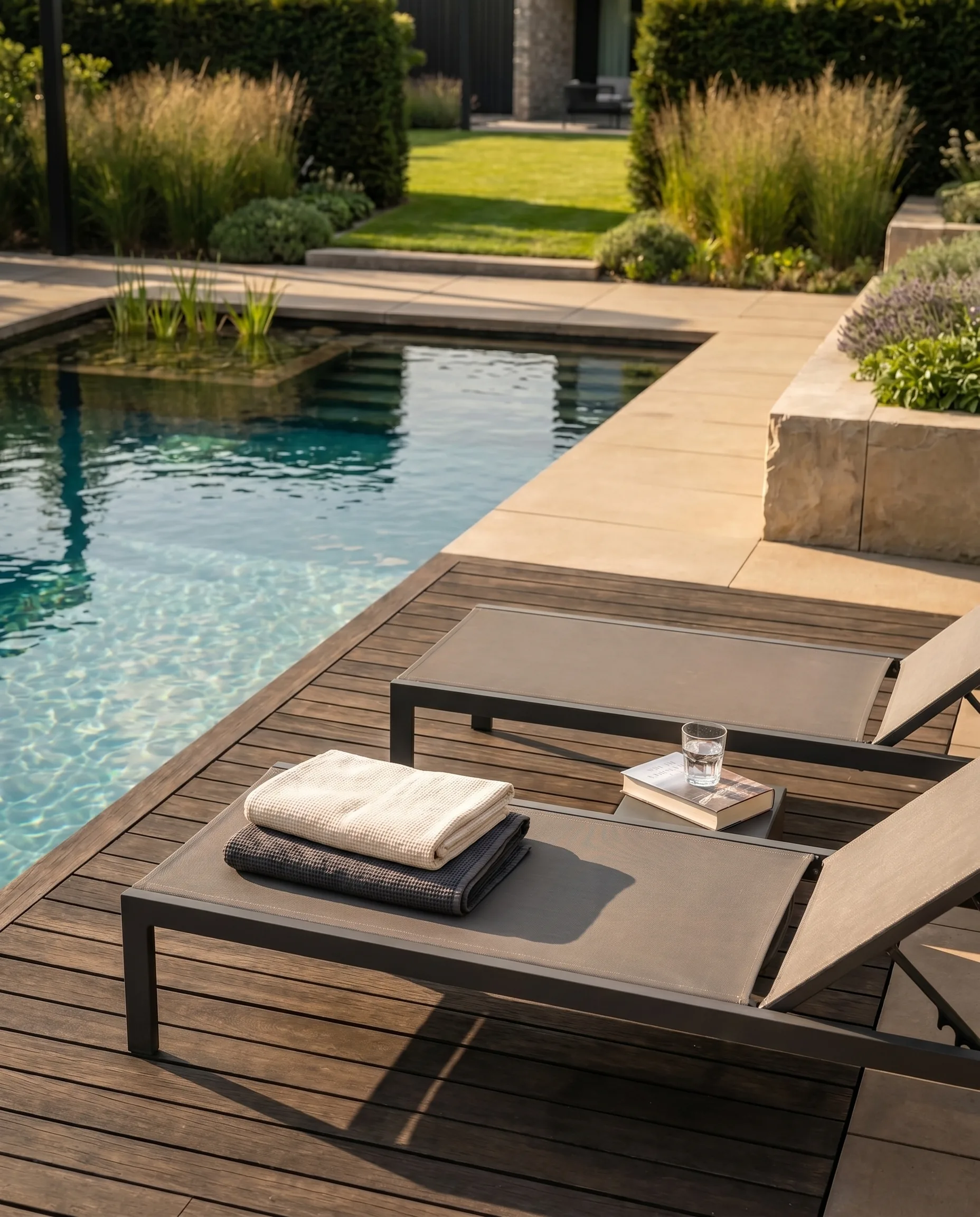
Plan enough room next to the pool for loungers and for walking past, plus a path from the house that is pleasant barefoot. The surface should be slip-resistant when wet. Dark stone and timber get hot in the sun. How terrace and pool are planned together is covered in the article Modern garden with terrace.
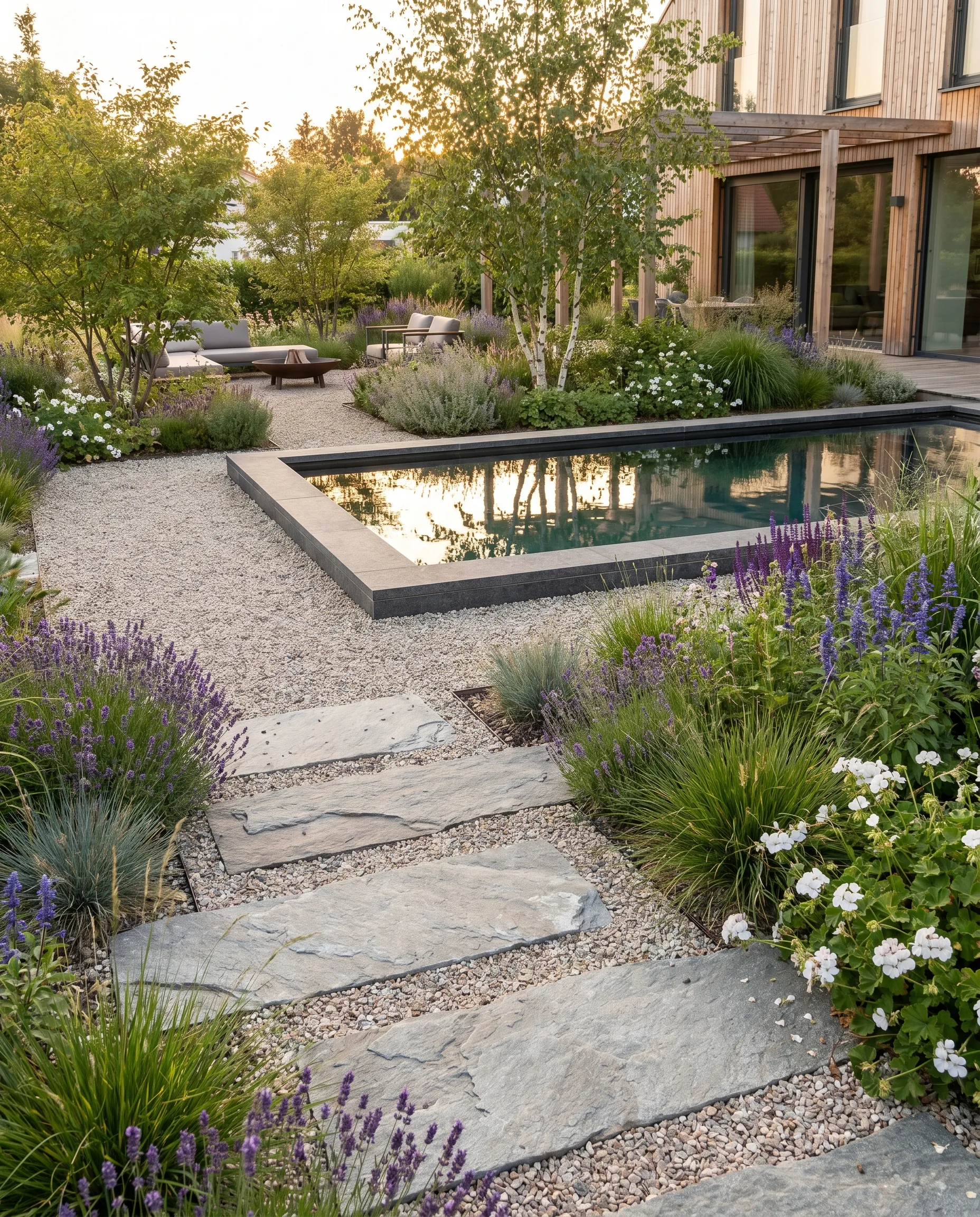
Gravel by the pool: Gravel with stepping slabs looks lighter than a large paved area. Right at the pool edge, though, it gets carried into the water on people's feet. A solid strip of slabs or timber between gravel and pool helps.
Planting
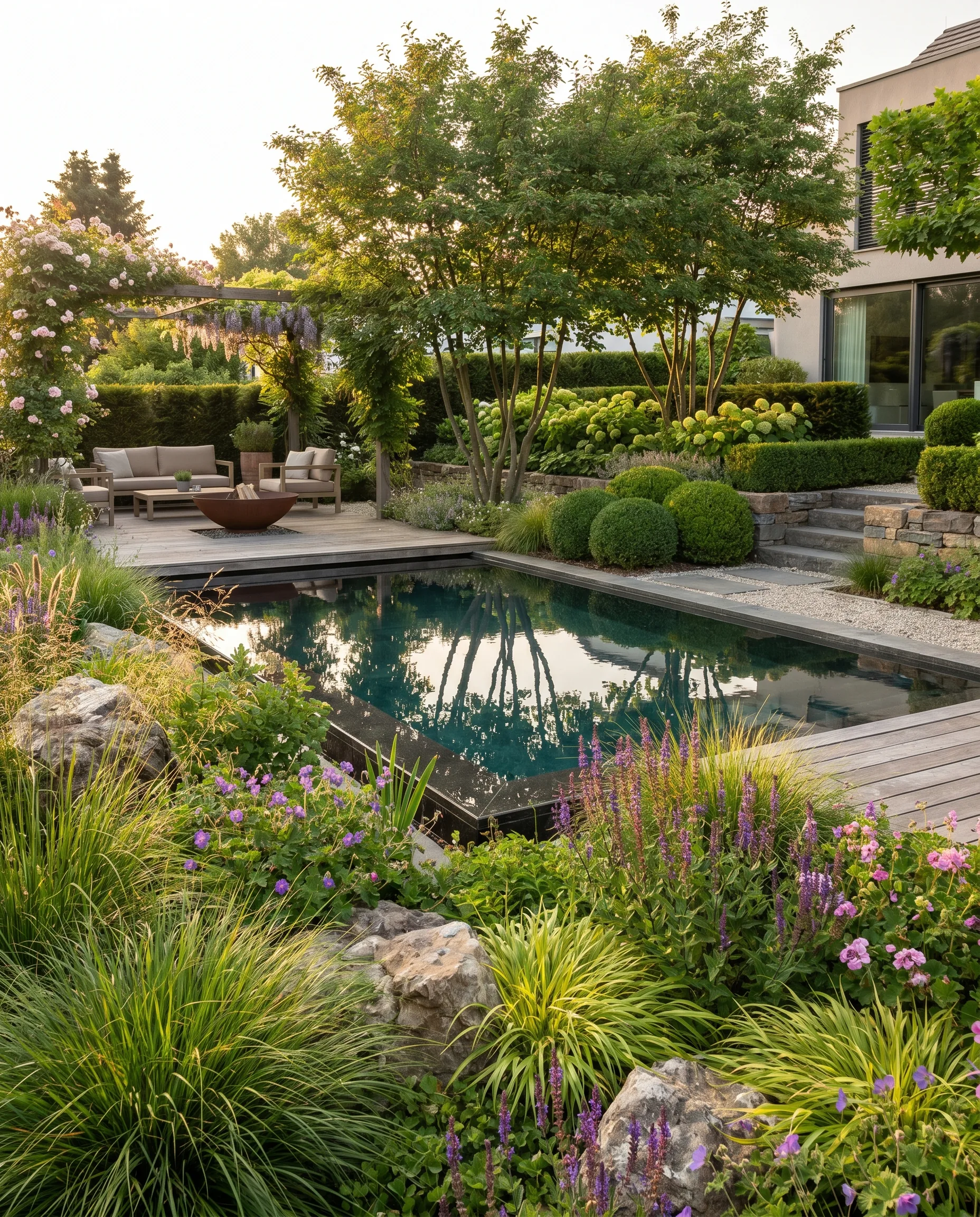
Plants soften the hard edge of the pool. Pay attention to what falls from them into the water: trees and shrubs with a lot of leaves, flowers or fruit don't belong right at the edge. Grasses, evergreen shrubs and perennials set back a little cause less work. Leave a solid strip between bed and pool edge so that no soil gets into the water. In gardens with small children, avoid poisonous plants at the pool, as everywhere in the garden.
Privacy
At the pool you want to feel unobserved. Hedges, privacy walls or a pergola screen the lounging area. In Germany, hedges and walls at the property boundary are subject to the distances and heights set by your federal state's neighbour law. It's best to talk to your neighbours beforehand.
Hiding the equipment
Pump, filter, possibly a heat pump and a roller cover need space. The equipment must be accessible, dry and ventilated. It often sits in a pit in the ground, in a garden shed or behind a wall at the edge of the pool area. Plan this spot right away, or the equipment box will end up in the middle of the view.
Light in the evening
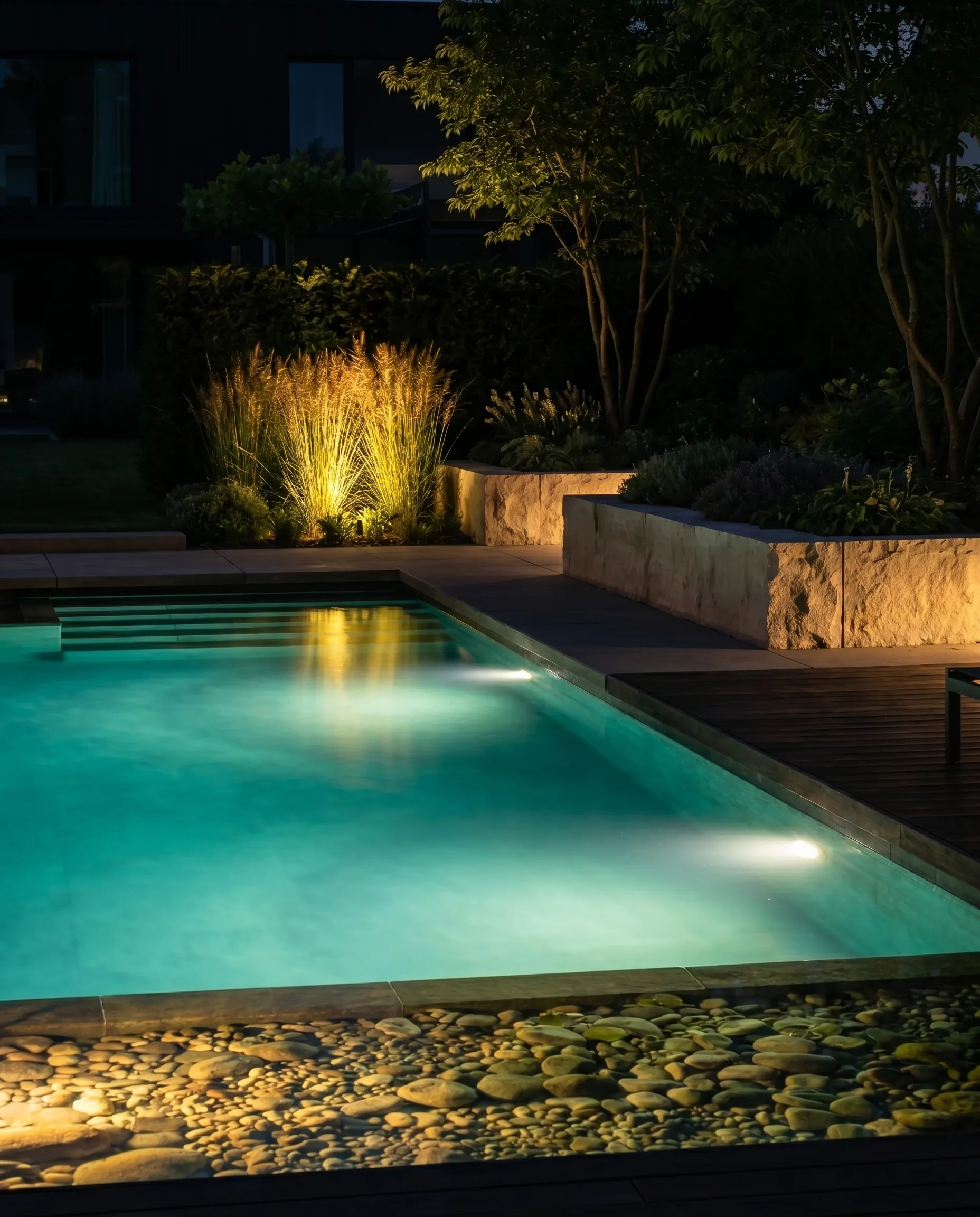
Underwater lighting and a few lit plants are enough for the pool to work in the evening. Lights on steps and paths make the area safer after sunset. More on this in the article on garden lighting.
Two examples, explained
The following images are AI visualisations by GardenPilot, not built gardens. They show design ideas, not construction plans. How clear the water stays or how much upkeep a pool needs cannot be read from an image.
Example 1: The pool as an extension of the terrace
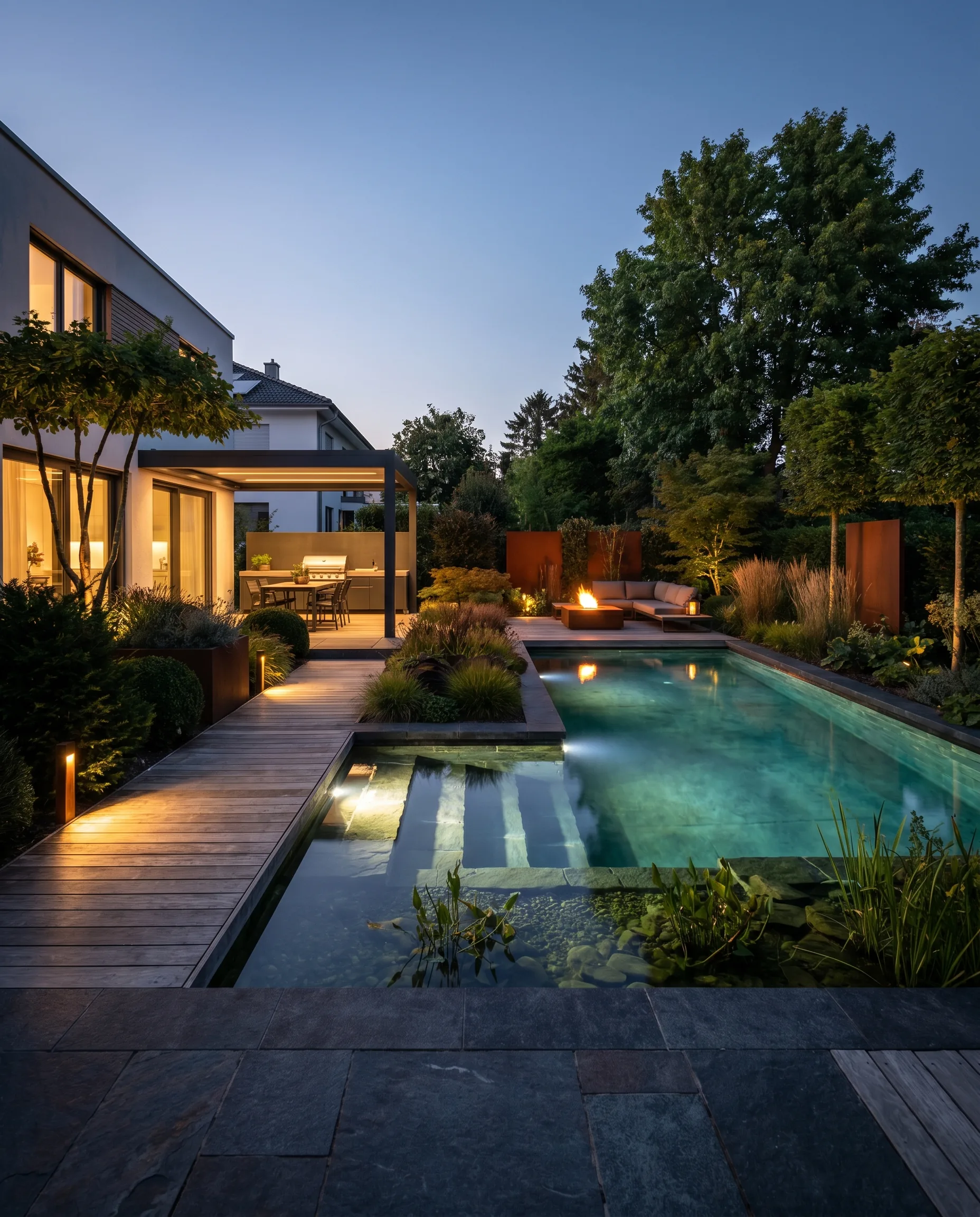
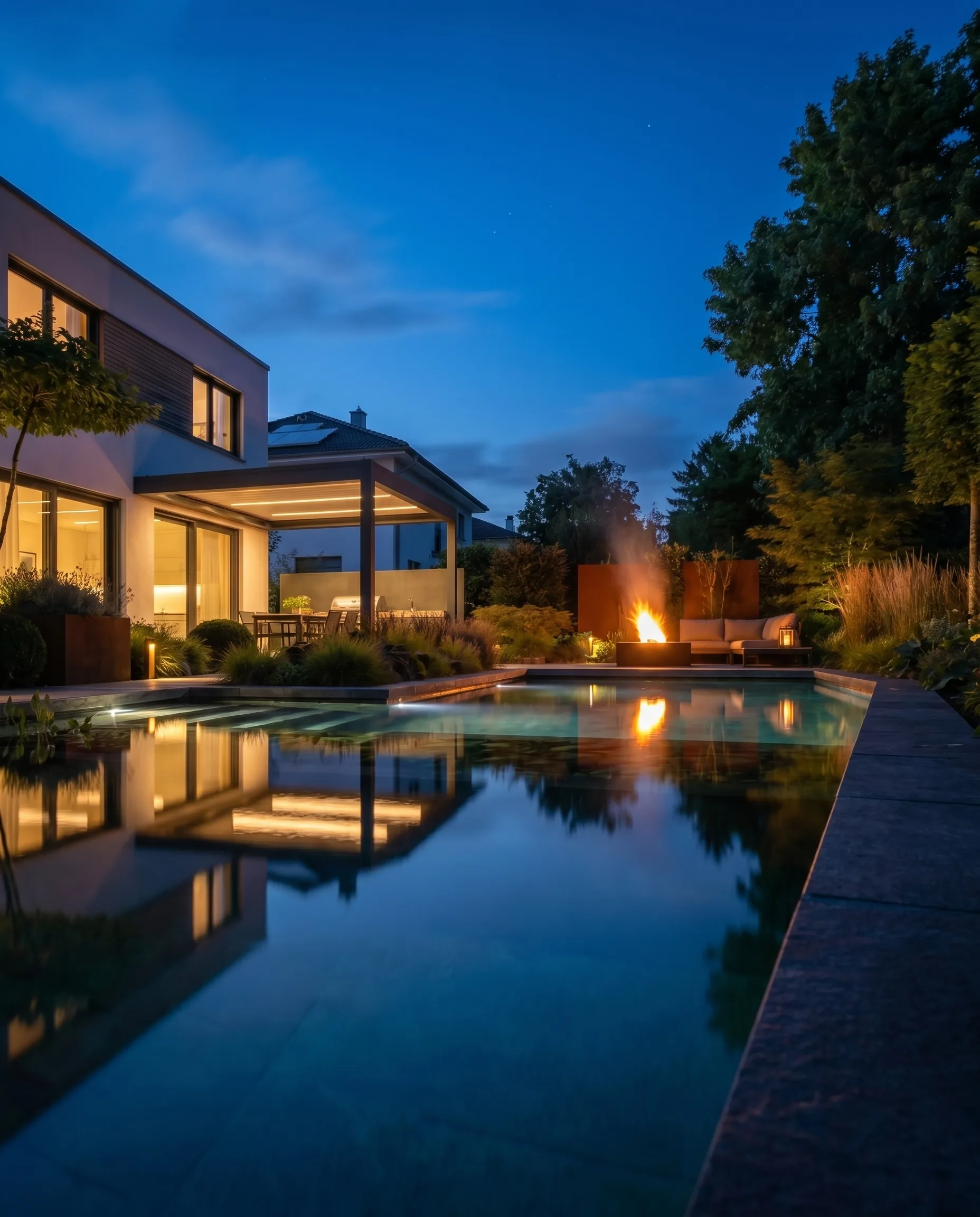
- Starting point: a detached house with an elongated garden beside it. A sunny site sheltered by trees is assumed.
- Key decision: The pool runs directly parallel to the house. By the house there is a covered terrace with an outdoor kitchen, at the other end a lounge with a fire pit in front of Corten steel walls. A timber boardwalk connects the two along the water.
- Transferable principle: The pool becomes part of the living area. The paths are short, and you can see the water from inside. The boardwalk turns the way along the pool into an axis with a destination at the end.
- Limitations: There is no fence in the image. With children in the household, one would have to stand between house and pool, and that takes away part of this solution's appeal. Splashing and pump noise are closer to the house. The large trees behind the lounge drop leaves into the pool. An open fire next to tall grasses and under trees is not a good idea because of flying sparks.
- Simpler version: a shorter pool, a paved path instead of the boardwalk, a seat at the end without a fire.
Example 2: The natural pool as a garden room of its own
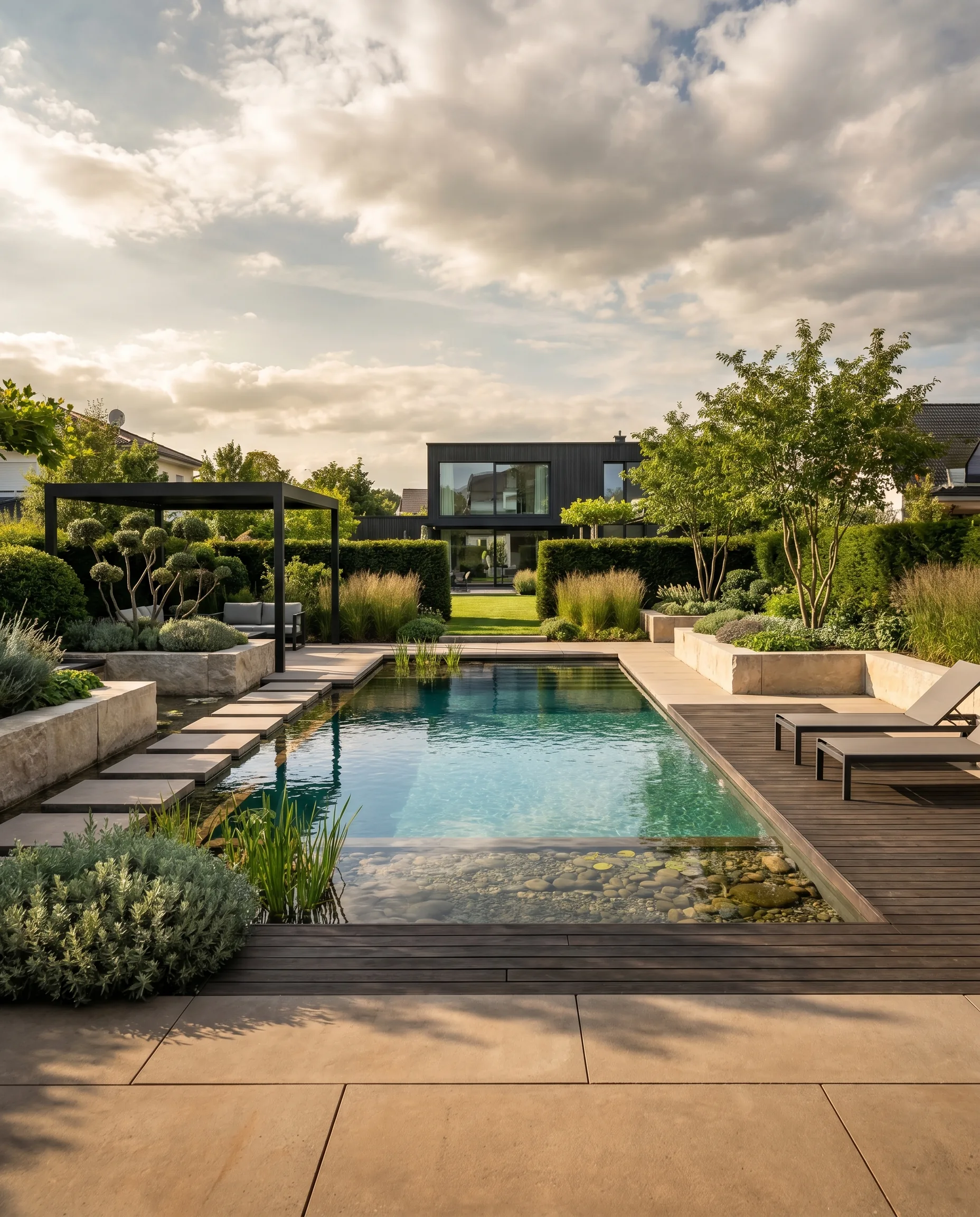
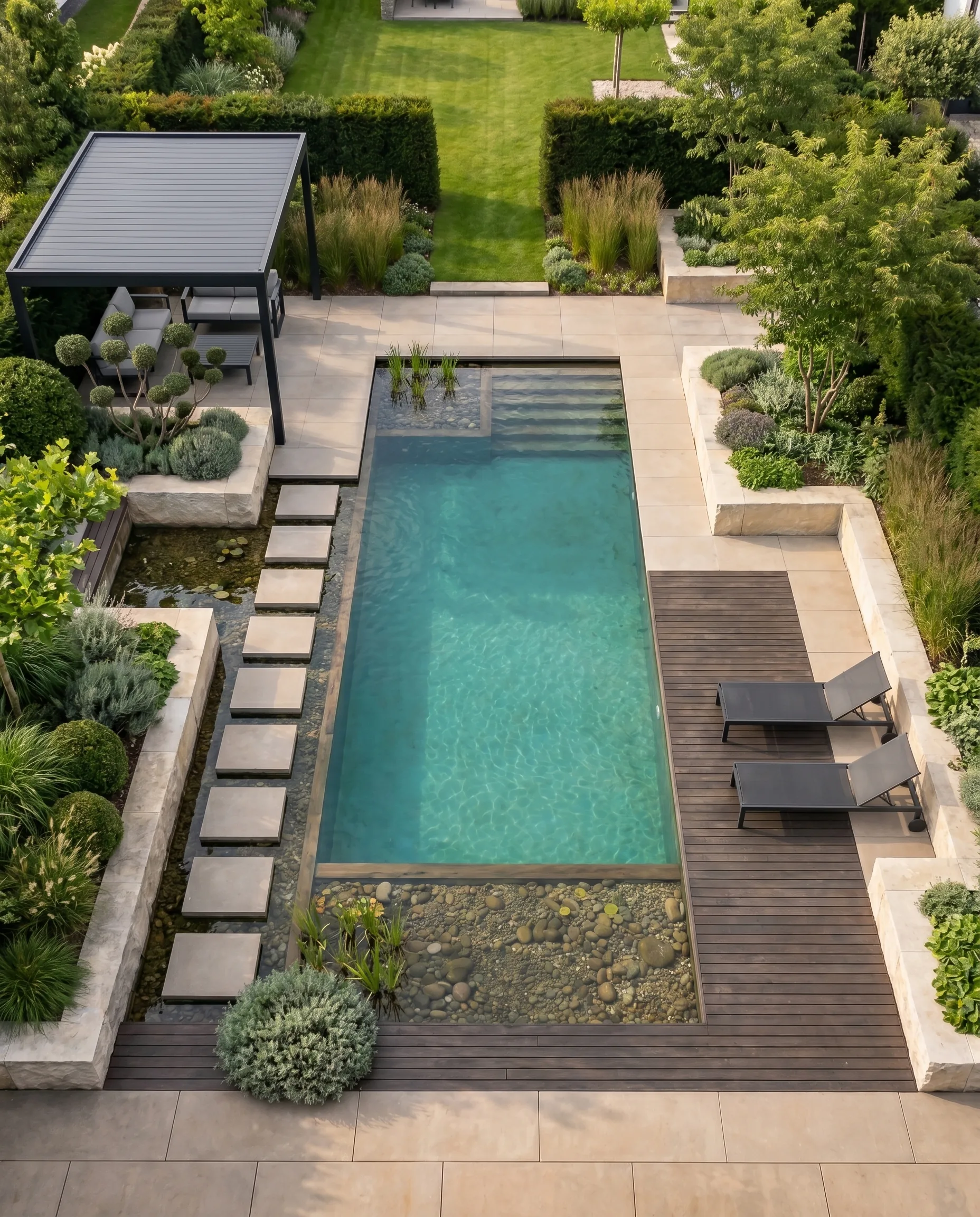
- Starting point: a garden with a lawn by the house and a rear part that has seen little use so far. A sunny site is assumed.
- Key decision: The pool doesn't go next to the house but into the back garden, separated by hedges. It is laid out as a natural pool: along one side, stepping slabs cross a shallow planted water zone, and at the front there is a zone of pebbles. Opposite is a timber deck with loungers, at the end a pergola with a lounge. Raised natural stone beds frame everything.
- Transferable principle: A garden room of its own for the pool. The lawn by the house stays free for other things, and a fence around the pool area can disappear into the hedge.
- Limitations: The way to the kitchen and bathroom is long, and from the house you can't see what is happening at the pool. The planted zone needs space and care every year. Stepping slabs over water are dangerous for small children. The image shows clear, turquoise water. How clear a natural pool really stays depends on its construction, equipment and upkeep.
- Simpler version: a classic pool without a planted zone, a paved path instead of the stepping slabs, a parasol instead of the pergola.
Try it before you build
How a pool would look in your garden, next to the house or at the back, is hard to picture on paper. With GardenPilot you upload a photo of your garden, choose a theme world and add what you would like, for example "narrow pool at the end of the garden, screened off by a hedge". The first image is free. For a comparison, you can have a second version shown with the other location (1 credit). The images are visualisations, not construction plans. Permits, structural engineering, equipment and safety are things to clarify with the building authority and a specialist contractor. How it works in detail is explained in the article AI garden design with a photo.
What would a pool look like in your garden? Upload a photo – the first image is free. Start free with your photo
Frequently asked questions
Does a garden pool need a building permit?
In Germany, that depends on your federal state's building code. In North Rhine-Westphalia, swimming pools with a volume of up to 100 m³ are permit-free; in Bavaria, swimming pools in gardens generally are, in both cases with restrictions in undeveloped outlying areas. A development plan, listed-building protection or a fixed roof can still require a permit. If in doubt, ask your local building authority.
How do I make a pool safe for small children?
The German lifesaving association DLRG recommends a fence all around the pool, at least one metre high and impossible to climb, with a self-closing gate. A cover alone is not enough, and a pool alarm only as an addition. Whenever children are in or near the water, they need supervision without gaps.
What is the difference between a natural pool and a swimming pond?
Both work without chlorine. In a swimming pond, a planted regeneration zone cleans the water with little or no equipment. It therefore needs more space and looks like a pond. A natural pool uses a pump and a biological filter and looks more like a pool.
Where should a pool go in the garden?
As sunny and sheltered from wind as possible, not under deciduous trees and with a view from the house or terrace. Whether it sits right by the house or as a room of its own in the back garden depends on how you use it and whether there are children in the household. The equipment is planned at the same time, not right at the boundary with the neighbours.
Further reading
What would this look like in your garden?
Upload a photo of your garden and see design ideas on your own space. The first image is free.
Start free with your photoMore articles from Modern Gardens
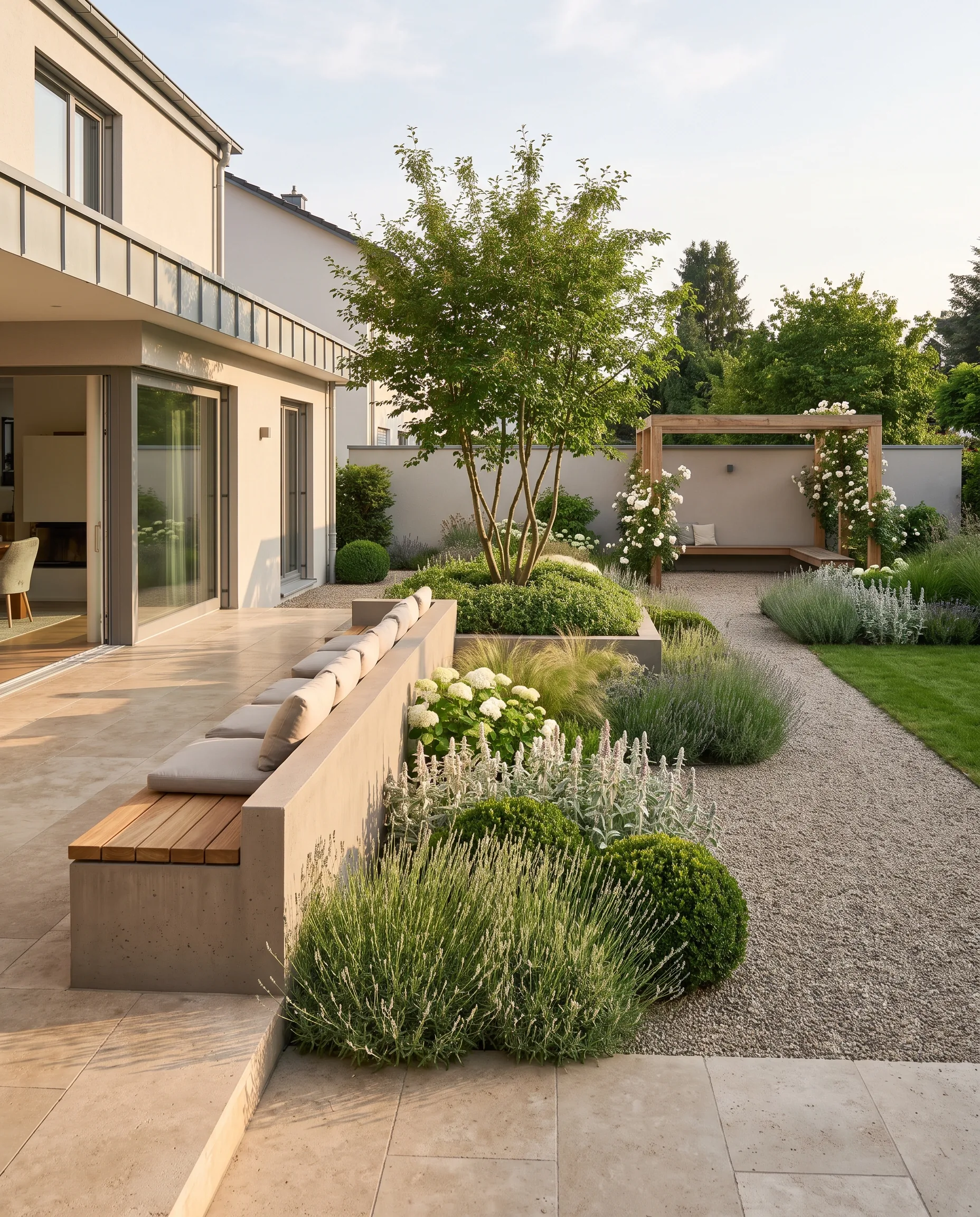
Designing a Modern, Low-Maintenance Garden: What Really Saves Work
Where the work in a garden comes from, which decisions reduce it for good and where "low-maintenance" is a myth: lawn, hedge, beds, joints, timber and water, with two explained examples.
Modern Garden with a Terrace: Position, Size, Paving and Shade
Where the terrace goes, how big it should be, which paving fits and where the shade comes from – plus what applies legally if you add a roof.
Minimalist Garden: What Defines It and How Much Care It Needs
A few materials, one basic shape, open areas: what a minimalist garden is made of, when it looks bare, how much care it needs and why it is not a gravel garden.