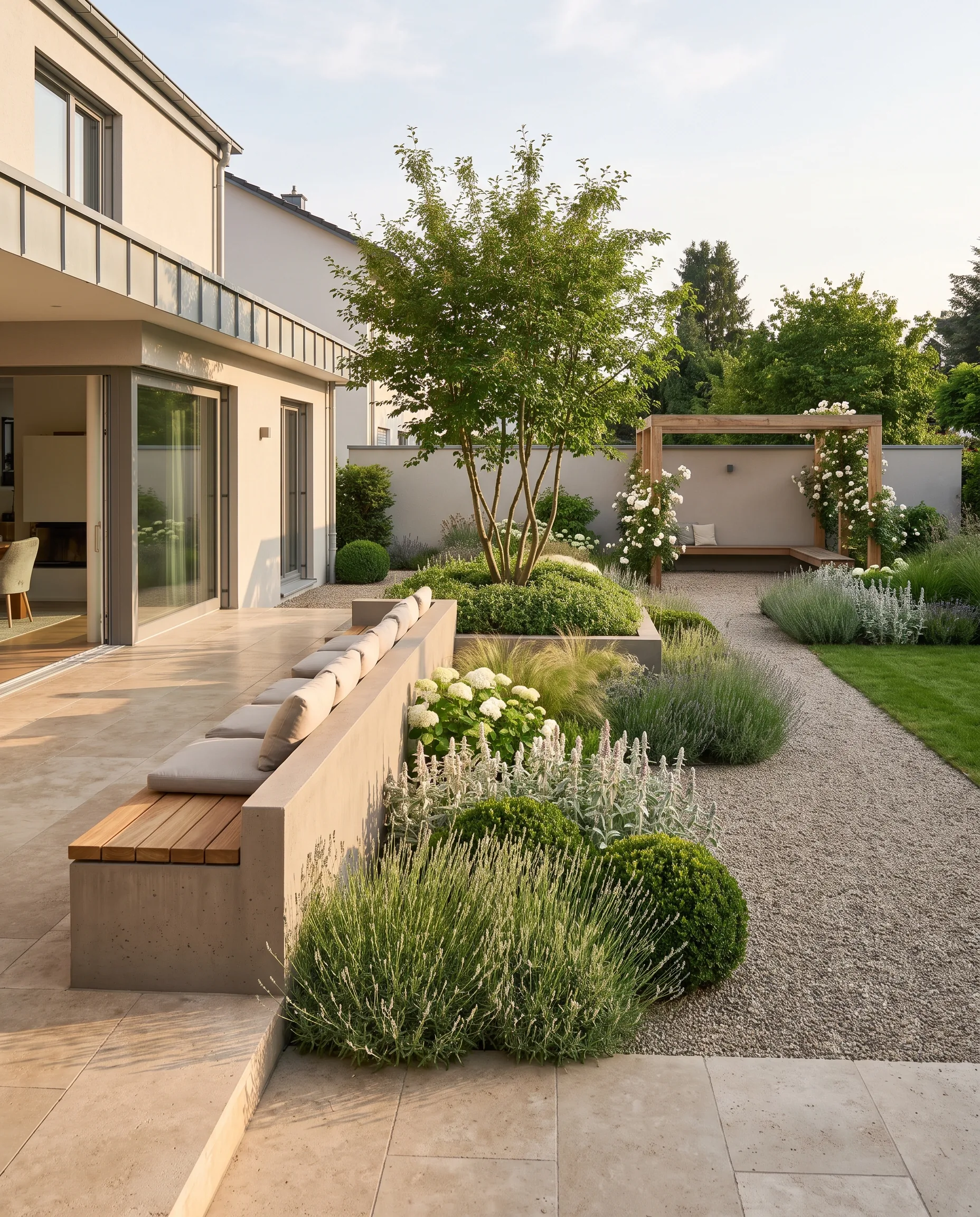
Low-maintenance doesn't mean maintenance-free. Even a garden that needs little work still has to be mown, cut back and weeded, just less often and in fewer places. How much work a garden makes is largely decided at the planning stage: with the lawn, the boundary, the paving and how densely the beds are planted. This article shows where the work in a garden comes from, which decisions reduce it for good and where "low-maintenance" is only a promise. Two explained examples at the end show how it fits together and where the limits are.
All gardens on this page are AI visualizations by GardenPilot, not built gardens. An image shows a design idea. Whether it needs little care depends on plants, soil and construction, not on the image.
At a glance
- Lawn is the area with the most regular work. Plan as much as you actually use and give it a fixed edge.
- Densely planted beds need less weeding than beds with bare soil. Plants that suit the site need less water once established.
- A clipped hedge has to be cut every year. A wall with climbers or free-growing shrubs means less pruning, but costs money or space.
- Large slabs have fewer joints. In Germany, weedkillers are banned on paths and paving, so joints are kept clean by hand.
- Gravel gardens and artificial grass are not a low-maintenance solution. In several German states they are explicitly not allowed on unbuilt land.
Where the work in a garden comes from
Before you choose a style, it's worth looking at which area causes which work:
| Area | What comes up regularly | What reduces the effort |
|---|---|---|
| Lawn | Mowing from spring to autumn, edging, feeding, watering in dry spells | smaller area, fixed mowing edge |
| Hedge | Cutting, every year for clipped hedges | wall with climbers, free-growing shrubs |
| Beds | Weeding while there are gaps; cutting back once a year | dense planting, plants suited to the site, mulch |
| Joints | Growth in sand and grit joints | large slabs, fewer metres of joints |
| Gravel | Leaves, seeds, moss | gravel only between plants, not as a bare surface |
| Timber | Cleaning; oiling if the colour should stay | let it turn grey, build with airflow |
| Water | Leaves, algae, pump and filter | smaller area, a spot without falling leaves |
We deliberately don't give hours. How long these jobs take depends on size, soil, weather and your own standards. There is no reliable flat figure for it.
Six decisions that save work for good
1. Lawn only where it gets used
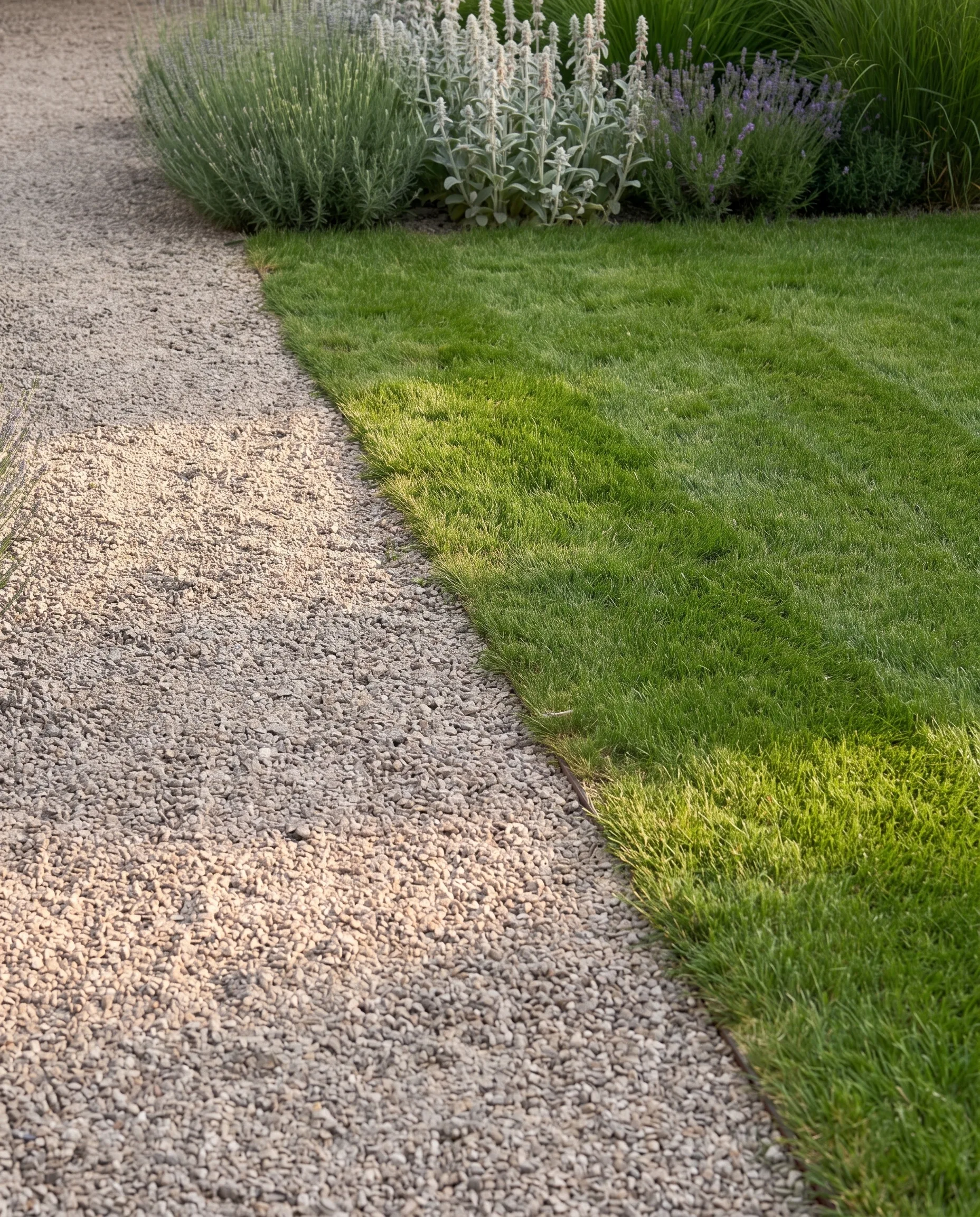
A lawn is soft and good to play on, but it is the area with the most regular work. It needs mowing from spring to autumn, and at every edge it grows into the bed or path. So ask yourself what you need it for: playing, lying in the sun, the dog? Then keep one continuous area. If it's only looked at, a planted area is often the better choice.
Where lawn stays, a fixed edge saves the most. A metal strip or a row of stones, set flush with the ground, keeps lawn and bed apart, and the mower can run over it. Re-cutting the edge then largely falls away.
If a robotic mower is to take over: only let it run during the day. Hedgehogs are out at dusk and at night and curl up when in danger instead of running away. The Leibniz Institute for Zoo and Wildlife Research in Germany analysed 370 cases of cut injuries to hedgehogs; almost half of the animals died. Some German cities have therefore banned robotic mowers from running at night.
2. Plant beds densely and to suit the site
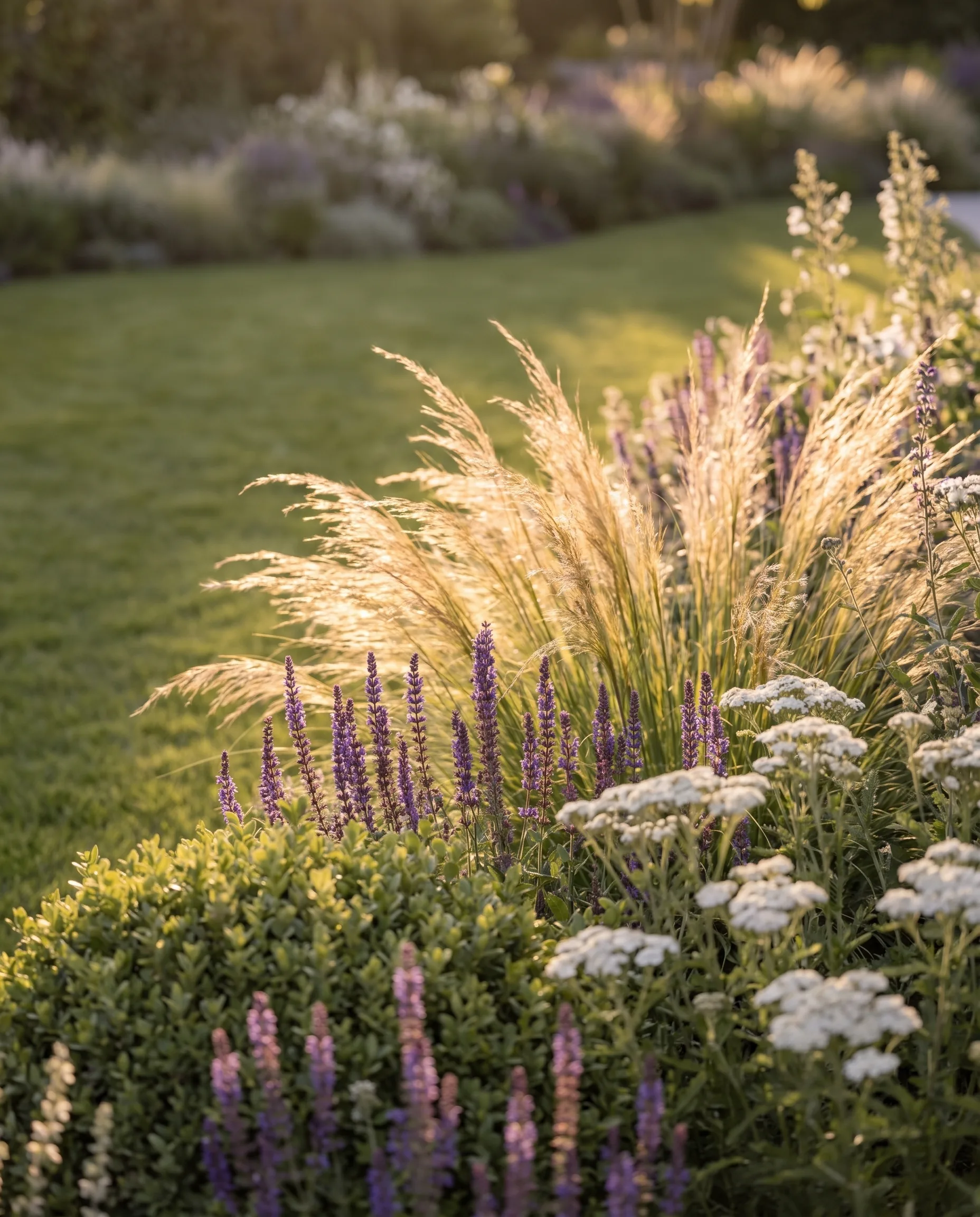
Weeds germinate where light falls on bare soil. A bed in which the plants cover the ground therefore needs less weeding than one with gaps between single plants. Two decisions make the difference:
- Choose plants for the site. Sunny and dry, sunny and moist, partial shade at the edge of trees: for each of these sites there are perennials that thrive there without constant care. If you plant against the site, you'll keep watering, feeding and replacing.
- Plant densely, with low ground cover between the taller perennials. This is also how the tested perennial mixes of the Bavarian State Institute for Viticulture and Horticulture (LWG) work: tall structural perennials, companion perennials and ground cover that together close the surface. The LWG describes them as largely self-regulating plantings that need only extensive care.
Even a bed like this isn't maintenance-free. In the first one to two years it needs thorough watering in dry spells, and it has to be weeded until it has closed up. Short, frequent rounds work better than two big ones a year. After that, the main job is cutting everything back close to the ground at the end of winter. Mulch helps most in the first year: a layer of gravel or grit on dry, sunny sites, composted bark under trees. A planted gravel area like this is something different from a gravel garden. How a garden with little work can also be ecologically valuable is covered in the article Low-maintenance natural garden.
3. At the boundary: hedge, wall or free-growing shrubs
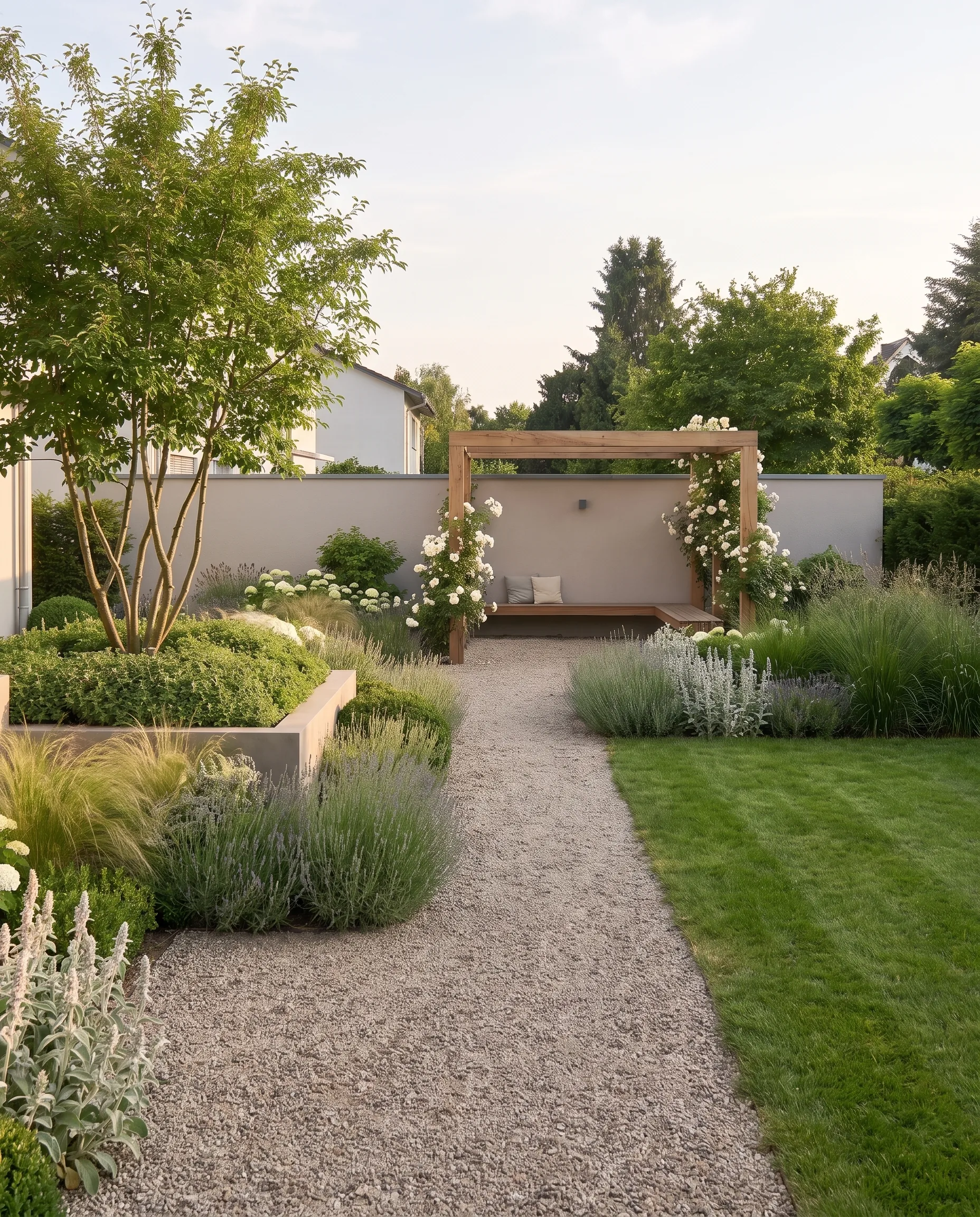
A clipped hedge is green and good for birds, but it has to be shaped every year, more often for fast-growing species. In Germany there is also a legal limit: from 1 March to 30 September the Federal Nature Conservation Act only allows gentle shaping and maintenance cuts that remove new growth. Heavier cutting belongs in the period from October to February.
These options mean less cutting:
- A wall or fence with climbers. Hardly any cutting along the boundary, but higher building costs. In Germany, whether a boundary wall needs a permit and how high it may be is set by the state building code, neighbour law and the local development plan. Ask the building authority first.
- Free-growing shrubs. They are cut less often, but need considerably more width than a clipped hedge.
In the image above, a rendered wall replaces the hedge. The white climbing roses on the pergola do need pruning themselves, though: a smaller job in one spot instead of a big one along the whole boundary.
4. Paving: large slabs, few joints
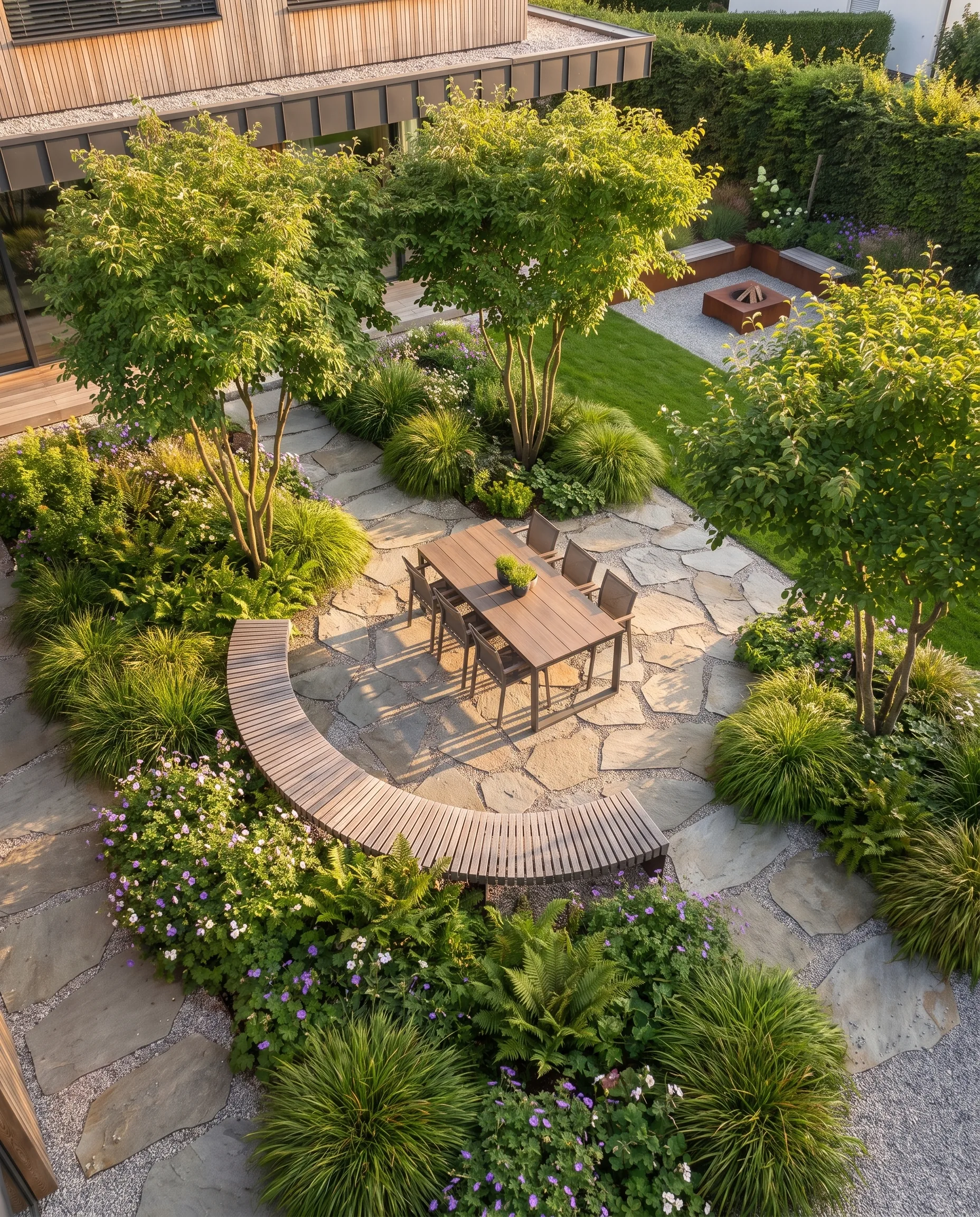
Over time, moss and wild plants settle in joints filled with sand or grit. Chemicals are not an option: in Germany, the Plant Protection Act bans the use of plant protection products on paved surfaces such as paths, patios and paving. That leaves a joint scraper, a brush or hot water.
The work therefore depends mainly on the length of the joints. Large, rectangular slabs have far fewer metres of joints on the same area than small pavers or irregular crazy paving like in the image. Those look natural but bring many joints with them. If you don't want to scrape the joints, you can also plant them on purpose, for example with tread-tolerant cushion plants. Then the green in the joint is intended.
5. Timber: let it turn grey or maintain it regularly
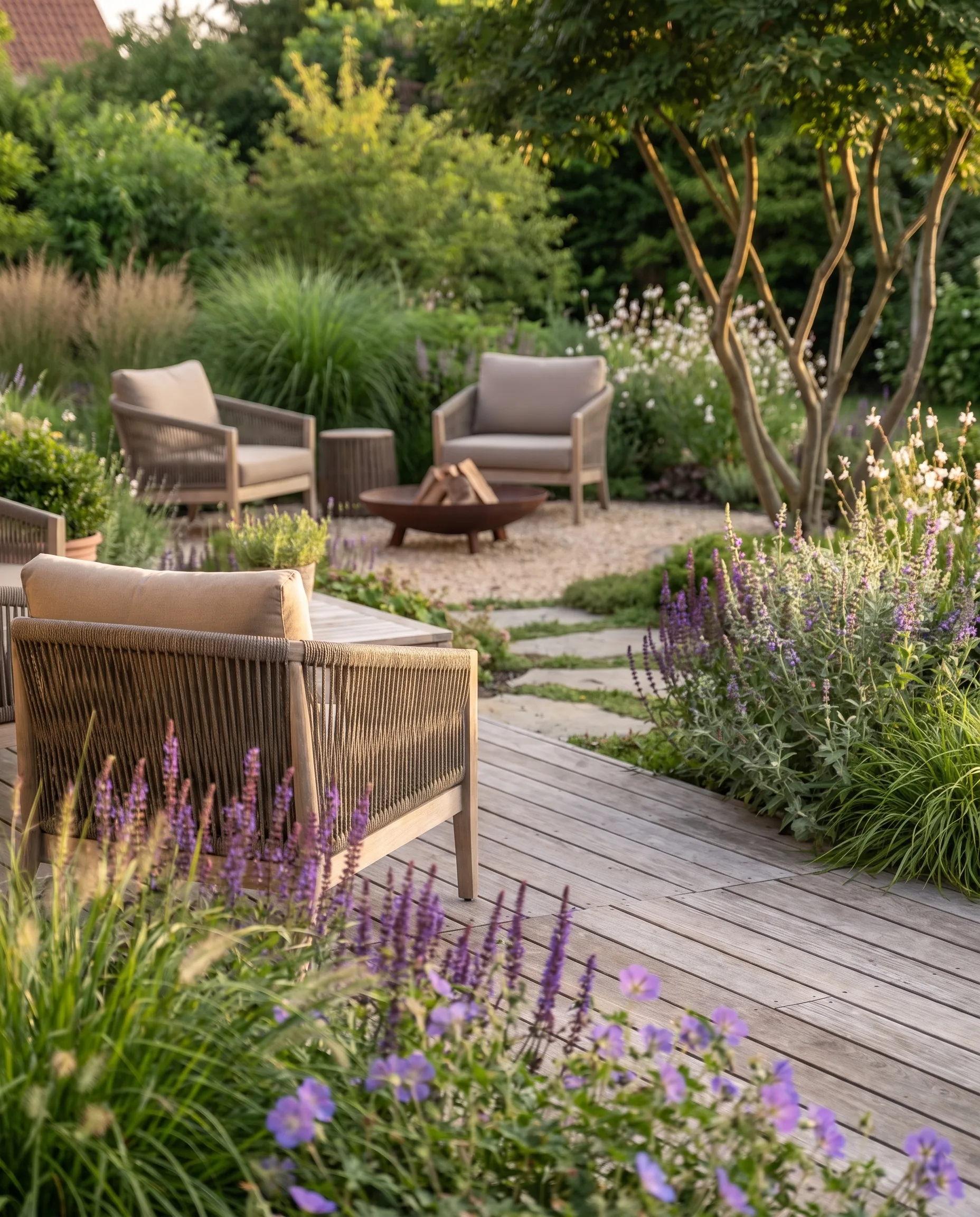
Untreated timber turns silver-grey outdoors over time. This happens at the surface: light breaks down the wood component lignin, and rain washes it out. According to the planning guide for timber decking from dataholz.eu, greying is a purely visual feature and has no effect on the technical properties or the service life of the decking.
So the decision is one of taste: if you like the grey, you save yourself the oiling. If you want to keep the original colour, you have to treat the surface regularly. That can delay greying, not stop it. Either way, timber decks need a construction that lets the wood dry after rain, and occasional cleaning.
6. Water: beautiful, but never maintenance-free
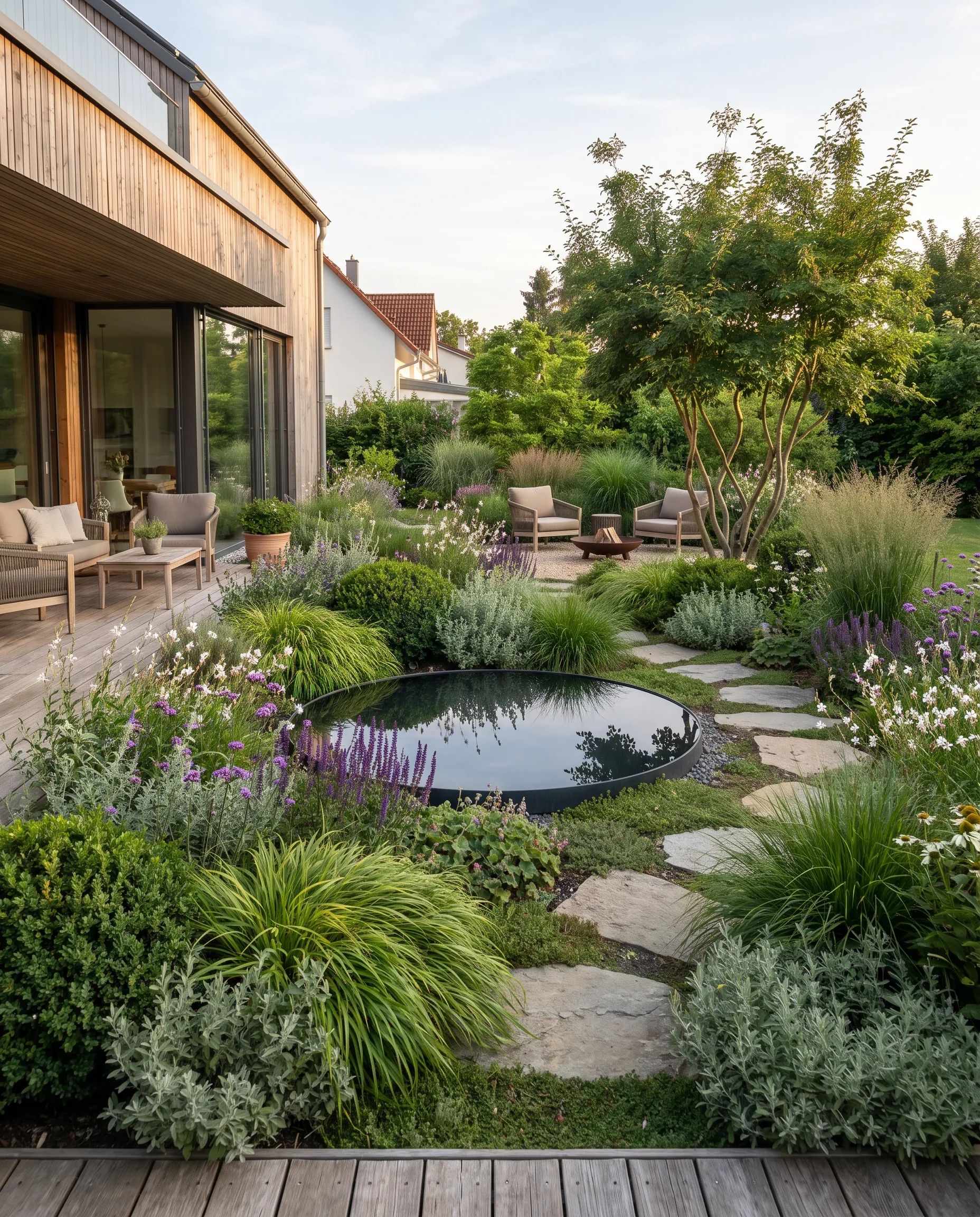
A water bowl or basin is often the most beautiful spot in a modern garden. It still isn't low-maintenance. Leaves and spent flowers have to come out, algae appear especially in sun and warmth, and where a pump or filter runs, its servicing comes on top. A basin that isn't directly under trees, and a small area instead of a large one, means less work.
If small children play in the garden, sort out depth and safety first. Toddlers can drown in just a few centimetres of water. More on shapes and construction: Water basins in the garden
Where "low-maintenance" is a myth
Gravel gardens and gravel without plants
A surface of crushed stone on plastic sheeting or fleece looks clean for the first few months. Then leaves and dust collect between the stones, over time a thin layer of humus forms, and seeds from the surroundings germinate in it. Wild plants root through the fleece. Weedkillers are not allowed on such surfaces in Germany, so it's weeding by hand. On top of that, the stones heat up in summer, and insects find nothing there.
In Germany, gravel gardens are explicitly ruled out in several states. There is no nationwide ban. Examples:
- Baden-Württemberg: since 2020, gravel surfaces for designing private gardens are in principle not a permitted use (Section 21a of the state Nature Conservation Act).
- Hesse: the same rule since June 2023 (Section 35(9) of the state Nature Conservation Act).
- North Rhine-Westphalia: unbuilt areas must be planted; gravel surfaces and artificial grass explicitly do not count as a permitted use (Section 8 of the state building code, since 2024).
- Lower Saxony: in 2023 the Higher Administrative Court in Lüneburg ruled that a gravel bed with a few single plants is not a green area within the meaning of the building code.
In other German states, too, the building codes require unbuilt areas to be planted, and many municipalities add their own rules in development plans. If in doubt, ask your local authority. Gravel itself isn't the problem: dense planting with gravel as mulch between the plants is something different from a bare stone surface.
Artificial grass
Artificial grass doesn't need mowing. You still have to remove leaves, moss and animal droppings. It heats up much more in the sun than real lawn, the fibres wear and shed plastic particles, and at the end of its life it is plastic waste. In North Rhine-Westphalia, artificial grass on unbuilt areas has explicitly not counted as planting since 2024. If mowing is too much for you, a smaller lawn with planting around it is the more honest solution.
Cherry laurel as a "low-maintenance" hedge
Cherry laurel is often recommended as a quick evergreen hedge. It isn't low-maintenance: it grows vigorously and has to be cut every year. According to the Bonn poison information centre, all parts of the plant are poisonous, especially the leaves and seeds. In Switzerland it has not been allowed on sale since September 2024 because it is classed as an invasive species that spreads into woodland. In Germany it is not banned. If you have children or want to save on cutting, look for a different solution for the boundary.
Two examples, explained
The following images are AI visualizations by GardenPilot, not built gardens. The top view belongs to the same design in each case and shows where the areas are. It is not a construction plan.
Example 1: Planting islands in pale paving, no lawn
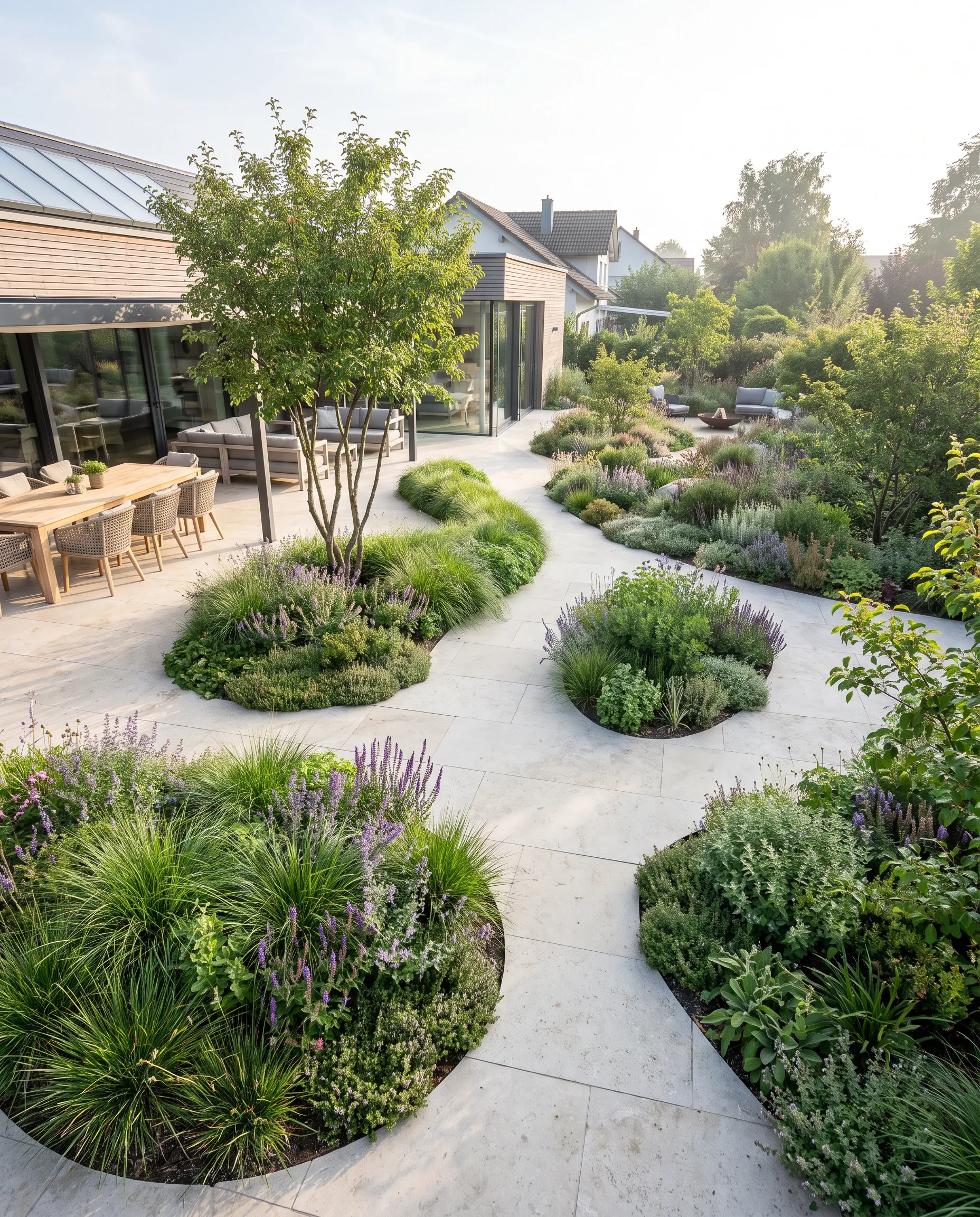
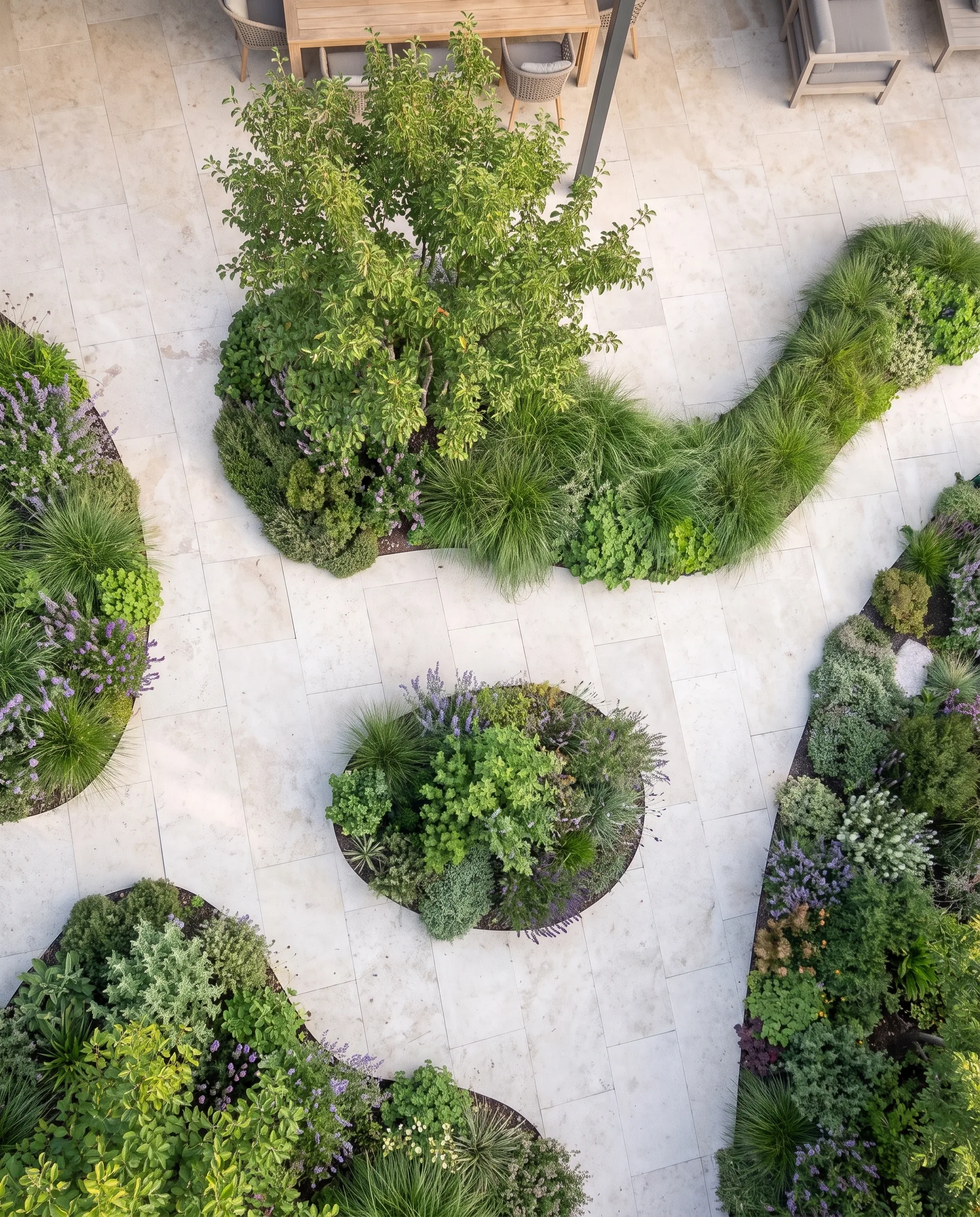
- Starting point: a garden behind a low house, assumed to be a sunny site. The wishes are a dining area by the house, a lounge in the garden and as little mowing as possible.
- Key decision: no lawn. The area consists of large, pale slabs with wave-shaped and round beds set into them. The beds are densely planted with grasses and perennials; a multi-stem tree stands in the island next to the dining area.
- Transferable principle: where a bed meets paving, there's no lawn edge to re-cut and no mower. Large slabs keep the length of joints short. Densely planted islands leave weeds little bare soil.
- Limitations: such a large paved area only lets rainwater soak away through the joints, heats up in summer and is less pleasant for playing or lying on than lawn. Pale slabs show leaves and dirt. The local development plan may limit how much of the plot can be paved.
- Simpler version: the same idea on a small scale: a patio of large slabs with one or two densely planted beds set into it, and the rest of the garden stays planting or lawn.
Example 2: Beautiful, but not a low-maintenance garden
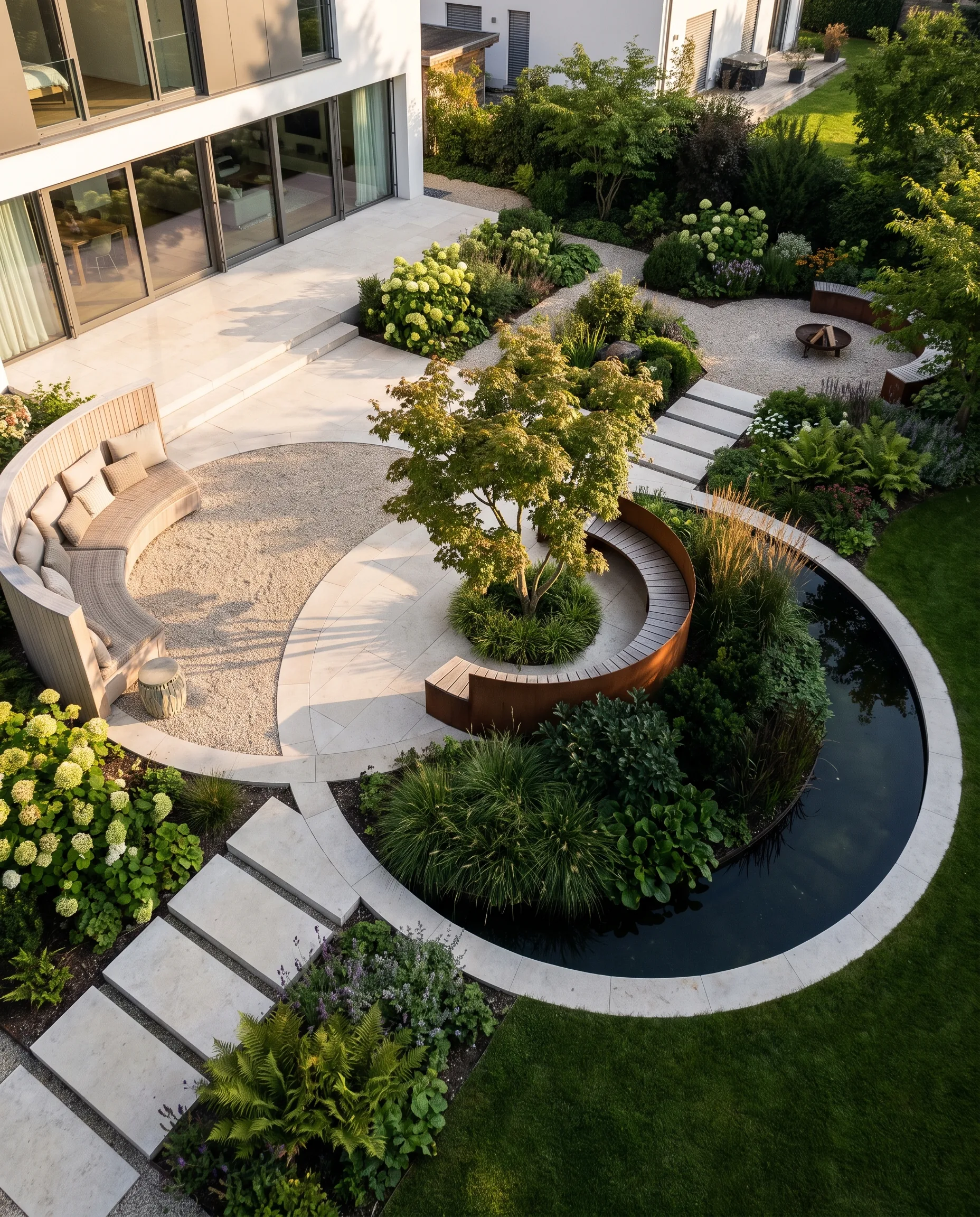
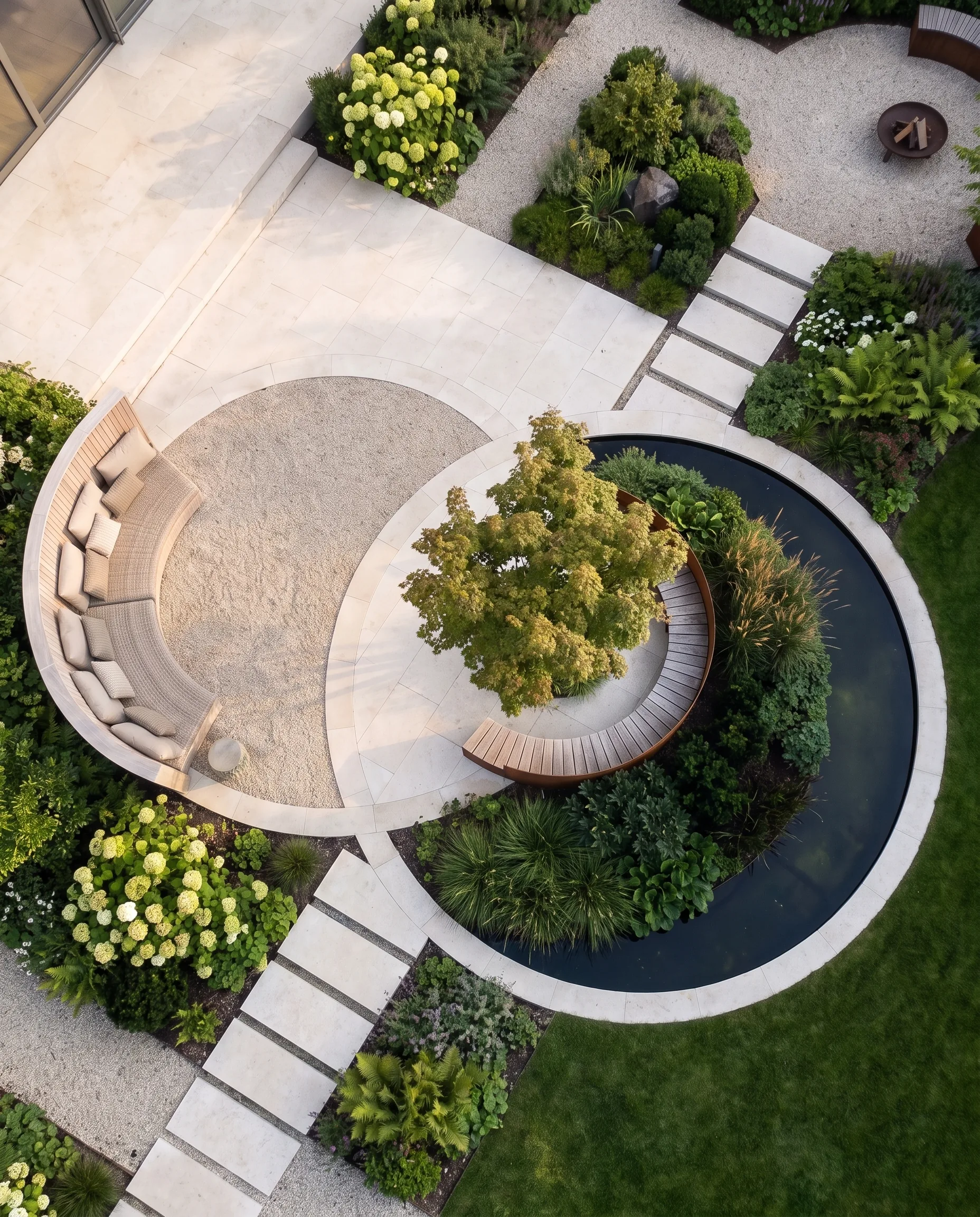
This example shows that modern doesn't automatically mean low-maintenance.
- Starting point: a garden behind a modern house with a large patio. The wish is a strong focal point.
- Key decision: a water ring around a planted island with a tree and a curved bench, next to it a round gravel area with a sofa, stepping stones through the planting and lawn to the side.
- What makes work here: the water ring sits next to a tree, so leaves have to come out regularly, plus algae and the technology. The lawn meets the water's edge in a curve and has to be edged by hand there. Leaves and seeds collect on the gravel areas. The timber seats on the benches turn grey or get oiled. And wherever water, gravel, slabs, lawn and bed meet, there are edges.
- Transferable principle: a single strong focal point carries a garden. It doesn't have to be water.
- Simpler version: a tree in a round bed as the centre instead of the water ring, a paved area instead of the gravel circle, and no lawn edge along the water. If you don't want to do without water, a single water bowl in a spot without falling leaves is the smaller effort.
More design ideas with water, planting bands and seating areas are in the article Modern garden design: 8 ideas.
Try it before you build
Whether your garden still looks the way you want with less lawn, a wall instead of a hedge or large slabs is hard to judge on paper. With GardenPilot you upload a photo of your garden, choose a theme world and add what matters to you, for example "lawn only in front of the patio, dense planting everywhere else". The first image is free. Each further variant costs 1 credit, so you can put two wishes side by side. The images are visualizations, not construction plans: whether an area needs little care is decided by plant choice, soil and construction. How it works in detail is explained in the article AI garden design with a photo.
What would your garden look like with less work? Upload a photo – the first image is free. Start free with your photo
Frequently asked questions
How do I make a garden low-maintenance?
Start with the areas that make regular work: as much lawn as you use, with a fixed edge; dense beds with plants that suit your site; a boundary solution that doesn't need cutting every year; large slabs instead of small-scale paving. Water and many different materials increase the effort.
Is gravel low-maintenance?
As mulch between dense planting, yes, especially on dry, sunny sites. As a bare surface without plants, no: leaves and seeds collect in it, weeds germinate, and in Germany weedkillers are banned there. In several German states such gravel surfaces are also not allowed on unbuilt parts of a plot.
Which hedge is low-maintenance?
No clipped hedge is cut-free. Slow-growing species or free-growing shrubs that are only thinned out now and then make less work, but they need more space. If you hardly want to cut at the boundary, choose a wall or fence with climbers. In Germany, heavier cutting is only allowed from October to February.
Is a modern garden automatically lower-maintenance?
No. Clean shapes and few materials can save work because there are fewer edges and joints. Water basins, large gravel areas, timber decks and many different surfaces, which often come with modern gardens, increase the effort. What matters is which areas you choose, not the style.
Further reading
What would this look like in your garden?
Upload a photo of your garden and see design ideas on your own space. The first image is free.
Start free with your photoMore articles from Modern Gardens
Modern Garden with a Terrace: Position, Size, Paving and Shade
Where the terrace goes, how big it should be, which paving fits and where the shade comes from – plus what applies legally if you add a roof.
Minimalist Garden: What Defines It and How Much Care It Needs
A few materials, one basic shape, open areas: what a minimalist garden is made of, when it looks bare, how much care it needs and why it is not a gravel garden.
Modern Garden with a Pool: Location, Pool Type, Safety and Design
Pool, natural pool or swimming pond? Where the pool should go, what to clarify legally, how to keep children safe and how pool and garden come together – with two explained examples.