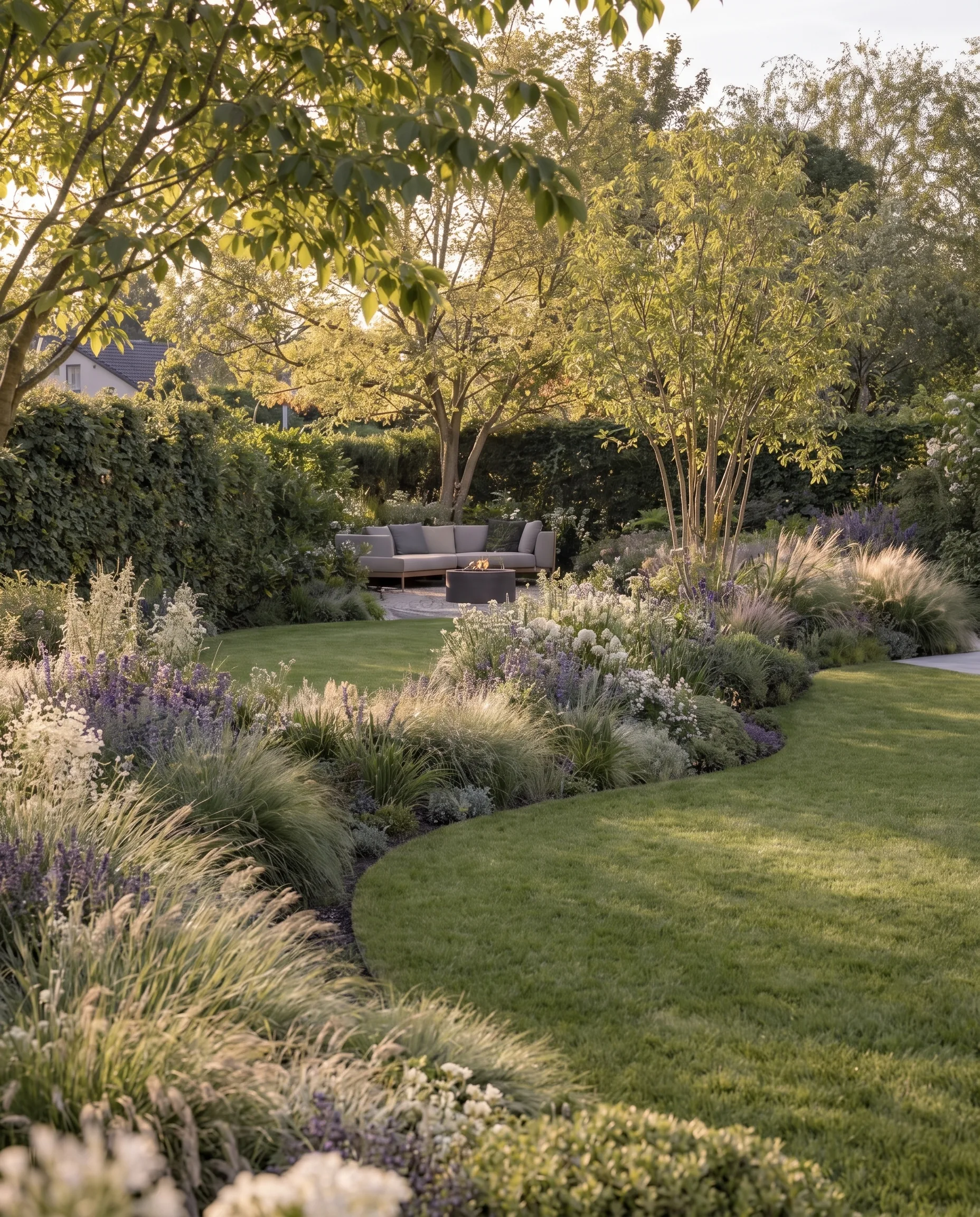
The patio sits in blazing sun. The lawn needs constant attention. And the corner with the loveliest evening light goes unused. If you want to change your garden for 2027, that is exactly where it pays to start.
Our five garden trends for 2027: flowering beds that need less watering, shady seating areas, design with rainwater, nature-friendly planting with a clear form, and garden rooms for the evening. You can put them into practice one at a time or combine them. You don't need to redo the whole garden.
For this selection we evaluated current German industry publications and horticultural sources, so the trends describe gardens in Germany. Interest in adapting gardens to the climate is particularly well documented. How we translate these topics into garden design for 2027 is our editorial assessment.
As of 15 October 2026. All garden images in this article are AI visualisations by GardenPilot. They show design ideas, not built reference gardens.
Garden trends 2027 at a glance
| Idea | What it gives you | How to start |
|---|---|---|
| Flowering beds instead of unused lawn | More colour and structure; with the right plants, less watering | Turn a sunny strip of lawn into a perennial bed |
| Shade as part of the design | A seating area you can also use on hot days | Watch how the shade moves around your favourite spot |
| Using rainwater in the garden | Water for watering and a new design element | Plan a closed water store at the downpipe |
| Nature-friendly with a clear form | Food and shelter for wildlife in a deliberately designed garden | Tidy one bed edge and plant a wide variety behind it |
| Small garden rooms for the evening | More ways to enjoy the garden you already have | Try two chairs in a spot you haven't used so far |
1. Flowering beds instead of lawn nobody uses
Imagine the narrow strip of lawn along the fence were a bed: violet flowers in early summer, silvery foliage in between, later upright flower spikes and grasses backlit by the evening sun. The same area suddenly gains depth and something that changes with the seasons.
The idea for 2027: keep lawn where you actually need it. Other areas can do more than just be green.
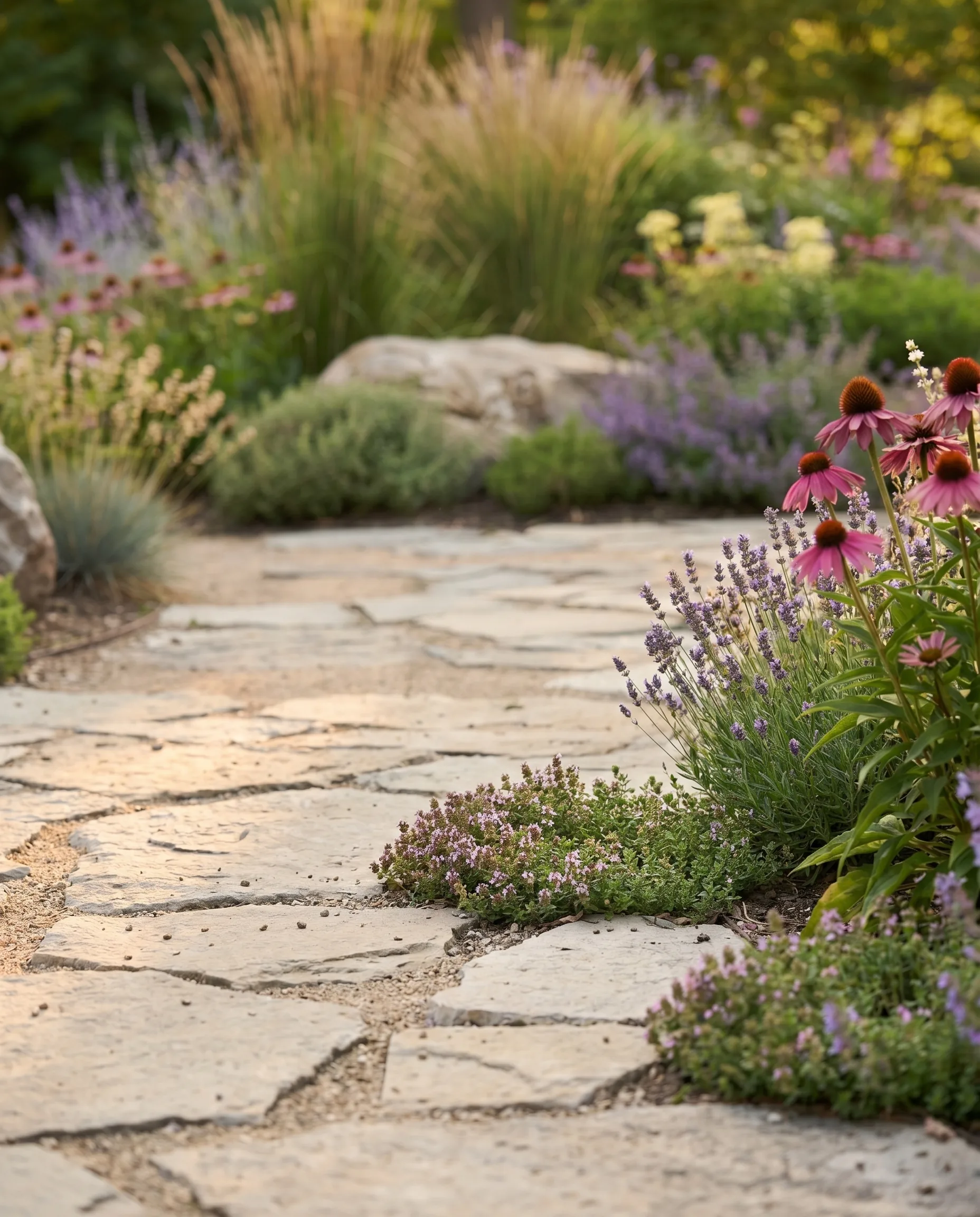
How to turn this into a convincing design
Choose a few plant species and repeat them across the bed. For example, catmint as a soft, low carpet, upright sage flowers in between and taller perennials further back. Three recurring plant groups usually come together into a calmer picture than ten individual favourites.
For sunny spots with well-drained soil, these plants are worth considering:
- Woodland sage (Salvia nemorosa): upright violet or pink flowers that contrast with soft leaf shapes.
- Catmint (Nepeta × faassenii): a loose edging along paths and bed borders.
- Tall sedum (Hylotelephium species and cultivars): sturdy clumps of foliage and flower heads for late summer.
- Yarrow (Achillea species and cultivars): flat flower heads that combine well with upright forms.
The exact choice depends on soil, winter wetness and the space available. Drought-tolerant also means: these plants need water after planting too, until they are established. For tried-and-tested combinations, the Bavarian State Institute for Viticulture and Horticulture (LWG) offers perennial mixes for sunny sites (in German).
Works especially well: along sunny property edges, in front of the patio or in a front garden. On heavy, wet soil or in shade you need a different plant selection. A play area is better left as lawn.
Your first step: Look for a strip you mow regularly but hardly ever walk on. That is exactly where your first new bed could go.
Why the topic matters now: according to a study for German garden centre associations published in October 2026 (in German), around two thirds of hobby gardeners in Germany are thinking about adapting to the climate. Heat-tolerant plants and using rainwater are among the most sought-after topics.
2. Shady spots that become your favourite place
You have a lovely dining table outside, but in July you'd rather sit indoors? Then your garden may be missing something crucial: a well-placed shady area.
For 2027, it pays to start patio planning from a different question: Where do you really want to sit on a hot day? Only then decide on paving and furniture.
Three options for different gardens
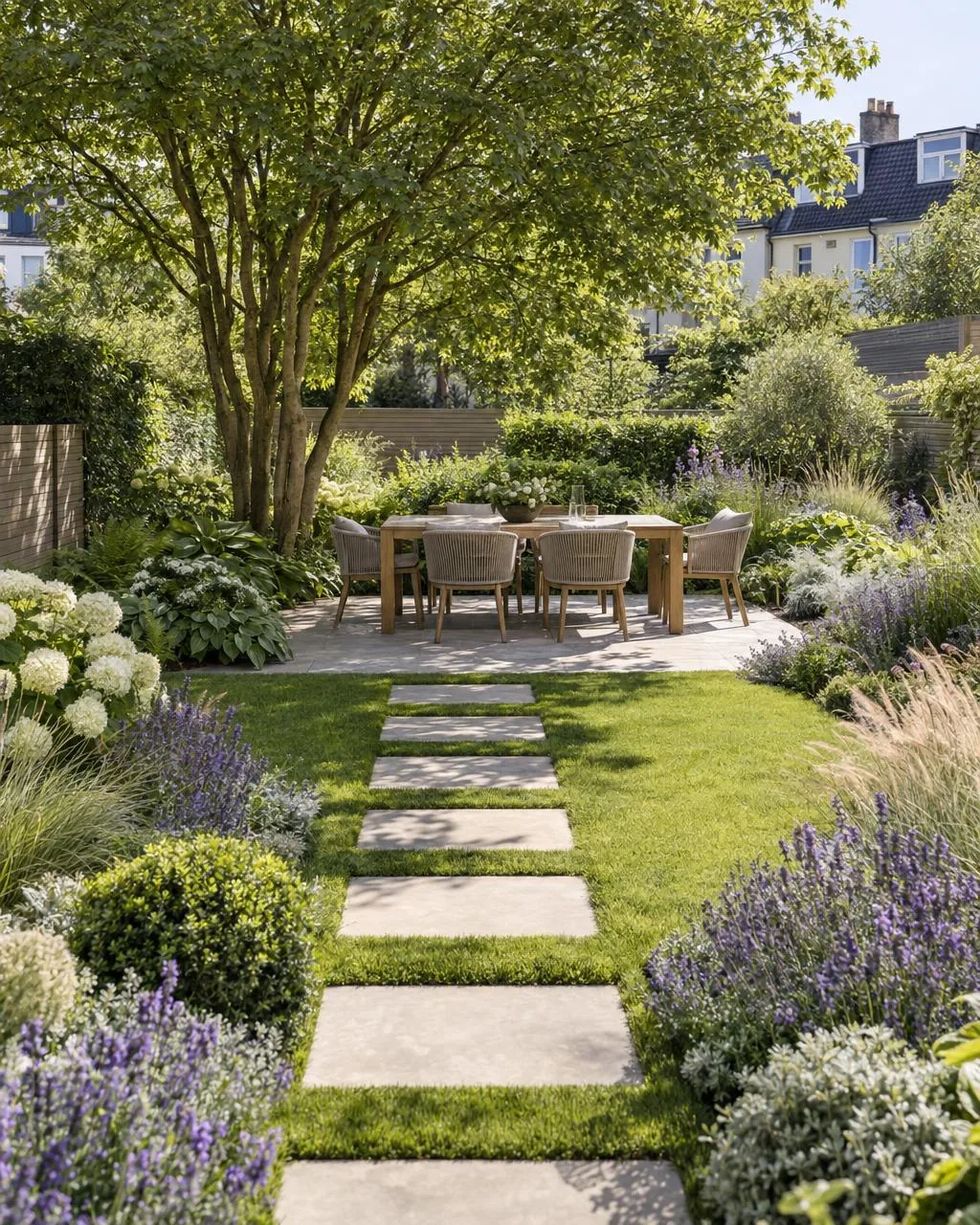
A tree next to the seating area creates a living boundary to the space. Its crown frames the view, and the mood changes with the seasons. Plan for the eventual crown size and enough root space from the start. A young tree gives little shade at first; a parasol can bridge the wait.
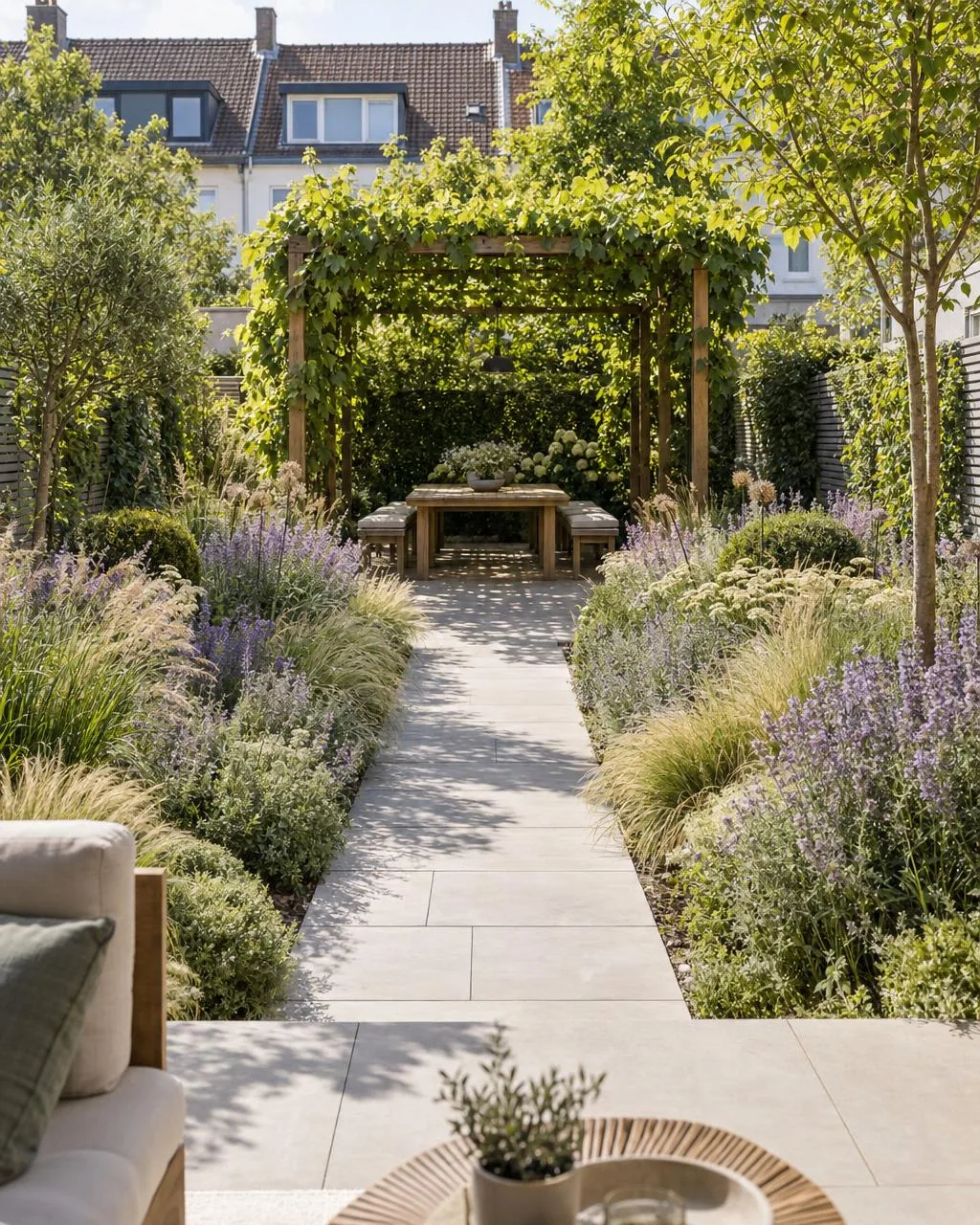
A planted pergola gives the seating area a clear form. It can look particularly good when timber, climbing plants and an adjoining bed are planned together. It does take time, though, until the plants form a dense roof. Types and plant choices are explained in our article on the garden pergola.
A second, small seating area is the simplest solution if there is already shade elsewhere. Not everything has to happen on the main patio. A bench by a side bed may suit afternoon coffee better than the big lounge by the house.
NABU, the German nature conservation union, counts trees and planting among the measures for a climate-ready garden (in German). Our design suggestion: treat the shady spot as the centrepiece of a garden area.
Works especially well: for sunny patios and gardens with large paved areas. If your garden is already dark, keep the light areas you have.
Your first step: Photograph your preferred spot on a sunny day in the morning, at midday and in the late afternoon. That shows you when, and from which direction, shade is missing.
3. Rainwater becomes part of the garden design
A rain chain next to the patio. A narrow channel in the paving. A planted area where water is allowed to collect for a while. Rain can become visible in the garden and give it an extra quality.
The design idea: collect water, guide it sensibly and arrange suitable plants around it.
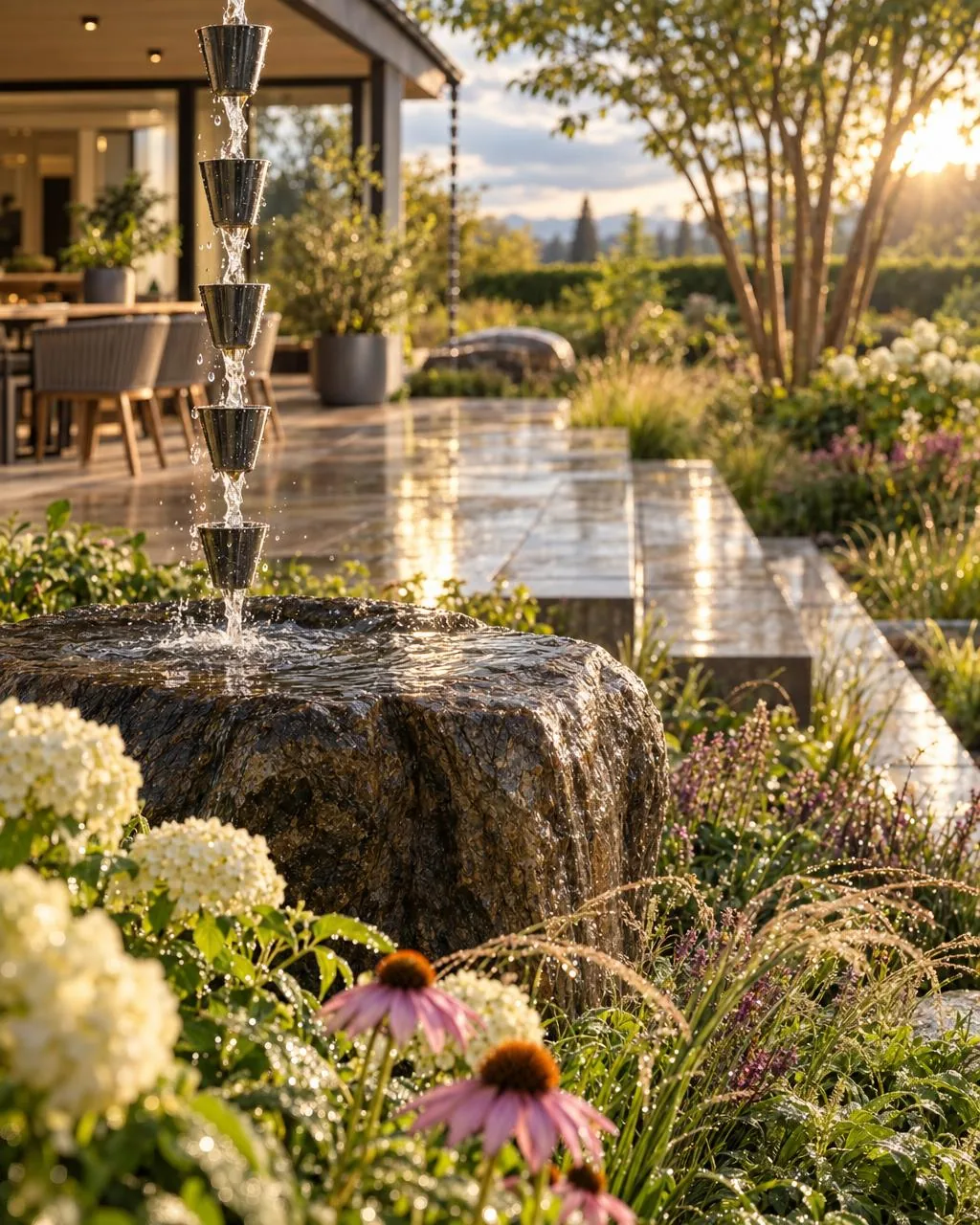
Start with the path the water takes
First ask yourself: Where does the rainwater arrive? Where could you store it? And where does it flow when the store is full?
Even a small roof delivers a tangible amount: 10 millimetres of rain on 40 square metres of roof add up to 400 litres of water on paper. In practice, less reaches the store because of losses and the particular system. The calculation still helps you grasp the order of magnitude.
For a small garden, a closed rainwater tank at the downpipe can be the right way in. In a larger redesign, cistern, irrigation and paved areas can be planned together.
A planted infiltration swale is another option if the soil, space and drainage are suitable. It doesn't simply go into the nearest corner: water must not endanger buildings or neighbouring plots. Connection, overflow and local rules should be clarified with a professional before you change anything at the downpipe.
Important for the picture: A rain chain does not replace a water store. A decorative water basin does not automatically do the job of an infiltration swale. What matters is where the water actually ends up.
Works especially well: if you want to use roof water for watering or are changing the patio and paths anyway. On poorly draining soil, a swale without professional assessment is not a good solution. Water stores must be securely closed so children cannot get in.
Your first step: Find an easily accessible downpipe and a possible spot for a tank. Plan the overflow at the same time. Further advice is available from the German Environment Agency on rainwater use (in German).
4. Nature-friendly, but with a clear form
You like flowers, bees and lively beds, but don't want a garden that looks random? You can have both.
A straight path, a cleanly drawn bed edge or a simple seat can hold a varied planting together. The garden gets a recognisable framework, while the plants within it are free to develop.
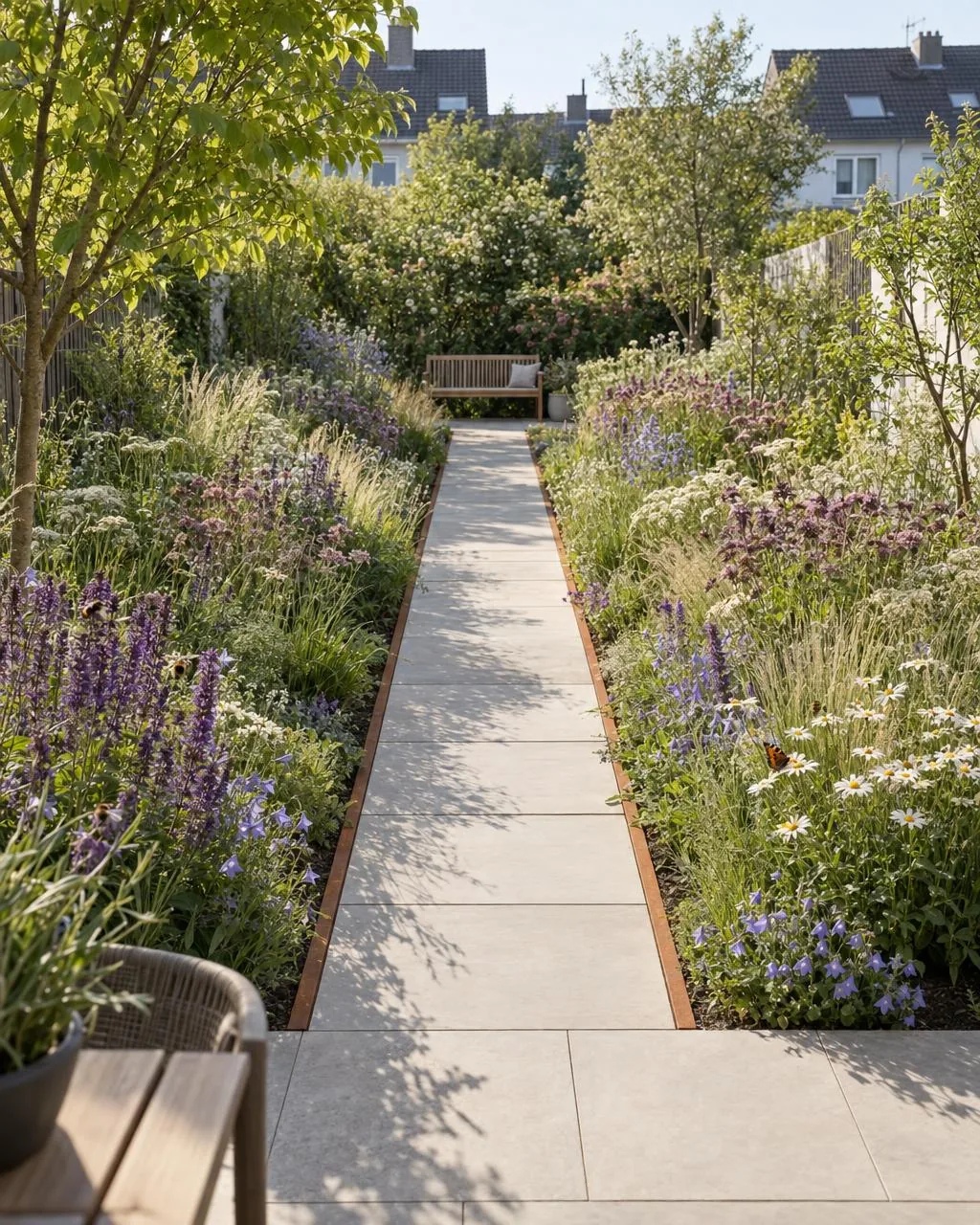
How the combination works
Start with a line you can see clearly from the house: the edge of the patio, a path or the edge of the lawn. Behind it, set plants of several heights. Recurring groups make the variety belong together.
For wildlife, what counts are the actual plants and habitats. A planting with ornamental grasses can look natural; native wild plants also provide food for specialised species. Depending on the site, suitable examples in Germany are meadow clary, oxeye daisy and spreading bellflower. For shrubs, consider cornelian cherry, dog rose or hawthorn; mind their eventual size. NABU's list of native plants (in German) offers guidance.
Herbs or berries can have a place too: chives along a sunny path or a berry bush near the seating area can combine ornamental value and harvest.
In autumn, selected seed heads stay standing and leaves may lie under the shrubs. That way the garden keeps its structure and offers shelter.
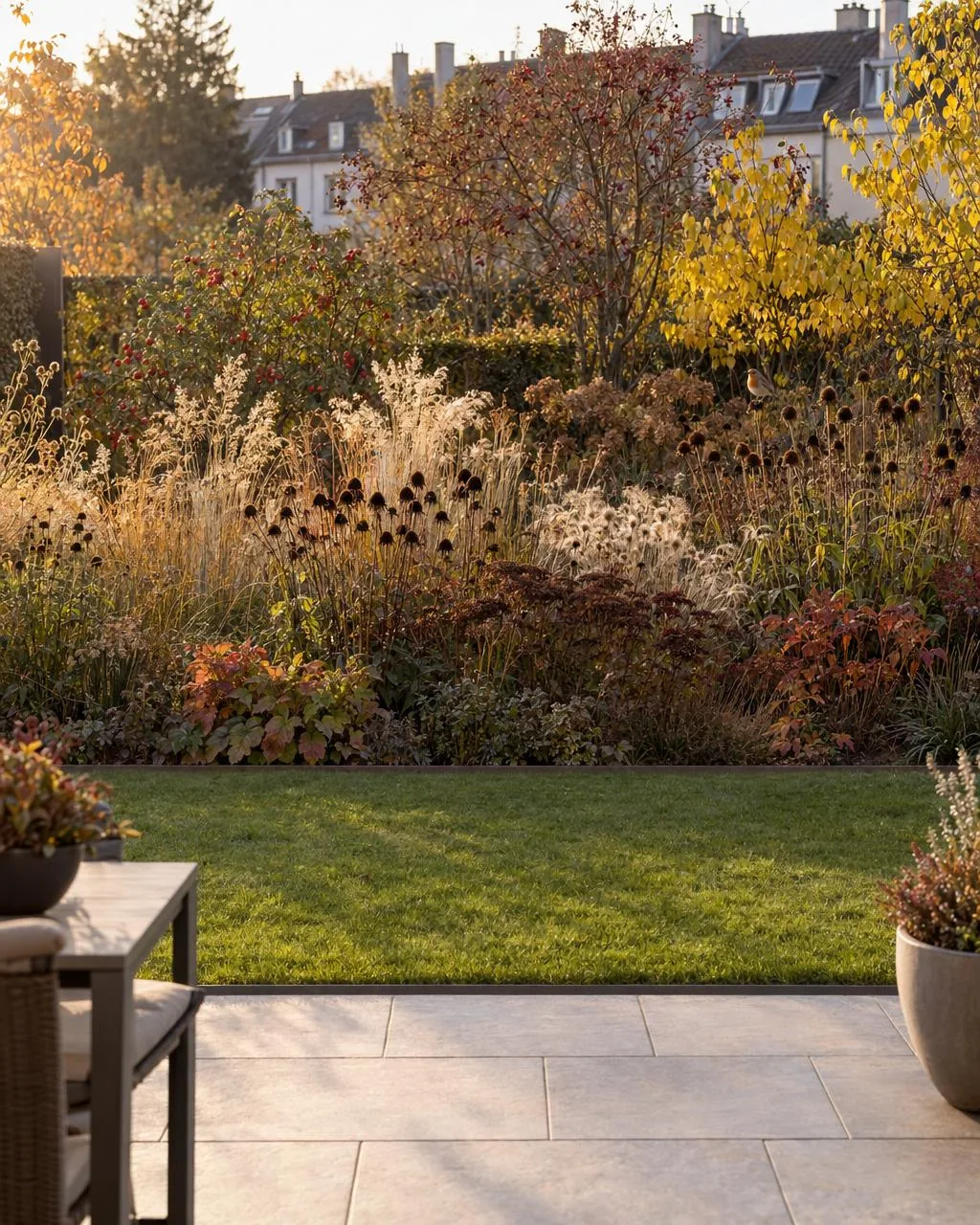
Works especially well: if you want to make a modern garden more lively. In narrow gardens a wide, freely growing wild hedge is often too big; individual suitable shrubs or perennial beds can be used more precisely.
Your first step: Make one clearly defined area more natural. That lets you see which plants and which kind of garden care suit you.
More on creating such a garden and the actual work involved: Low-maintenance natural garden.
5. Garden rooms for the evening
A large garden can offer surprisingly little reason to linger. A small corner with a comfortable chair, a nice view and some privacy, on the other hand, can be used every evening.
Our idea for 2027: plan garden areas around the moments you want to experience there. Breakfast in the sun, reading in the shade, dinner with friends: these usually make location and furnishing much clearer than a furniture wish list.
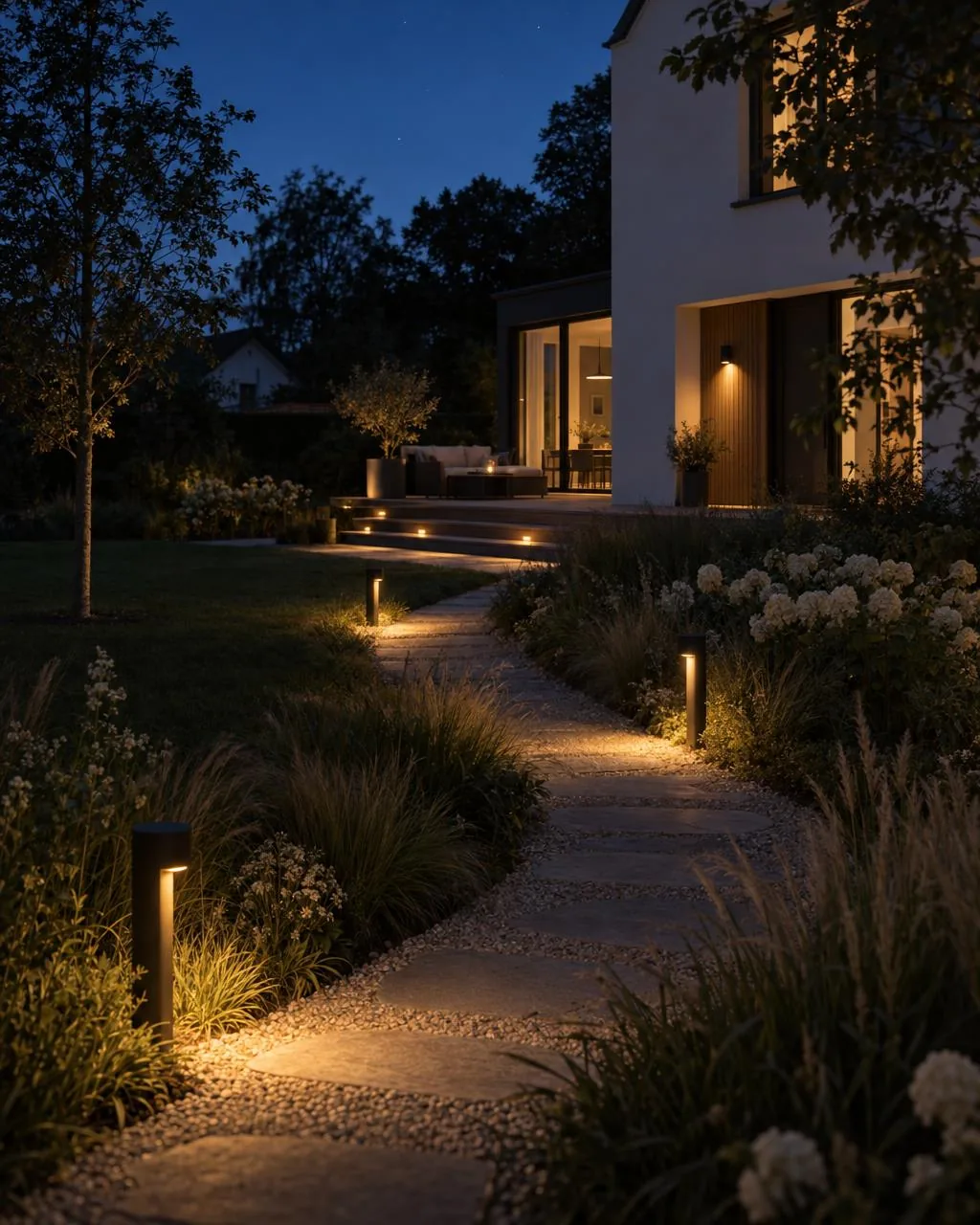
A garden room doesn't always need a new patio
You can frame an existing spot with planting at the side, turn a bench towards a nicer view or put a small table in the evening sun. Make sure the spot is easy to reach and there is enough room to use the chairs comfortably.
For the evening, targeted lighting is enough: orientation on paths and steps, pleasant light at the seating area, dark retreats in between. Warm, shielded light and limited operating times help avoid unnecessary brightening. Background is provided by the German Federal Agency for Nature Conservation's guide to outdoor lighting (in German).
The garden as an additional living space is one of the developments described for 2026 by the Cologne trade fair spoga+gafa. For 2027 we apply this to how the garden is divided up: first think about where a good place to linger could be created.
Works especially well: if your garden so far consists mainly of a patio and a large leftover area. In very small gardens, one flexible spot often does several jobs; extra seating areas there would only feel cramped.
Your first step: Move two chairs you already have to a different spot as a test. Use it for a few days before you plan new paving.
More on this: Planning a patio and Garden lighting.
One garden, three directions: what changes the effect?
How much a garden can change is shown by these three visualisations from the same GardenPilot project. The starting image, also an AI visualisation, shows an overgrown plot between houses. Each variant sets a different focus.
Quiet retreat
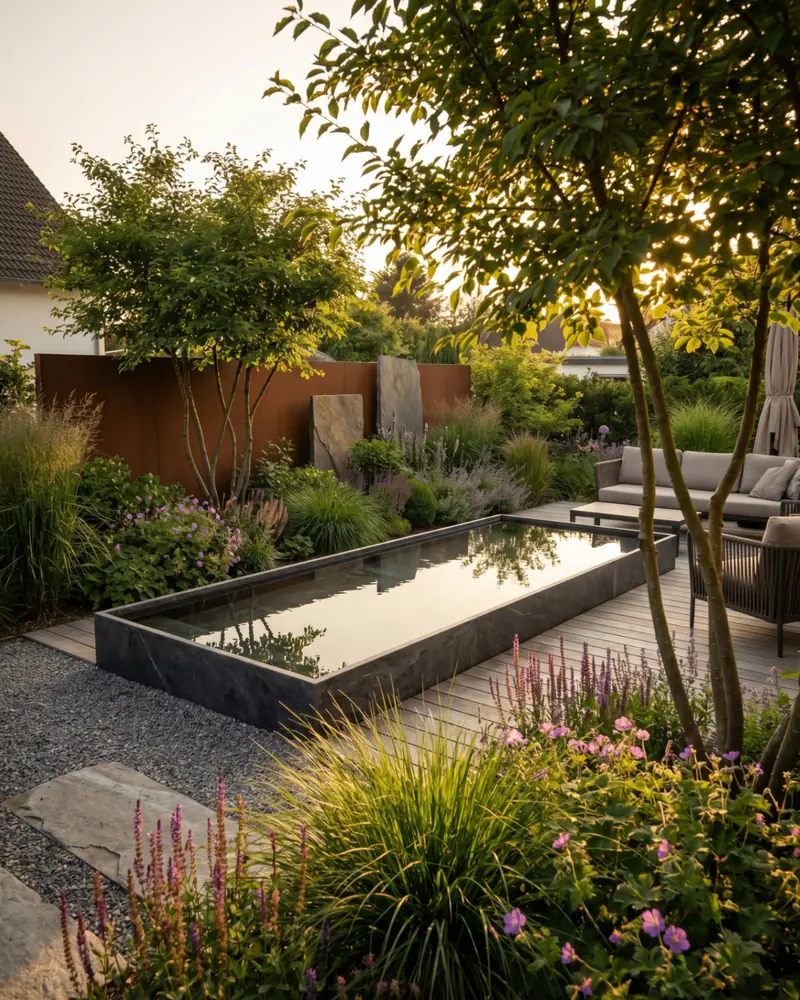
Here the question in the foreground is: Where do I want to unwind? A water basin can be a design focal point for this. In this visualisation it is not a proven system for using rainwater.
Open centre with a green frame
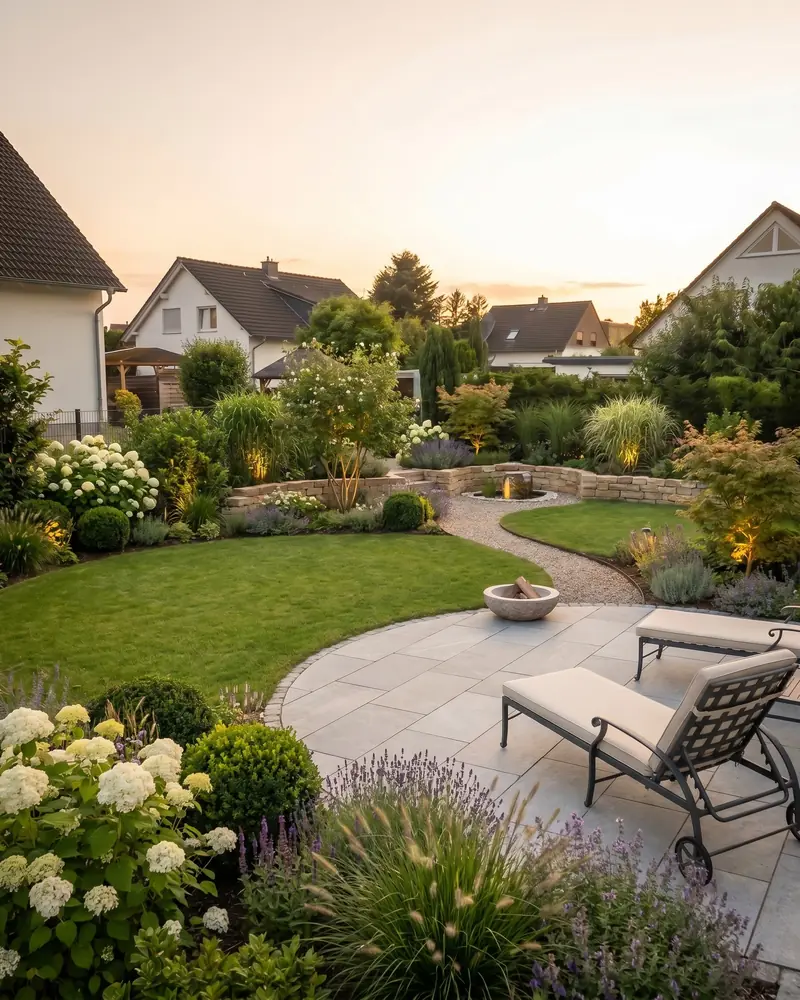
This direction works as a starting idea if you want to keep an open area. The shape of the centre brings order to the whole design.
Lush path through the garden
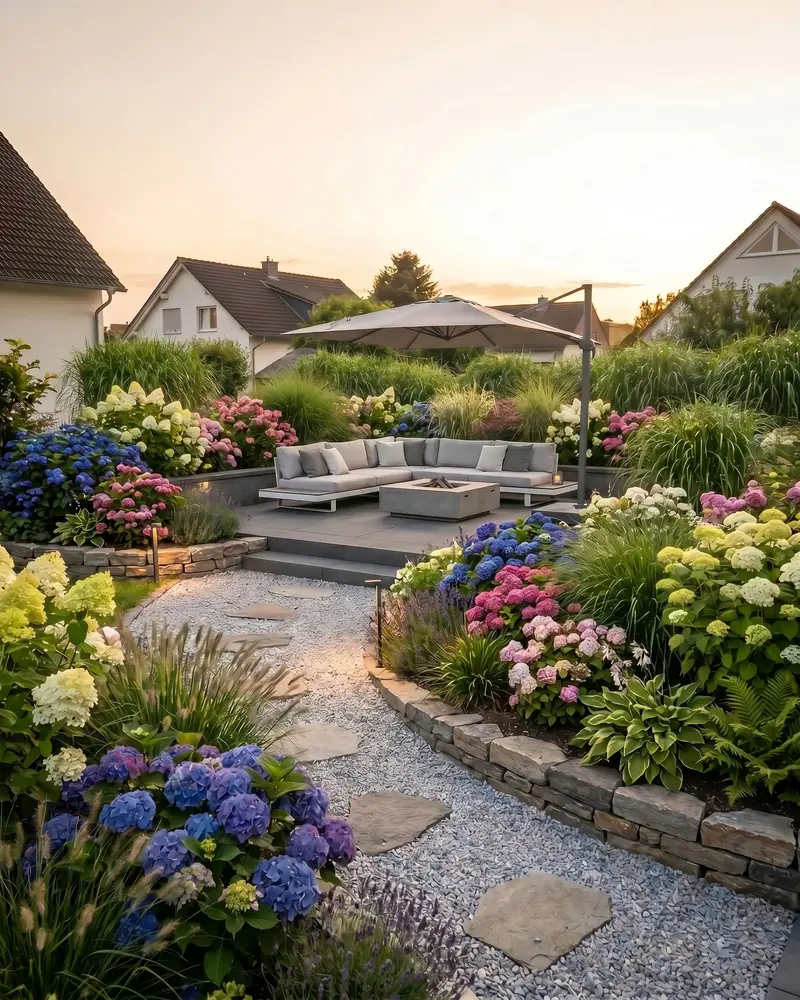
Here the greenery gets more space. Whether the plants shown suit your site has to be checked afterwards. A lush look alone says nothing about water needs or ecological value.
Which direction would you rather see every day? That decision is a good start for your own planning. With GardenPilot you can try out design ideas on a photo of your garden. You start with a free test project, no payment details required.
Show me the possibilities for my garden →
What German market data reveals about garden trends
The figures provide context for our selection. They do, however, cover different years and markets:
| Market and period | Change in sales | What it tells you |
|---|---|---|
| Perennials in Germany, 2024 | +19 % | The plant segment grew markedly. A specific boom in drought-tolerant species is not proven by this. |
| German garden market overall, 2025 | −0.6 % to around €19.7 billion | The industry as a whole declined slightly. |
| Garden equipment in German DIY and garden stores, 2025 | +0.6 % | This range grew slightly in the sales channel covered. |
Sources (in German): ZVG/AMI on 2024, IVG on 2025, BHB/GfK on 2025, presentation page 14.
Changes in sales are not unit numbers and not a vote on garden styles. The more recent indication of concrete needs comes from the German study of October 2026: interest in adapting is widespread, but so far only a minority have acted on it. That suggests a sensible approach for your planning: choose the change that will noticeably improve your garden.
Which garden trend suits you?
| If this bothers you … | … start here |
|---|---|
| "I water all the time and the bed still looks tired." | Check plant choice and soil; trend 1 |
| "I can't stand being on the patio at midday." | Plan shade and the position of the seating area; trend 2 |
| "I'd like to use roof water for watering." | Plan the store and overflow; trend 3 |
| "My garden is tidy but rather lifeless." | Plant one clearly defined area more diversely; trend 4 |
| "I actually always sit right by the patio door." | Try out another place to sit; trend 5 |
Pick one main goal first. A coherent garden comes about when the decisions fit together: plants to the site, shade to the seating area and paths to the places you really use.
Frequently asked questions about garden trends 2027
What are the garden trends for 2027?
Our selection covers five directions: drought-tolerant flowering beds, shady seating areas, rainwater use as part of the design, nature-friendly planting with a clear form, and deliberately planned garden rooms. They are based on German publications from 2025 and 2026 and horticultural sources. The selection for 2027 is an editorial assessment.
Which garden trends suit small gardens?
A continuous bed, a suitably shaded seating area and a closed rainwater tank can all be planned in a small space too. The key is to combine functions. A seating area with planting at the side can be a retreat, a focal point and a spatial boundary at the same time.
Which plants need little water in a sunny garden?
For sunny, well-drained sites, woodland sage, catmint, tall sedums and suitable yarrows, for example, are worth considering. The choice must suit the soil and winter conditions. While they establish, drought-tolerant plants also need regular checks and water if necessary.
Are gravel and stone gardens still in style?
Gravel can be part of a planted design as path material or as a suitable mineral mulch. What matters are site, plant choice and use. A large, largely unplanted stone surface does not meet the goals described here of more greenery and a nicer place to spend time. In several German states, pure stone gardens are no longer permitted anyway, for example in Baden-Württemberg, Hesse and North Rhine-Westphalia. If you want to change existing stone areas, you may be able to reuse the stones for a suitable path. Our article on the nature-inspired front garden shows how.
Which garden trend can I try out cheaply?
An existing chair in a better spot costs nothing at first. A changed bed edge or redesigning a small strip of lawn can also be started on a manageable scale. Trees, pergolas and drainage changes, on the other hand, need more careful planning and their own budget.
Do I have to redesign my whole garden for 2027?
No. Start with the area whose change will make the biggest difference to your everyday life. A usable shady spot or a bed planted to suit its site can matter more than a complete overhaul. You can first try out how the idea might look on a photo of your own garden.
Sources and context
The market data and studies describe Germany. The application to garden design in 2027 and the design examples come from the GardenPilot editorial team. This is a selection of relevant developments, not a ranking of measured growth trends. Sources are in German unless stated otherwise.
- ZVG/BVE/Wir sind Garten, 1 October 2026: Studie: Klimaanpassung wird zum Gartenthema. Public summary of the commissioned study carried out by INNOFACT; the full study report is not freely available.
- Industrieverband Garten, February 2026: IVG Medientag Garten: Marktzahlen 2025.
- BHB/GfK, 3 March 2026: Annual press conference 2026, page 14: German sales by product range in 2025.
- ZVG/AMI, 27 January 2025: Preisentwicklung lässt Markt wachsen, data year 2024.
- Koelnmesse: Garden Living Trends 2026 (in English). A trade-fair view of design and products, not a consumer survey.
- LWG Bavaria: Veitshöchheim perennial mixes for sunny sites and climate-resilient urban greenery.
- NABU: 10 ideas for climate adaptation in the garden and native plants for insects and birds.
- German Environment Agency, 11 July 2025: Tips for sustainable rainwater use.
- German Federal Agency for Nature Conservation: Guide to redesigning and retrofitting outdoor lighting, BfN-Skripten 543.
What would this look like in your garden?
Upload a photo of your garden and see design ideas on your own space. The first image is free.
Start free with your photoMore articles from Garden Planning & Costs
The Garden in Autumn: What to Do Now – and Why Now Is the Time to Plan for Spring
Leaves, hedges, planting time: which garden jobs really matter in autumn, what you can leave standing – and why autumn is a good moment to plan your garden makeover for spring.
Creating a Garden for a New Build: The Checklist for Home Builders
Topsoil, levels, conduits, rainwater: what to clarify for the garden while the excavators are still on site at your new build.
New-Build Garden: 9 Ideas for the Garden at Your New House
No old tree, neighbours close by, large windows, compacted soil: nine design ideas for the typical starting points of a new-build garden.