
If you remodel an existing garden, you do not only pay for what is new. First the old has to go: slabs, remains of walls, shrubs, sometimes a tree. That costs labour and disposal fees. In return, a lot can stay that would have to be bought for a new garden. This article shows how to work out the costs specific to remodelling an existing garden: demolition and disposal, what you save by keeping things, how to budget in phases and how large your contingency should be. The prices for individual surfaces such as paving, lawn and beds are in the article How much does garden design cost?. The order in which to remodel is explained in Redesigning your garden: step by step. Fees and rules refer to Germany.
At a glance
- Demolition and disposal are a cost block of their own. In the example below, cleanly separated rubble costs a third of mixed waste at the recycling centre.
- What stays saves twice: it does not have to be demolished and does not have to be bought new. In Germany you must preserve excavated topsoil anyway.
- A tree can cost more than the felling. Depending on the municipality, a permit, a fee and replacement planting may be added.
- Phases work if the whole garden is planned. But each phase has its own travel and its own machinery.
- Work out the contingency from the open questions, not as a flat percentage.
- In Germany, in an existing household you can deduct 20% of the labour costs from your tax, up to €1,200 a year.
What is different from creating a new garden
For a new garden on open ground, a firm calculates areas: so many square metres of terrace, so many square metres of lawn. When remodelling, three things are added that appear in no per-square-metre table.
Removal. Old paving, sub-base, edging, walls, foundations, root stumps: everything that is to go has to be lifted, loaded and hauled away. That is mainly labour time.
Disposal. The recycling centre or waste contractor charges a separate fee for each material. How high it is depends heavily on how cleanly the materials are separated (next section).
Working around what stays. Where a tree is to stay, no machines may drive and no materials may be stored in the root zone. Under the German standard for protecting trees on construction sites (DIN 18920), the root zone is the area under the crown plus 1.50 metres. Work there is done by hand. Hedges, walls or a garden shed that stay can also block the way for a digger and wheelbarrow.
On top of that, you cannot see into an old garden. What lies under slabs and lawn often only shows up when digging. That is why every remodel needs a contingency.
Demolition and disposal: how to calculate
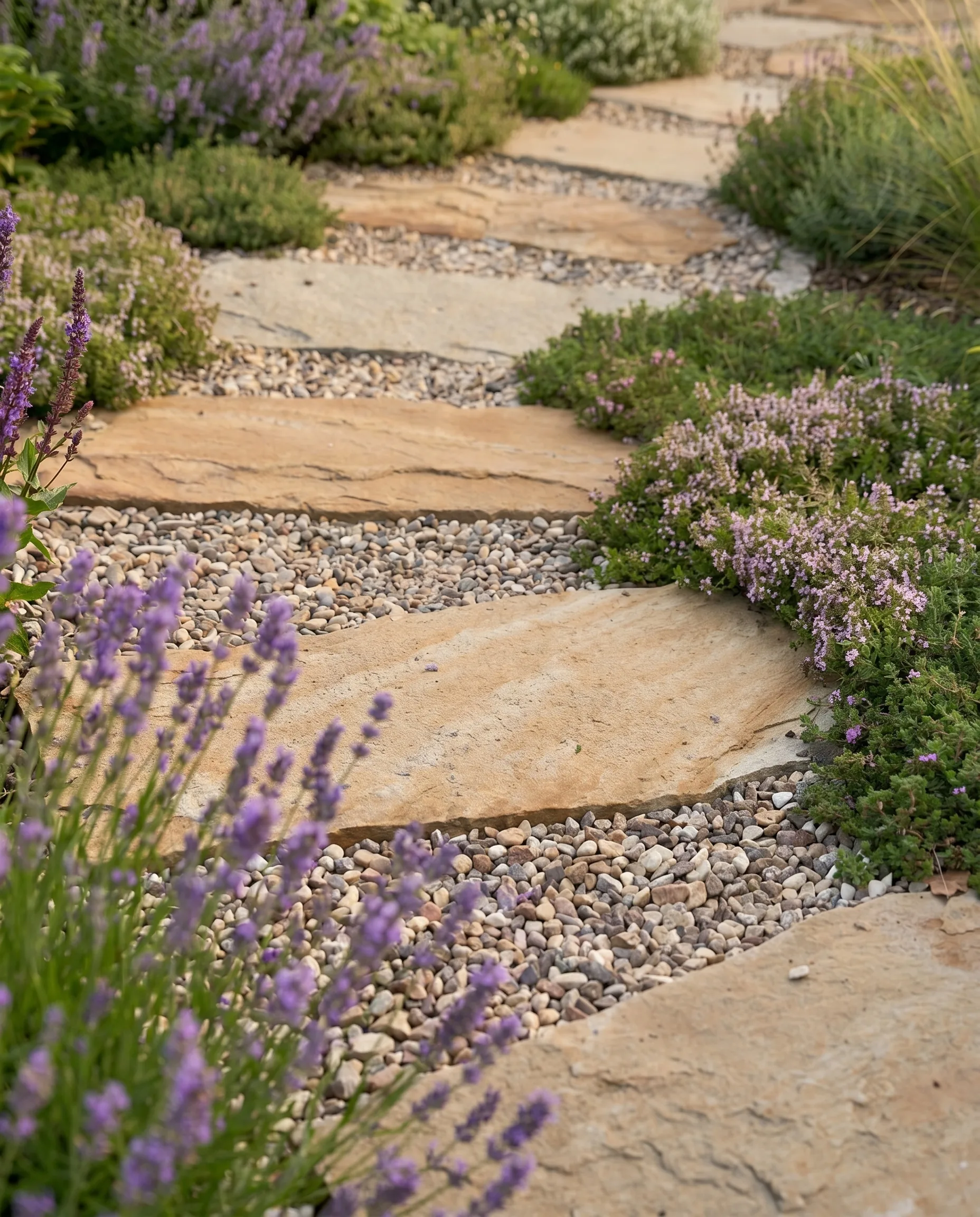
What disposal costs is set by your recycling centre or waste contractor in its fee schedule. As an example, here is the fee schedule of the recycling centres of the Südbrandenburgischer Abfallzweckverband (SBAZV), a waste management association in Brandenburg, valid since 1 January 2025. It shows well what matters:
| Material | Fee |
|---|---|
| Rubble, clean, edges up to 30 cm | €63/t |
| Soil and stones, clean | €63/t |
| Rubble with impurities or larger than 30 cm | €78/t |
| Mixed construction and demolition waste | €195/t |
| Building materials containing asbestos | €200/t |
| Bitumen and tar-containing products | €500/t |
| Green waste | €20/m³ (up to 1 m³), above that €10 per started half m³ |
Source: SBAZV, fee schedule for the recycling centres, valid from 1 Jan 2025, Annex 1 (in German). Small private loads up to 1 m³ are charged by volume there. Other facilities charge different prices.
An example: an old terrace of concrete slabs, 25 m², the slabs 40 × 40 cm and 5 cm thick. That is 1.25 m³ of concrete. Normal concrete weighs about 2.4 tonnes per cubic metre, so the slabs weigh about 3 tonnes.
- Whole slabs, clean: they are larger than 30 cm and therefore fall into the €78/t class at the SBAZV. That is about €234.
- Broken to 30 cm or less, clean: €63/t, about €189.
- Mixed with soil, membrane, wood and roots: as mixed construction and demolition waste they cost €195/t, about €585.
So the same pile of concrete costs up to three times as much, depending on how it is separated. On top come the sub-base of crushed stone and grit if it cannot stay, transport and labour. The fee can be the smaller part: in Commerzbank's worked example for a 30 m² driveway, excavation costs €360 and disposal €96 (as of 8 Jan 2025). If a firm takes care of disposal, ask whether it is a separate line in the quote and how materials are separated.
Be careful with old fibre cement panels. Since 1993, the manufacture and use of asbestos has been banned in Germany. Older corrugated sheets, for example on a garden shed, facade panels or plant containers made of fibre cement may contain asbestos. The environmental office of the city of Nuremberg strongly advises against removing such parts yourself. Do not break or saw them; ask your waste contractor or a specialist firm. Disposal is also more expensive: at the SBAZV, building materials containing asbestos cost €200/t and must be delivered in dust-tight packaging. Bitumen- or tar-containing waste such as old roofing felt is even more expensive at €500/t.
Green waste is comparatively cheap but takes up a lot of space. Four cubic metres of shrubs cost €80 at the SBAZV. Root stumps are dug out or ground out. The firm charges for that by effort.
What stays saves money
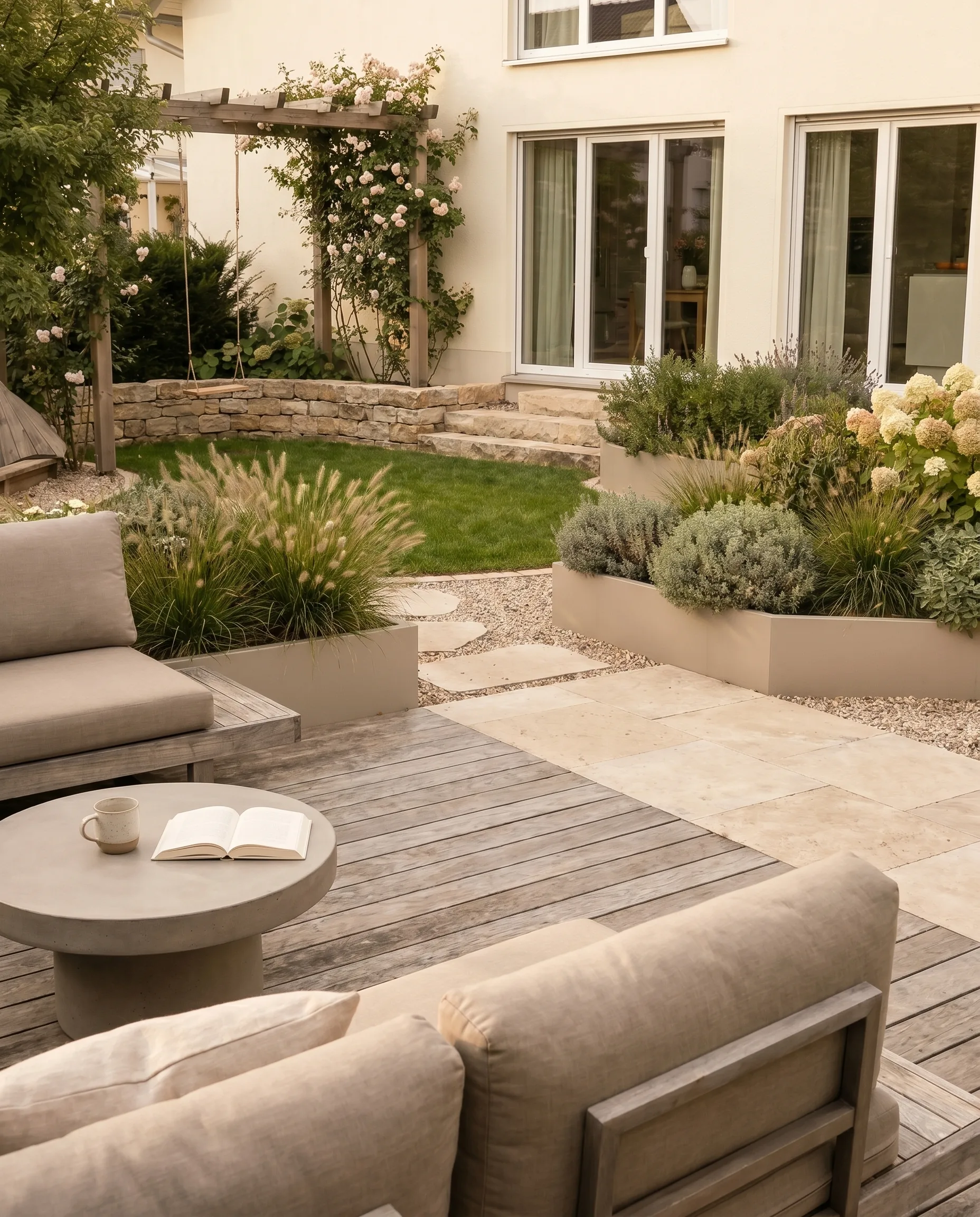
Everything that can stay saves twice. It does not have to be demolished and disposed of, and it does not have to be bought and built new. Before you have anything demolished, it is worth taking a second look at these parts:
- Topsoil. Where the top, humus-rich layer of soil is excavated, the German Building Code requires it to be preserved in usable condition anyway (§ 202 BauGB). Store it separately and spread it again later. New topsoil costs €8 to €15 per square metre, delivered and spread, according to the portal Clean Invoice (as of 5 Mar 2026). For 60 m² of beds and lawn, that is €480 to €900 you do not have to spend.
- Walls, steps and stairs. An intact natural stone wall or solid steps can often be built into a new plan. Whether they are stable is for a specialist firm to judge.
- Sub-base. Under an old terrace there is usually a sub-base of crushed stone and grit. If it is load-bearing and the height and fall are right, new paving can be laid on it. A specialist firm has to check this on site. If it works, excavation, disposal and a new sub-base are no longer needed.
- Slabs and stones. Well-preserved natural stone slabs or clinker bricks can be relaid elsewhere, for example as stepping stones or bed edging.
- Trees and shrubs. A large, healthy tree or a dense hedge takes years to grow back. According to Clean Invoice, a new tree costs €200 to €1,500, and it will still be far from the size of the old one.
If a tree does have to go. Many German municipalities protect trees above a certain trunk girth with a tree protection bylaw. Then you need a permit before felling. In Berlin, for example, it costs an administrative fee of €45 to €760, and a refusal is also charged. In addition, the authority can require replacement planting or a compensation payment. Other municipalities have other rules. What you should clarify legally before removing trees and shrubs is covered in Redesigning your garden: step by step.
Budgeting in phases
Many gardens are remodelled over several years. For the budget this means: you plan and cost the whole garden, but at first you only pay for the first part. To keep this from costing more than necessary, three rules help.
Plan the whole garden before you build the first phase. Otherwise the path from the first year will not fit the terrace from the third, and you pay for part of it twice.
Pay first for what can later only be changed by demolishing. That includes fall and drainage, cables, pipes and empty conduits, and the position and sub-base of the terrace and main path. Best lay empty conduits straight away, including for lighting or irrigation that will only come later. Retrofitting them under a finished terrace means lifting the slabs again. What belongs in which phase is explained in the section "Redesigning in stages" in Redesigning your garden: step by step.
Include the fixed costs per phase. Travel, transporting machinery and setting up the site are incurred again for each phase. Some firms list them as a separate item, others include them in the unit prices. Ask, so that you do not compare two phases with an overall quote that contains them only once.
Phases can also help with tax. In Germany, the tax deduction for tradespeople's services is capped at €1,200 a year (see below). It applies to the year in which you pay (§ 11(2) EStG). If you spread the work over two years, you can use the cap twice. Whether this pays off in your case is best clarified with your tax adviser.
How large the contingency should be
For construction projects, flat percentage rules of thumb are in circulation. For garden remodels we have not found a reliable source for any particular percentage. Rather than a flat rate, it is better to derive the contingency from the questions that are open before work starts. For each open question, work out what the unfavourable case costs:
| Open question | Unfavourable case | Extra cost |
|---|---|---|
| What lies under the beds? | 30 m² with 20 cm of rubble instead of soil | €330–630 |
| Can the terrace sub-base stay? | rebuild 25 m² | €625–1,250 |
| Does a tree need a felling permit? | fee as in Berlin | €45–760, plus replacement |
| Are old panels made of fibre cement? | professional removal | per quote |
Rubble: dig out and dispose of 6 m³ at €15–30/m³ plus 30 m² of topsoil at €8–15/m² (Clean Invoice, 5 Mar 2026). Sub-base: excavation and disposal €15–25/m² plus crushed stone €10–25/m² (Commerzbank, 8 Jan 2025). Fee: service.berlin.de, accessed 14 Oct 2026.
In this example that adds up to roughly €1,000 to €2,600 plus the items that can only be priced with a quote. Set this amount aside. If it is not needed, it is there for the next phase.
Incidentally, a firm's cost estimate is not a fixed price. Under German law, if it becomes apparent that it will be exceeded substantially, the firm must tell you without delay (§ 649 BGB). You can then decide whether to continue or terminate. If you terminate, you pay for the work done so far and the expenses (§ 645 BGB).
Tax: tradespeople's services in an existing household
In Germany, for work at a house you already live in, you can deduct 20% of the labour costs directly from your income tax, up to €1,200 a year (§ 35a(3) EStG). You reach this cap with €6,000 of labour costs in a year.
- What counts: labour costs, plus machine and travel costs if they are on the invoice.
- What does not count: materials, i.e. slabs, plants, crushed stone or soil.
- What you need: an invoice and a bank transfer to the firm's account. Cash payment is not enough (§ 35a(5) EStG). Ask the firm to show labour and material costs separately on the invoice.
- Remodel or new build: the Federal Fiscal Court ruled that earthworks and planting in an existing household are eligible, even if the garden is laid out completely new (BFH, judgment of 13 Jul 2011, VI R 61/10). According to the tax authorities, laying out a garden for the first time as part of a new build does not count.
This is an overview, not tax advice. In individual cases, the tax office decides.
Where GardenPilot helps – and where it doesn't
When remodelling an existing garden, the most expensive decision is often what should go. GardenPilot can help you make that decision before anything is demolished. You upload a photo of your garden and see design ideas from the same angle, with your house and what is already there. The first image is free. Further variants, for example one with more lawn and one with more beds, cost one credit each. The images are visualisations, not construction plans, and GardenPilot does not put a figure on demolition or disposal costs. How it works and what it costs is covered in the article AI garden design with a photo.
What should stay, what should go? Upload a photo of your garden and compare variants before you have anything demolished. The first image is free. Start free with your photo
Frequently asked questions
How much does it cost to redesign a garden?
That depends on how much is built new and how much is demolished. For a 200 m² garden with a new terrace, new lawn and new beds, our worked example in the article How much does garden design cost? arrives at roughly €7,400 to €11,800. Remodelling adds removal, disposal and a contingency for surprises in the ground.
How much does it cost to dispose of an old terrace?
For 25 m² of concrete slabs weighing about 3 tonnes, the SBAZV charges about €190 to €590, depending on how they are separated. On top come labour, transport and, if needed, the sub-base.
Is it worth keeping parts of the old garden?
Often yes, because then you neither have to demolish nor buy new. This applies especially to topsoil, healthy trees, intact walls and a load-bearing terrace sub-base. Whether a wall or sub-base can really stay is checked on site by a specialist firm.
Can I deduct a garden remodel from my taxes?
In Germany, in an existing household, yes: 20% of the labour costs, up to €1,200 a year (§ 35a EStG). Materials do not count, and you must have paid by bank transfer.
Further reading
What would this look like in your garden?
Upload a photo of your garden and see design ideas on your own space. The first image is free.
Start free with your photoMore articles from Garden Planning & Costs
Garden Trends 2027: 5 Ideas from Germany for a Better Garden
A garden that works in summer and feels great after work: these five ideas combine design with what garden owners in Germany need right now.
The Garden in Autumn: What to Do Now – and Why Now Is the Time to Plan for Spring
Leaves, hedges, planting time: which garden jobs really matter in autumn, what you can leave standing – and why autumn is a good moment to plan your garden makeover for spring.
Creating a Garden for a New Build: The Checklist for Home Builders
Topsoil, levels, conduits, rainwater: what to clarify for the garden while the excavators are still on site at your new build.