Redesign Your Garden in 2025: AI Planning & DIY Execution (Examples & Costs)
Many gardens feel underused despite having great bones: patios that are too small, unclear pathways, or neglected beds. A targeted redesign can reorganize what’s already there and noticeably improve everyday life in your garden. GardenPilot supports you with fast AI analysis, clear DIY execution plans, and transparent cost overviews.
What to expect in this article:
- Analysis – Where are the biggest opportunities and problems?
- Concrete steps – Which measures are truly worth it?
- Costs – Realistic price ranges per module.
“Your garden plan in 60 seconds – start the AI analysis now”
When is a garden redesign worth it?
A redesign makes sense when your garden doesn’t match your needs or when its design potential is going to waste. Common reasons include patios that are too small, an unbalanced path layout, lack of structure, unsuitable planting, or a space that simply isn’t pleasant to spend time in. GardenPilot detects these patterns automatically in your photo and delivers a clear action plan.
Typical reasons to redesign:
- missing or undersized seating areas
- materials look dated or visually busy
- high maintenance burden
- no clear paths or functional zones
“Is your garden affected? Upload a photo now and uncover its potential.”
The 7 biggest mistakes (and how GardenPilot saves your DIY project)
Many garden projects don’t fail because of a lack of ideas—but because there’s no structure, the sequence is wrong, or the mix of materials doesn’t work. To make sure that doesn’t happen to you, the overview below shows common mistakes and the corresponding solution that GardenPilot provides through data-driven planning.
| Mistake | How GardenPilot helps |
|---|---|
| Patio too small | AI checks proportions and suggests suitable sizes |
| Missing spatial structure | Zoning & clear sightlines |
| Too many materials | Reduce to 1–2 main materials |
| Plants without a concept | Modular planting plans by style & maintenance level |
| Wrong sequence | Optimal build sequence, step by step |
| No budget | Instant cost estimate per module |
| DIY in the wrong place | DIY suitability per module + execution guide |
"Avoid mistakes – get your photo analyzed & receive a reliable plan"
The transformation in detail: From chaos to a green oasis
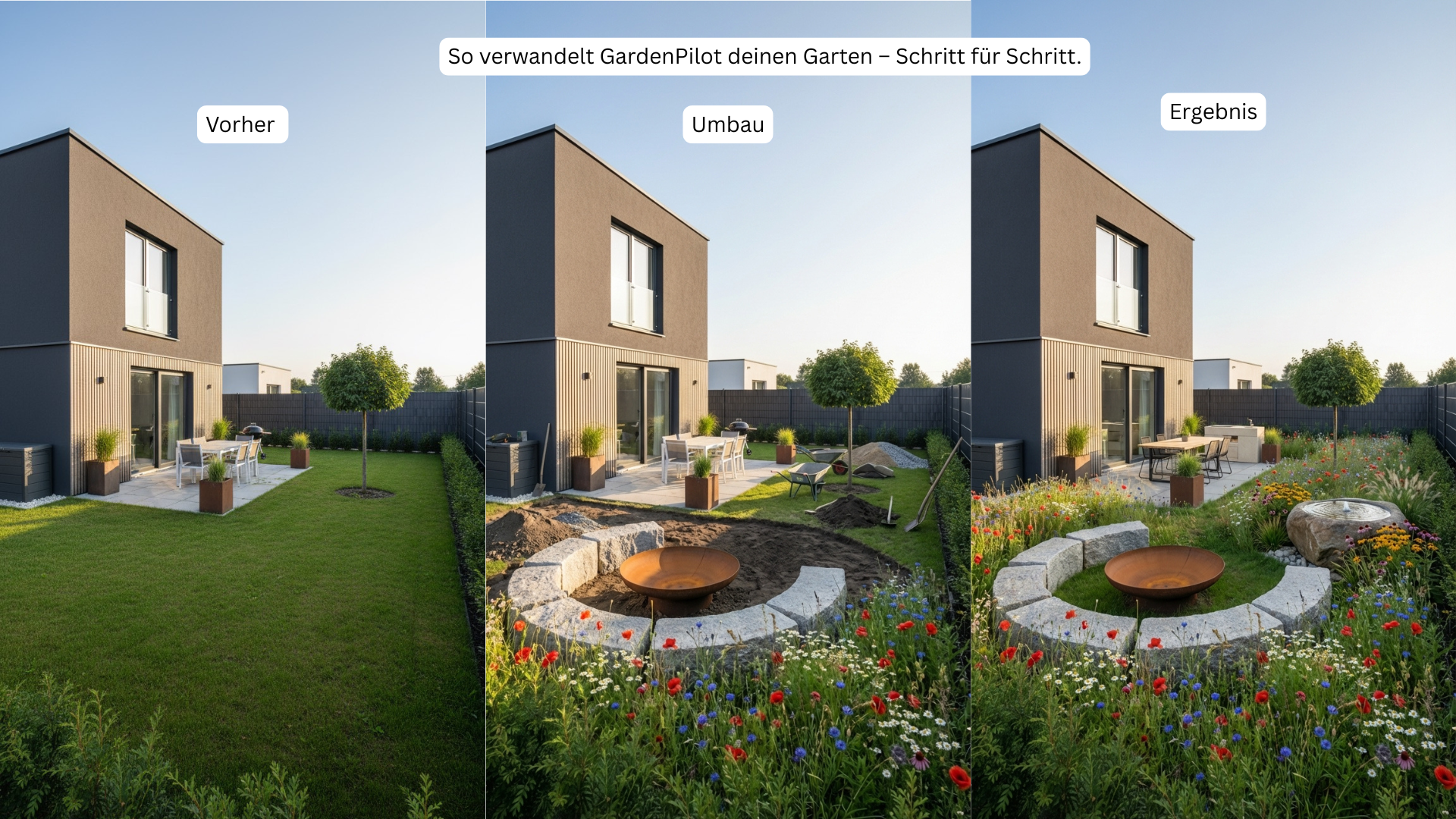
The comparison below shows how GardenPilot transforms this typical narrow terraced-house garden into a professionally designed dream garden.
1. The sad current state: mistakes built in
The starting point visualizes mistakes 1, 3, and 4: an overcrowded, undersized patio; a patchwork of materials (concrete, gravel, wood); and unstructured planting that makes the garden feel tight.

2. The construction phase: create structure, avoid mistakes
This logical intermediate step in the build process shows how the plan becomes reality. The site is cleared, the organic shapes are marked, and the new materials (natural stone slabs) are ready.

3. The final result: functional aesthetics
The final design solves every problem: the patio is large enough, and the organic shape of the perennial beds and the curved path creates depth. The focus on a few, premium materials (natural stone and wood) calms the overall look.
After image: Professionally designed garden in a New German Style with a large natural-stone terrace, a curved lawn path (stepping stones) and a specimen tree (Amelanchier) with a bench as the highlight.
Step by step: how your garden transformation succeeds
Step 1 – Upload a photo & AI analysis
A successful redesign starts with clarity: what already works in your garden—and what’s holding it back? With GardenPilot’s AI analysis, you get a complete overview of existing elements, potential, and risks.
The AI automatically detects:
- existing modules like patio, paths, lawn, privacy screening, beds
- material and color palette
- spatial proportions and functional areas
- problem zones (e.g., illogical paths, chaotic planting, style clashes)
- opportunities for upgrades (larger patio, additional seating areas, new bed spaces)
Mini example analysis
- Before: small patio, unclear paths, unstructured planting
- Identified potential: patio extension + clear zoning
- Risks: too many materials, high maintenance effort
Checklist – what you know after Step 1
- Are the areas clearly identified?
- Where is the biggest potential?
- Which modules make sense?
- Where can you get a big impact with minimal effort?
"Get your garden analyzed – upload a photo and see every opportunity"
Step 2 – Define goals & style
A garden shouldn’t just look good—it should feel right. That’s why a clear target vision is crucial. GardenPilot helps you define use, atmosphere, and maintenance effort realistically.
Define how you’ll use it
- lounge and relaxation zone
- BBQ or dining area
- outdoor kitchen
- play area for children
- space for hosting guests
Set the atmosphere
- modern & pared back
- cozy & warm
- Mediterranean & light
- natural & playful
Determine maintenance level
- low: grasses, hardy perennials, fewer beds
- medium: perennial areas, seasonal highlights
- high: topiary, hedges, demanding planting
GardenPilot style suggestions (automatically recognized)
| Style | Material palette | Plant mix | Effect |
|---|---|---|---|
| Modern | porcelain, concrete, anthracite | grasses, shaped shrubs | clean, calm, premium |
| Mediterranean | natural stone, wood, sandy tones | lavender, olive, grasses | warm, light, vacation feeling |
| Natural garden | wood, gravel, natural stone | perennials, wild plants | lively, ecological |
Checklist – does your target vision fit?
- Which atmosphere do you want to experience every day?
- How much maintenance is realistic?
- Does the style suit your home’s architecture?
- Does your budget align with your goals?
"Show matching style modules – and get a before/after vision"
Step 3 – Choose modules for the redesign
Ideas alone don’t change a garden. Modules—clearly defined building blocks such as patios, paths, or planting areas—create a structure you can follow and deliver real impact.
Key redesign modules
- expand or modernize the patio
- renew the path layout
- structure beds and create new ones
- optimize the lawn (shrink, renew, replace)
- redesign privacy screening
- planting modules (e.g., perennial areas, grass gardens, container islands)
- add lighting and irrigation
Module impact – table
| Module | Effect | Complexity | Cost range |
|---|---|---|---|
| Patio extension | biggest impact area | medium | 2.000–8.000 € |
| New paths | structure & guidance | low–medium | 1.000–4.000 € |
| Bed design | atmosphere & seasonal impact | low (ideal for DIY) | 500–3.000 € |
| Privacy screening | privacy | low–medium | 500–2.500 € |
| Planting modules | defines the style | low (ideal for DIY) | 300–2.000 € |
| Lighting | mood & function | low | 200–1.200 € |
| Irrigation | comfort & less maintenance | medium–high | 800–4.000 € |
Important to know:
A garden becomes visibly better through 1–2 strong modules—not through lots of small details.
GardenPilot recommends modules based on:
- impact
- budget
- DIY potential (incl. instructions)
- stylistic fit
[👉 *“Which modules are worth it for your garden? Have costs & DIY suitability analyzed”](/en/gartenprojekt-starten)
Step 4 – Develop layout & spatial structure
Great design doesn’t start with plants or materials—it starts with a functional layout. Once it’s clear which modules your garden should include, GardenPilot arranges them so your garden feels larger, calmer, and more harmonious.
What GardenPilot analyzes:
- Zoning: Which areas are best for seating, paths, or planting?
- Path routing: Curved or straight? Logical or random?
- Sightlines: Which directions create depth and openness?
- Proportions: Are areas divided sensibly?
- Quiet zones: Where does retreat happen, where is the active area?
Typical problems—and how GardenPilot solves them
| Problem | Effect | AI solution |
|---|---|---|
| Patio too close to the lawn | feels cramped | patio extension + new path routing |
| Paths without a destination | chaotic, restless | clear sightline → paths lead to seating/raised bed |
| Beds without edging | messy | clean lines (steel edging, stone, wood) |
| Too many small areas | garden feels small | combine areas, enlarge zones |
Alt text: “Garden zoning before/after – GardenPilot AI layout proposal”
Checklist – is your layout coherent?
- Is there a main ‘room’ (e.g., the patio)?
- Do paths have a destination?
- Does at least one sightline visually extend the garden?
- Are usage areas sensibly separated?
👉 *“What would your new layout look like? AI proposal in 60 seconds”
Step 5 – Choose materials & plants
Materials and plants define a garden’s atmosphere. They create structure, color, and style. The biggest impact comes when you reduce material variety and use plants with clear intent.
Materials – the foundation of style
GardenPilot automatically detects:
- existing main materials
- color temperature and textures
- style clashes or sources of visual noise
- budget-friendly alternatives
Material recommendations by style
| Style | Materials | Color world | Effect |
|---|---|---|---|
| Modern | porcelain, concrete, WPC | gray, anthracite, beige | clean, premium |
| Mediterranean | natural stone, wood | sand, terracotta, beige | warm, light, vacation effect |
| Natural garden | wood, gravel, natural stone | natural tones | organic, lively |
| Minimalist | large-format slabs | reduced color scheme | clean, architectural |
Plants – structure instead of randomness
A beautiful garden comes from a repeatable system, not impulse purchases.
3-layer principle:
- Structural plants: shaped shrubs, tall grasses → provide framework
- Filler plants: perennials with volume → create density
- Seasonal highlights: color, movement → bring the garden to life
Examples of planting modules from GardenPilot:
- Low maintenance: grasses + hardy perennials
- Mediterranean: lavender, olive, herbs
- Modern-minimalist: grasses, shaped shrubs, monochrome
Checklist – does your materials & planting concept fit?
- Have you chosen max. 1–2 main materials?
- Do the colors suit the house?
- Are structural plants in place?
- Do the plants support your style?
- Is the maintenance effort realistic?
👉 *“Show material & planting modules – incl. shopping list for your DIY execution”
Step 6 – Costs, budget & your personal DIY execution kit
So your redesign doesn’t spiral out of control, you need realistic costs and a clear sequence. GardenPilot calculates all modules automatically and delivers the right instructions.
Typical cost ranges
| Module | Typical costs |
|---|---|
| Patio | 120–250 € / m² |
| Paths | 60–150 € / m² |
| Renew lawn | 8–20 € / m² |
| Planting areas | 40–120 € / m² |
| Privacy screening | 80–200 € / linear meter |
| Irrigation | 800–4.000 € |
(You’ll find detailed costs in Part 4 – the costs chapter.)
DIY or pro? – GardenPilot provides the recommendation
Great for DIY: plants, gravel paths, raised beds, containers – for every DIY-suitable module, GardenPilot gives you step-by-step instructions, including material lists and tool recommendations.
Better left to a pro: base layers, walls, drainage, electrical work, irrigation
Execution order
- Earthworks & foundations
- Paths & patio
- Edging, beds, walls
- Planting
- Lighting & irrigation
If you prefer a professional, fully planned solution instead of doing it yourself, you’ll find a clear guide here:
Have your garden planned – process, costs & what to expect
👉 *“Calculate costs & execution for your garden – start the AI analysis now”
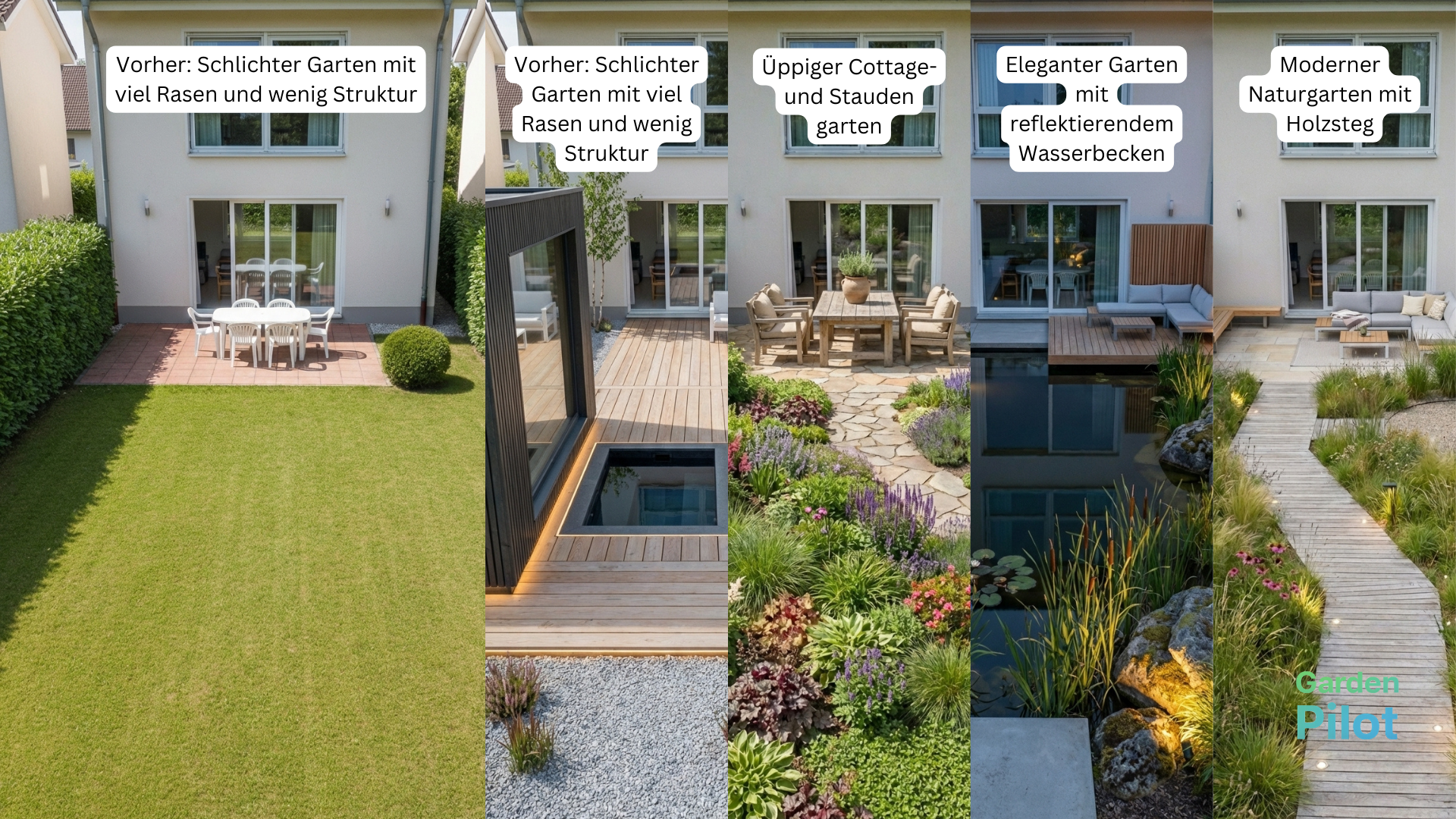
🌿 Before/After – One garden, four completely different GardenPilot designs
Many garden owners want ideas for how to redesign their garden—but don’t know which style suits them best.
Using a real example, GardenPilot shows how four entirely different garden concepts can be created from the same starting garden.
Each transformation is based on the future user’s individual wishes.
Before: a starting garden without atmosphere
.png)
The original garden consists of a large, open lawn and a simple patio.
It’s functional—but offers neither structure nor a place you truly want to spend time.
🌟 From one garden: four completely different design worlds
Transformation 1 – Modern natural garden with a timber boardwalk
.png)
Design idea: soft lines, timber boardwalk, natural perennials & grasses
Effect: lively, close to nature, harmonious
Ideal for: people who love a modern yet warm, natural feel
The garden gains structure and atmosphere. A curved boardwalk leads through a vibrant field of perennials, while the new lounge zone invites you to linger.
Transformation 2 – Elegant garden with a reflective water feature
.png)
Design idea: water as the central design element, crisply defined edges, subtle lighting
Effect: minimalist, calm, premium
Ideal for: lovers of modern architecture & clean lines
The reflective pool adds depth and elegance to the garden. Lighting and planted islands create a luxurious evening ambiance.
Transformation 3 – Private sauna oasis with cold plunge pool
.png)
Design idea: freestanding outdoor sauna, integrated cold plunge pool, warm timber deck
Effect: exclusive, relaxing, restorative—true spa character
Ideal for: wellness lovers, athletes, anyone looking for relaxation in their own garden
This design turns the garden into a private wellness retreat.
The combination of sauna and cold plunge creates contrast—heat & cold—and brings a luxury spa experience right to your home.
Transformation 4 – Lush cottage & perennial garden

Design idea: natural stone paths, lush perennials, soft forms
Effect: colorful, romantic, lively
Ideal for: people who love a blooming, nature-inspired garden
The garden becomes a colorful perennial paradise with high biodiversity and spectacular seasonal flowering.
👉 What would your garden look like in four different styles?
GardenPilot creates multiple personalized garden concepts based on your photo—in just a few seconds.
💡 Generate your own before/after ideas now
Costs, DIY vs. pro, and why GardenPilot is your perfect DIY partner
How much does a garden redesign cost? – The big cost overview
A successful garden redesign needs more than good ideas—it needs a realistic budget. The following price ranges are based on average market values in Germany (2025) and help you estimate how each module impacts total costs.
Costs per module – compact overview
| Module | Typical costs | Description / impact |
|---|---|---|
| Patio | 120–250 € / m² | Biggest lever; material & base determine price |
| Paths | 60–150 € / m² | Structure & orientation in the garden |
| Lawn | 8–20 € / m² | Reseeding or turf; low cost factor |
| Planting areas | 40–120 € / m² | Strong visual impact; depends on planting density |
| Privacy screening | 80–200 € / linear meter | wood, metal, plants, or gabions |
| Irrigation | 800–4.000 € | comfort & long-term maintenance savings |
Example calculations by garden size
🔸 Small garden (100 m²)
- Patio extension: 2.000–4.000 €
- Planting modules: 1.000–2.000 €
- Paths: 600–1.200 €
- Total: 3.600–7.200 €
🔸 Terraced-house garden (200–300 m²)
- renew patio
- new paths
- planting & privacy screening
- Total: 8.000–18.000 €
🔸 Complete redesign (400–500 m²)
- patio + paths
- multiple planting modules
- lighting & irrigation
- Total: 15.000–30.000 €
Note: You’ll find the complete cost overview in the article “How much does a garden cost? The big cost guide (2025)”.
DIY or specialist contractor? – What you can realistically do yourself
Many garden owners underestimate the risks of DIY projects. GardenPilot shows you, module by module, what you can do yourself—and where a specialist contractor makes sense.
DIY suitability – overview
| Task | DIY suitable? | Risk | Recommendation |
|---|---|---|---|
| Planting | Yes | low | Excellent DIY option with GardenPilot instructions |
| Build raised beds | Yes | low | ideal for beginners |
| Paths (gravel) | Medium | medium | possible if you understand the base layers |
| Lay a patio | No / Medium | high | only with experience |
| Install privacy screening | Medium | medium | professional alignment required |
| Irrigation system | No | high | pro recommended |
| Base layers / drainage | No | very high | risk of damage → contractor |
Ideal execution order
- Earthworks & foundations
- Paths & patio
- Edging, beds, walls
- Planting
- Lighting & irrigation
Why GardenPilot is your perfect DIY partner
GardenPilot is the first AI-powered platform that automatically analyzes your garden and delivers concrete renovation recommendations—fast, easy to understand, and based on real data.
What you can count on:
- AI photo analysis – detects modules, areas, potential & problem zones.
- Realistic before/after ideas – see instantly what your garden could look like.
- Style & material suggestions – harmonious concepts that fit your home.
- Cost estimate per module – transparent & easy to follow.
- DIY assessment – clear answer: what can you do yourself?
- Step-by-step DIY instructions – start immediately with material list & pro tips.
[👉 *“Start your free garden analysis now”* “In 60 seconds: analysis, modules, before/after & costs”](/en/gartenprojekt-starten)
Conclusion
A garden redesign often seems complex, but it follows clear principles. With a precise AI analysis, a fitting style concept, targeted modules, and realistic cost and DIY planning, you’ll create a garden that not only looks better—but feels better every day.
GardenPilot guides you step by step—data-driven instead of gut feeling.
About the author
Fin Pünjer – Founder of GardenPilot Expert in AI-assisted garden planning, modular design systems, and automated garden analyses. He combines technological innovation with landscape design principles to make garden planning and DIY execution accessible to everyone.
FAQ – Frequently asked questions
How much does a garden redesign cost?
Depending on scope, between €2,000 and €30,000. Patios and paths are usually the biggest cost blocks.
Can I redesign my garden myself?
Partly. Plants, beds, and simple paths are DIY-friendly. Base layers, drainage, electrical work & irrigation should be handled by professionals. GardenPilot shows you which tasks you can take on yourself and provides the instructions.
How does GardenPilot help me plan?
Through AI analysis, style & material suggestions, before/after images, clear cost overviews, and practical DIY execution instructions.
How long does a garden redesign take?
- Small projects: 1–3 weeks
- Medium projects: 4–8 weeks
- Large projects: 2–4 months (including planning)
If you want to redesign your garden in 2025, an AI visualization of your current space helps you make clearer decisions from the start—and avoid costly detours during DIY execution. Upload a photo of your garden and see with AI how it could look—along with a rough cost framework before you invest. That way, you avoid expensive planning mistakes. Visualize your garden with GardenPilot (how it works).
Frequently asked questions
How much does a garden redesign cost on average?
Costs depend heavily on the scope: a simple redesign with new beds, paths, and planting areas is significantly cheaper as a DIY project than a professional build with a specialist contractor. Key factors include garden size, the materials you choose, and how much you do yourself.
Which garden redesign ideas can be done without a specialist contractor?
Many measures—such as creating raised beds, laying gravel or bark-mulch paths, and refreshing planting areas—are very doable on your own. The key is clear upfront planning so quantities are right and time-consuming corrections are avoided.
How long does a complete garden redesign take?
The duration depends on the project scope and the time windows you have available: smaller changes such as creating new beds or optimizing paths can often be completed in a weekend, while larger projects involving patio construction or paving can take several weeks.
When is the best time to redesign the garden?
Spring and autumn are considered ideal for garden redesigns, because plants establish well during these periods and temperatures are comfortable for physically demanding work. Construction tasks such as laying paving or patio slabs can generally also be done in summer, as long as there’s no risk of frost.
Plan your own garden
Upload a photo of your garden and get a professional AI concept in minutes.
Start for freeMore articles from AI in the Garden
AI Garden Design with a Photo: Plan and Transform Your Garden Digitally
With AI garden design from a photo, your garden comes to life digitally—before you even put a spade in the ground. Discover how smart tools turn your own photos into ready-to-use design proposals.
Garden Planning Step by Step – The Optimized GardenPilot Process
Learn how to plan your garden step by step with a clear structure, AI analysis, and realistic costs. Perfect for DIY projects and professional implementation.