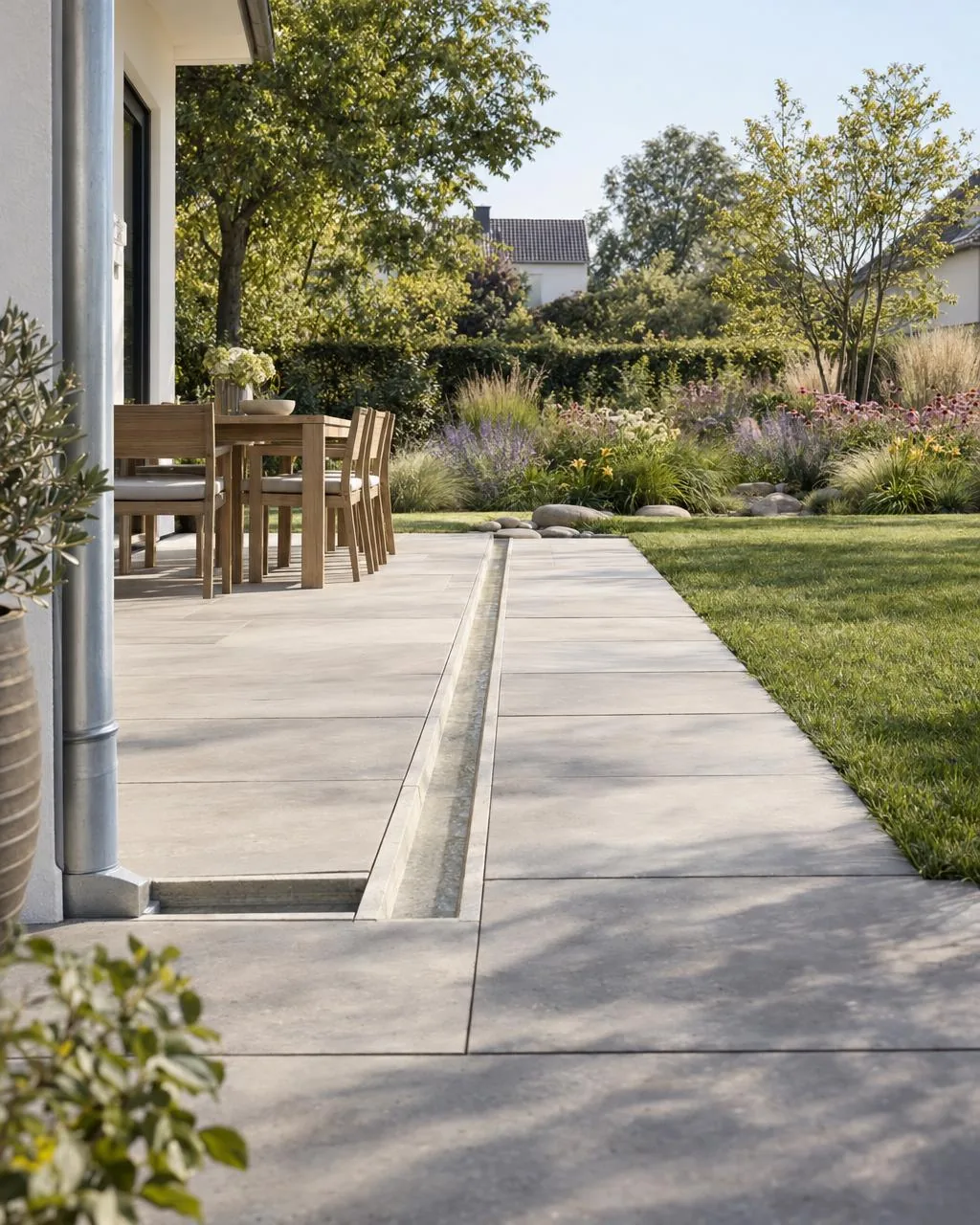
In summer you water with tap water, and at the next thunderstorm the water from your roof rushes into the sewer. Yet exactly this water can stay in the garden: in a water butt, in a cistern or in a bed that is allowed to take in the rain.
Five ideas for rainwater in the garden: a water butt that belongs to the garden, a cistern for larger gardens, a visible path for the water, a planted swale and surfaces that let water through. You can start small and expand later. Most of these ideas don't require redoing the whole garden.
As of 16 October 2026. The figures and rules describe the situation in Germany. All garden images in this article are AI visualisations by GardenPilot. They show design ideas, not built reference gardens.
Rainwater in the garden at a glance
| Idea | Works especially well | Effort | How to start |
|---|---|---|---|
| Water butt with overflow into a bed | any garden with a downpipe | low | Find a downpipe and a spot for it |
| Cistern | larger gardens, new builds, redesigns | high | Estimate watering needs and roof area |
| Visible water path | patio close to the house | medium | Sketch the water's path from the downpipe |
| Planted swale | well-draining soil with some space | medium | Check soil and distances |
| Permeable surfaces | driveway, parking space, paths | medium to high | Add up the sealed areas |
How much water does your roof deliver?
The calculation is simple: 1 millimetre of rain equals 1 litre of water per square metre. In summer 2026, Germany received on average around 171 litres per square metre, only 72 percent of the usual amount (German Weather Service, DWD, in German). On 40 square metres of roof that would come to around 6,800 litres on paper, even in a dry summer. In practice less arrives, because some of it evaporates or runs off through the overflow.
For comparison, the Bavarian State Office for the Environment (in German) gives watering needs of about 60 litres per square metre per year for lawns and park areas and around 20 litres per square metre per week for vegetable beds. Vegetable beds need particularly large amounts of water, and that is exactly where a store pays off most.
1. A water butt that belongs to the garden
The water butt is the easiest way in. But it doesn't have to stand in a corner like a makeshift solution.
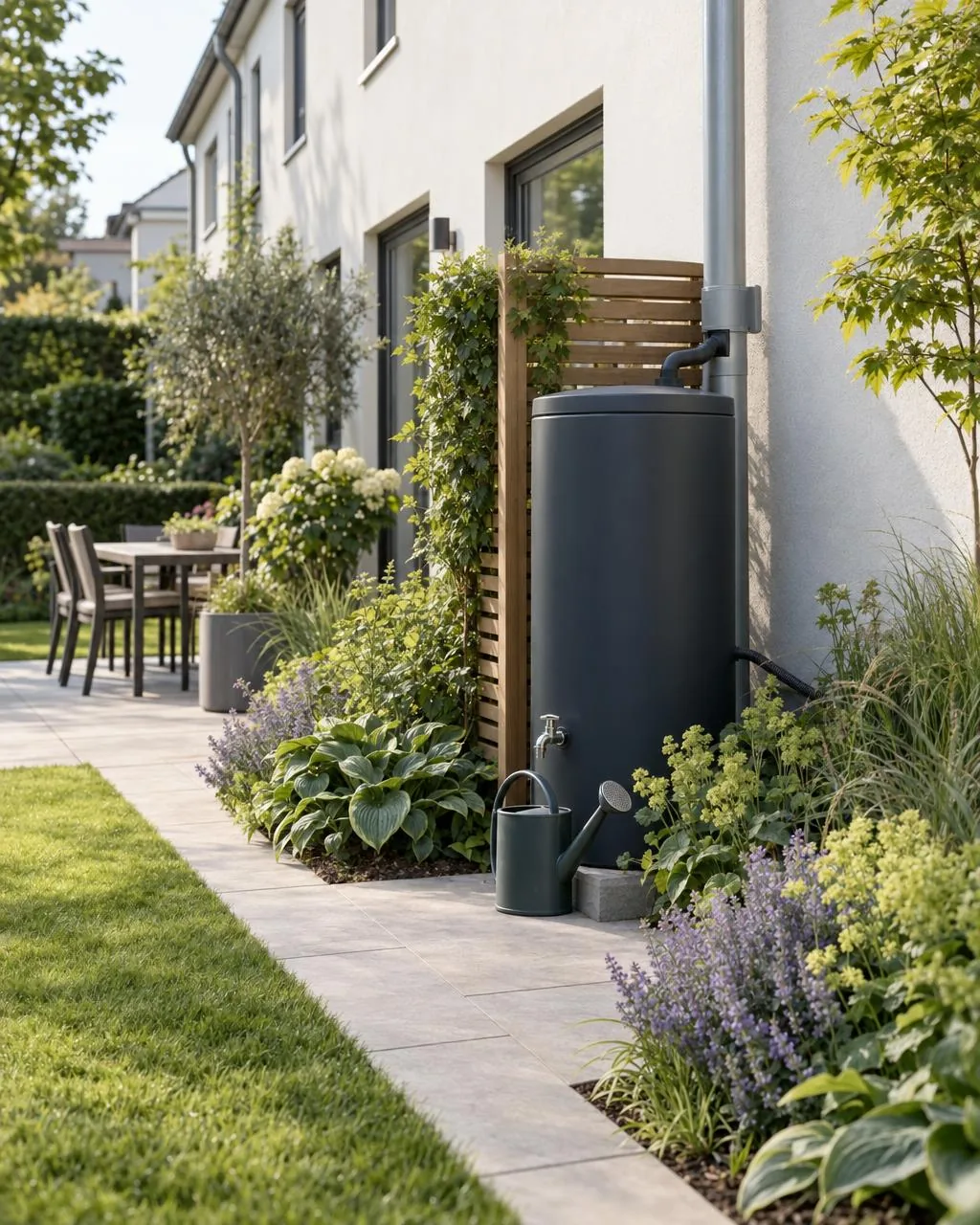
The idea: plan the store like a garden feature, with a fixed place, a frame and an overflow that leads into a bed.
How the butt becomes part of the design
Set the butt on a level, firm base and frame it with plants or a narrow screen. Water butts usually hold about 200 to 500 litres (Verbraucherzentrale NRW, in German). A rain diverter on the downpipe directs water into the butt, and when it is full the rest carries on down the pipe. Even better: an overflow leads the excess water into an adjoining bed.
It is best to water straight from the butt. The German Environment Agency calls soft rainwater ideal for plants (Umweltbundesamt, in German). From copper and zinc roofs, however, metal compounds can be washed off; gutters and downpipes made of these materials are usually harmless, according to the agency.
Important: The butt needs a firm lid that can be closed securely. Small children can drown in very little water, and a lid also keeps mosquitoes out. Empty the butt before the first frost, because freezing water can damage it.
Works especially well: in any garden with a downpipe, including a small terraced-house garden.
Your first step: Find the downpipe closest to the bed you water most. That is the right place for the butt.
2. A cistern for the larger garden
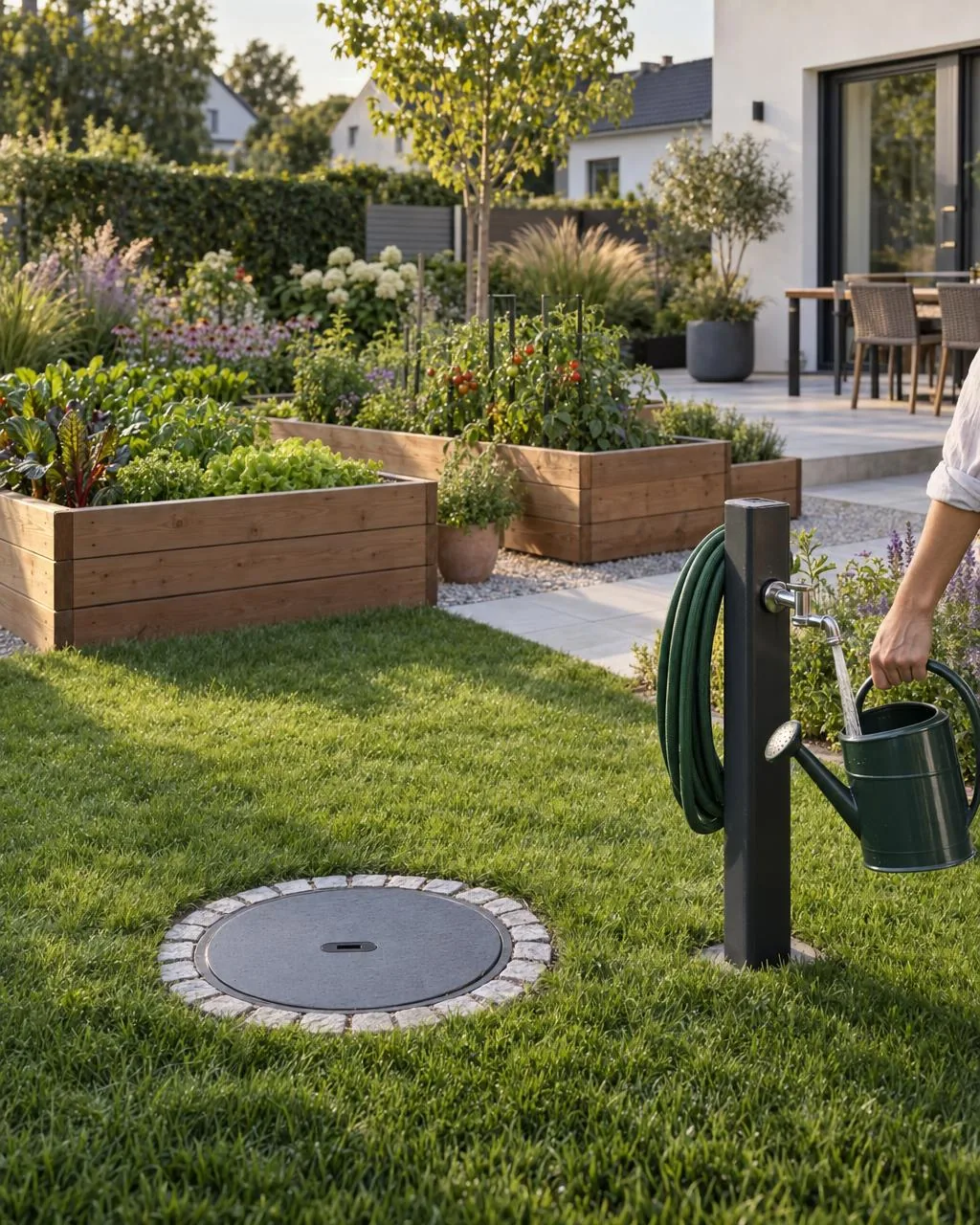
If you water a lot, a butt won't get you far. A cistern sits underground and holds many times as much.
The idea: store water out of sight and draw it where you need it.
What to know before you buy
Underground cisterns hold about 1,500 to 10,000 litres. Plastic models are easier to install than concrete ones (Verbraucherzentrale NRW). Depending on how much you do yourself and the size, costs run to a few thousand euros (Bavarian State Office for the Environment). Installation is cheapest when the garden is being dug up anyway, for example for a new build. When this fits into the building process is explained in Garden timeline when building a house.
If you only use the water in the garden, the system stays simple: tank, filter, pump and a tap. If the rainwater is also to flush the toilet, you need a separate pipe network in the house. In Germany, such a system must be reported to the local health authority at least four weeks before construction (§ 12 Drinking Water Ordinance, in German). The German Environment Agency puts the cost of an in-house system at 2,500 to 5,000 euros.
Many German municipalities subsidise cisterns. In 2026, for example, Gräfelfing and Marsberg had their own programmes. Ask your municipality before you buy and read the conditions, for example on minimum size.
Works especially well: in larger gardens with vegetable beds, for new builds and for a redesign where digging happens anyway.
Your first step: Estimate how much you water in summer and work out how much water your roof delivers. Only then is it worth getting a quote.
3. A visible path for the water
Rain can be visible in the garden before it soaks away. A rain chain, a shallow channel in the paving or a large stone the water falls onto: every shower becomes a small spectacle.
The idea: guide the water from the downpipe visibly and in a controlled way away from the house into a bed.

What matters
Always lead the water away from the house and never towards your neighbour. A channel needs a fall and must not run across a path where someone could slip in winter. Where the water arrives, large stones protect the soil from being washed out.
A rain chain is an eye-catcher, but it does not replace a store. What matters is where the water ends up: in a butt, in a swale or in a bed that can take it.
Works especially well: if a downpipe is close to the patio or a bed.
Your first step: Next time it rains, watch where the water from the roof goes today.
4. A planted swale that takes in the rain
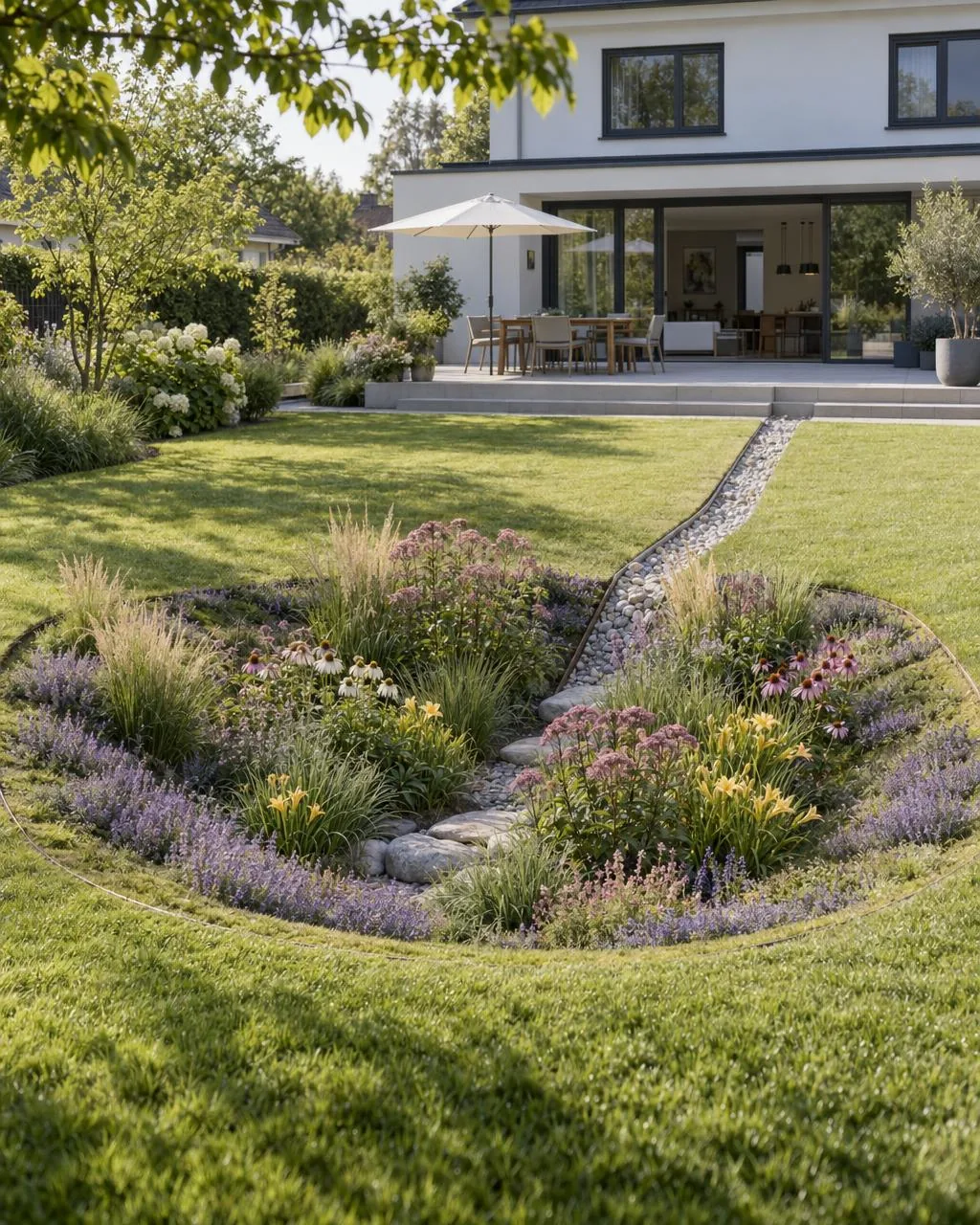
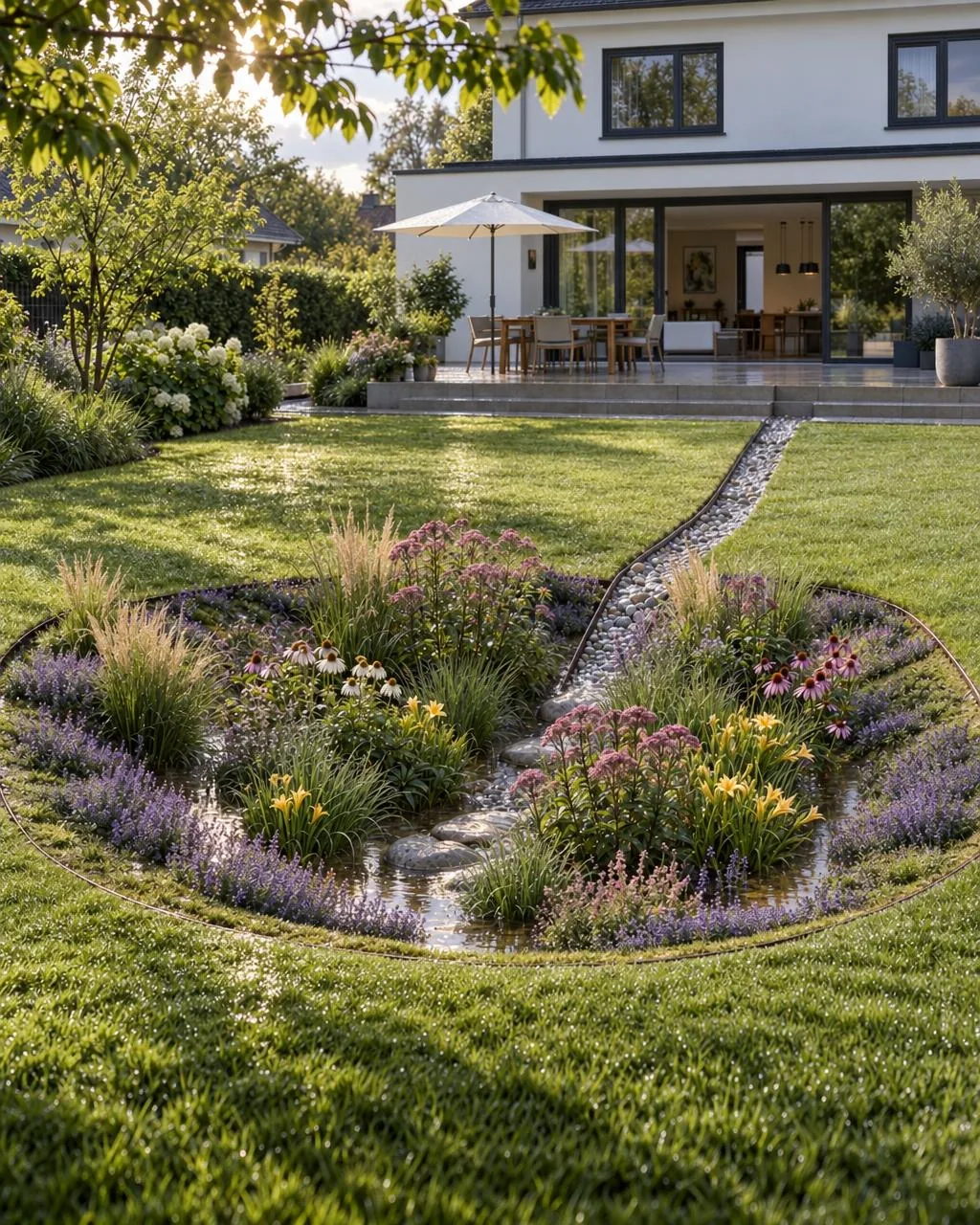
An infiltration swale is a shallow, planted hollow. After heavy rain, water stands there briefly and slowly soaks into the ground. The rest of the time it is a flower bed.
The idea: don't drain rain away, let it soak in where it falls, and design the swale like a perennial bed.
A swale is mostly dry
This surprises many people: according to the Bavarian State Institute for Viticulture and Horticulture (LWG), no more than 30 centimetres of water should stand in a swale, and it should be empty again after 24 hours at the latest (LWG leaflet "Mit Pflanzen versickern", in German). Most of the time it is therefore a dry site. Well suited are deep-rooted perennials that tolerate drought and can cope with short periods of wet, such as woodland sage, daylilies, Joe-Pye weed, coneflowers, switchgrass and feather reed grass from the LWG plant list.
Perennials also pay off technically: in LWG trials, planted swales took up to a third more water during prolonged rain than swales with lawn. Trees do not belong in the swale. From existing trees, keep a distance of half the crown diameter.
What to clarify beforehand
- Soil: It has to absorb water. With dense loam or clay the water stays put. Then storing is better than soaking away.
- Distance from the house: The swale needs distance so that no water presses into the basement. How much depends on the basement and the soil. The municipal drainage company in Frankenthal, for example, gives the depth of the building plus 50 centimetres for houses with a basement (EWF Frankenthal, in German).
- Groundwater: There should be at least one metre between the bottom of the swale and the highest groundwater level (Baunetz Wissen, in German).
- Permission: Whether you may let rainwater soak away without a permit is regulated by the federal state and municipality. If in doubt, ask the lower water authority of your district.
A swale for the whole roof is best planned with a professional. A small swale for part of the roof water can be built on a manageable scale if soil and distances are right.
Works especially well: in gardens with well-draining soil and some space next to the patio or at the edge of the lawn.
Your first step: Do a simple test. Dig a hole about 30 centimetres deep, fill it with water and see whether it has drained after a few hours.
5. Surfaces that let water through
Driveway, parking space and paths are often the largest sealed areas around the house. That is exactly where a lot can change.
The idea: surface areas so that they carry loads and still let water through.

Which surfaces are suitable
Paving with wide grass or grit joints, grass pavers and gravel let water through. For a parking space with a car on it every day, paving with wide joints usually works better than pure grass pavers, where the grass suffers under the tyres. Where water runs off the surface, a slightly lower bed can take it in.
This can also pay off financially. Many German municipalities charge a separate fee for rainwater that flows from sealed areas into the sewer. In Hanover, for example, it is 0.80 euros per square metre per year; for areas whose water is drained through an infiltration system, the fee is reduced by 70 percent (City of Hanover, in German). How it works where you live is set out in your municipality's fee regulations. You usually have to apply for a reduction yourself.
Works especially well: if the driveway or parking space is due for renewal anyway.
Your first step: Add up how many square metres of roof, patio and driveway drain into the sewer today. In Germany this figure is often also stated on your fee notice.
What would a swale or a new water path look like in your garden? With GardenPilot you can try out design ideas on a photo of your garden. You start with a free test project, no payment details required.
Show me the possibilities for my garden →
Which solution suits you?
| If this bothers you … | … start here |
|---|---|
| "In summer I keep watering with tap water." | Water butt at the nearest downpipe; idea 1 |
| "I have a large vegetable garden." | Look into a cistern; idea 2 |
| "In heavy rain, water stands on the patio." | Plan a water path away from the house; idea 3 |
| "My lawn edge isn't used anyway." | Small swale with perennials; idea 4 |
| "The driveway needs redoing anyway." | Paving with wide joints; idea 5 |
A combination brings the most: a butt or cistern for watering, the overflow into a bed or swale, and as little sealed surface as necessary. Why rainwater is also one of the garden trends for 2027 is explained in our article Garden Trends 2027.
Frequently asked questions about rainwater in the garden
Do I have to register a water butt or cistern?
A water butt or cistern used only for the garden generally does not have to be reported to the health authority in Germany. A system that uses rainwater inside the house, for example for the toilet, does. If you disconnect a downpipe from the sewer or let rainwater soak away, ask your municipality first.
Is a cistern worth it?
That depends on how much you water and whether digging is happening anyway. For a small garden, a water butt is often enough. With large vegetable or lawn areas, for a new build or if your municipality subsidises cisterns, it is more likely to pay off.
May I let rainwater soak away in my garden?
Usually yes, but the rules differ by federal state and municipality. What matters is well-draining soil, enough distance from the house and the groundwater, and that no water runs onto your neighbour's property. If in doubt, the lower water authority will clarify whether you need a permit.
Which plants suit an infiltration swale?
Plants that tolerate drought and can cope with short periods of wet, because a well-built swale is empty again after a day at the latest. The LWG names, among others, woodland sage, daylilies, Joe-Pye weed, coneflowers, switchgrass and feather reed grass.
What do I do with the water butt in winter?
Empty it before the first frost and leave the tap open so that any remaining water can drain. A rain diverter on the downpipe can usually be switched to winter mode, so the water carries on down the pipe.
What would rainwater as a design feature look like in my garden?
The best way is to try it on your own garden. Upload a photo and describe what you would like, for example a planted swale next to the patio. With GardenPilot you start free with a photo of your garden.
Sources and context
The information describes the situation in Germany. Legal rules differ by federal state and municipality; this article does not replace advice from your municipality or a professional. Sources are in German.
- German Weather Service (DWD), 31 August 2026: Deutschlandwetter im Sommer 2026.
- Bavarian State Office for the Environment: Regenwassernutzung.
- Verbraucherzentrale NRW, 16 April 2024: Regenwasser sinnvoll nutzen.
- German Environment Agency, 11 July 2025: Tipps für eine nachhaltige Regenwassernutzung.
- Drinking Water Ordinance 2023: § 12 Anzeigepflichten.
- Bavarian State Institute for Viticulture and Horticulture: Leaflet "Mit Pflanzen versickern – Versickerungsmulden standortgerecht bepflanzt", 2nd edition 2010.
- Baunetz Wissen: Regenwasserversickerung, on DWA-A 138.
- Eigen- und Wirtschaftsbetrieb Frankenthal: Planungshinweise für Versickerungsanlagen.
- City of Hanover: Gebühren für Niederschlagswasser.
- Examples of subsidies 2026: Municipality of Gräfelfing, Town of Marsberg.
What would this look like in your garden?
Upload a photo of your garden and see design ideas on your own space. The first image is free.
Start free with your photoMore articles from Garden Elements
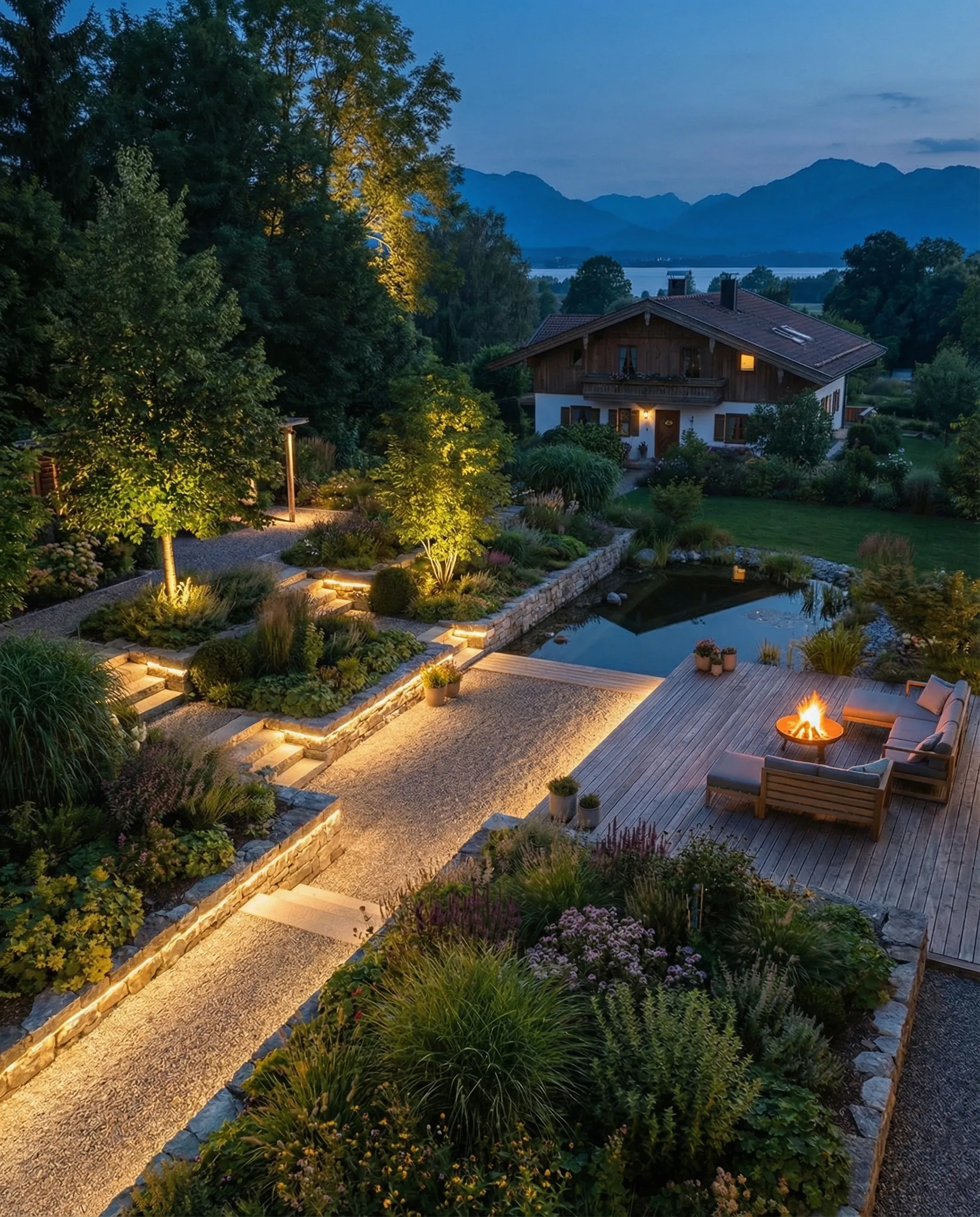
Garden Lighting: How to Light Paths, Steps, Seating Areas and Water
Light for paths, steps, seating areas and water explained with examples: what each kind of light does, what to plan before you pave, what you may connect yourself and which light is kinder to insects and neighbours.
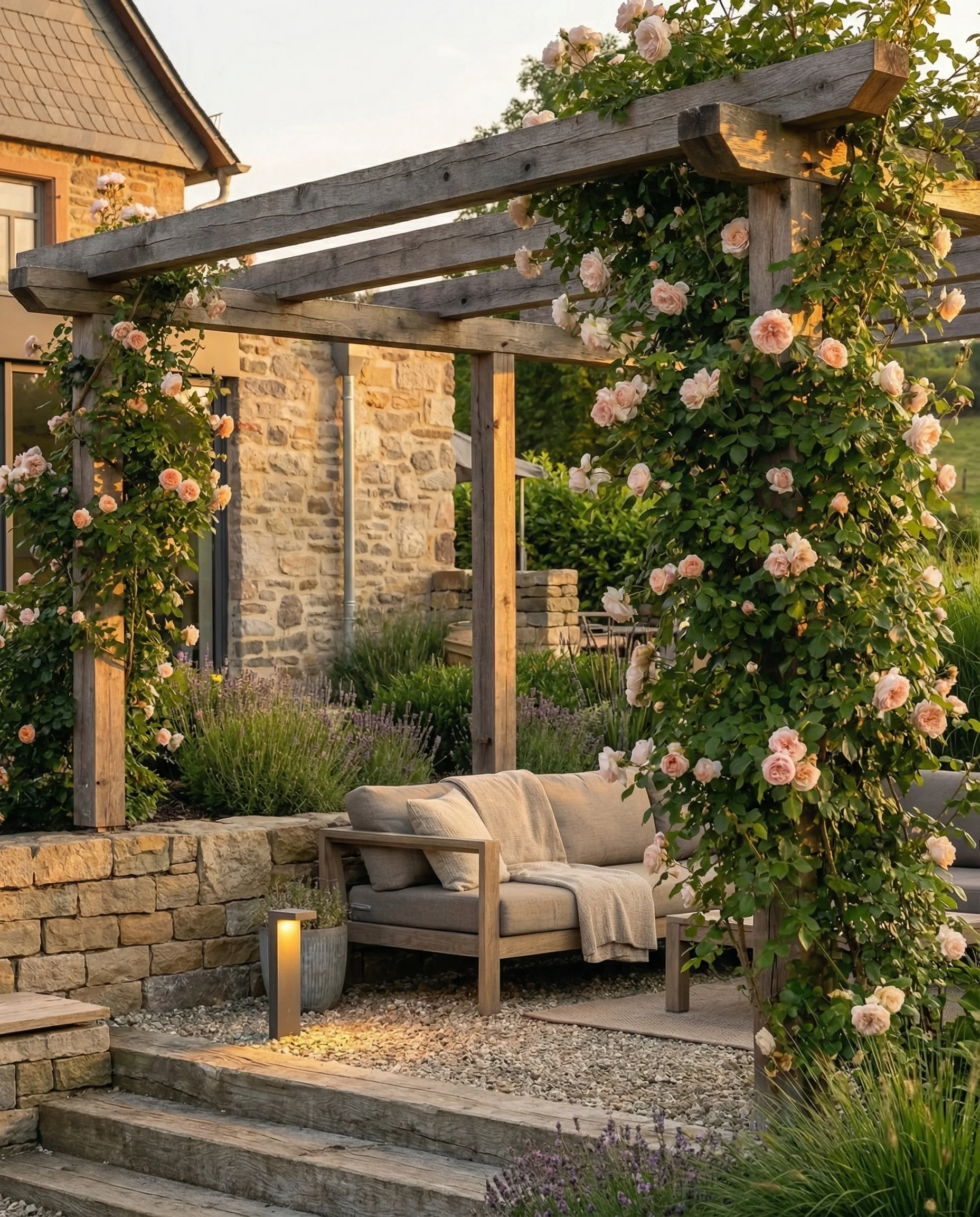
Pergolas in the Garden: Types, Plants, Position and Permits
What a pergola does and does not do: types, materials, climbing plants, position and permits, with two explained examples including a top view or sketch.
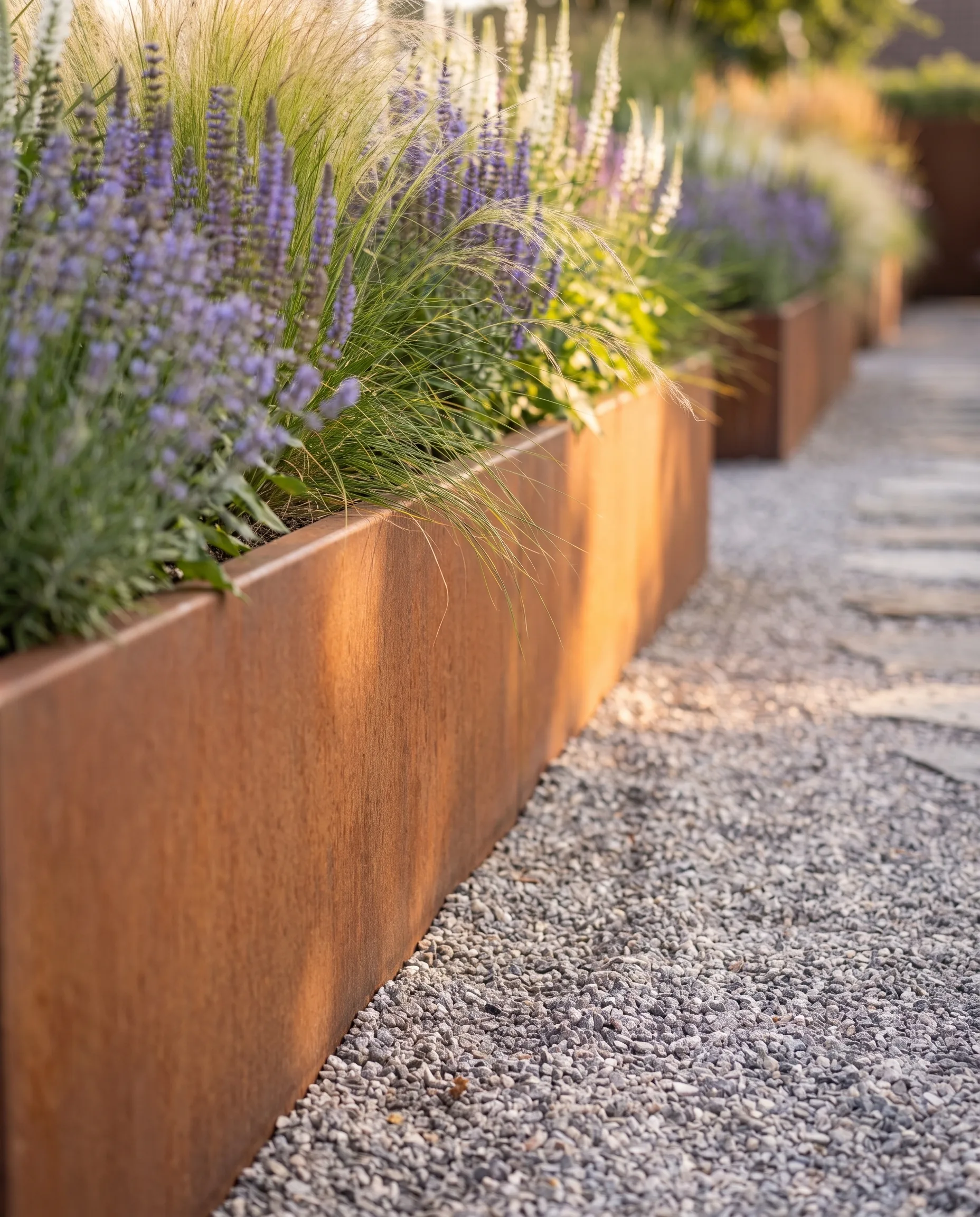
Corten Steel in the Garden: Uses, Patina, Rust Run-off and Care
Bed edging, raised bed, water basin or fire pit: where Corten steel fits, how long the protective layer takes, how to protect light paving from rust run-off and why insides and salt are tricky.